One of the most respected medical groups when it comes to hearing loss prevention has gone on record supporting efforts to partially deregulate firearm suppressors.
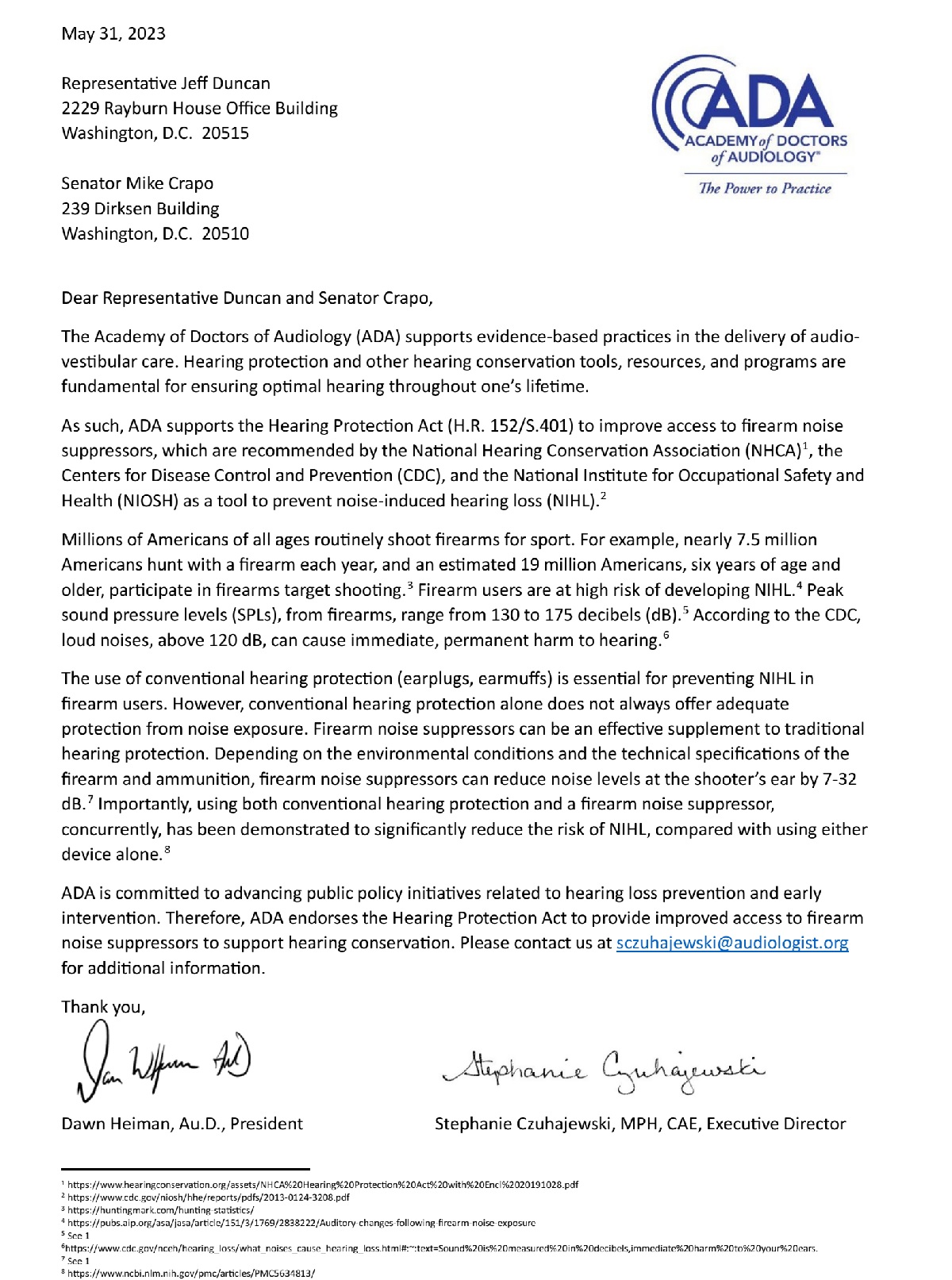
In a letter sent at the end of May, the Academy of Doctors of Audiology, vouching support for "evidence-based practices in the delivery of audiovestibular care," endorsed the Hearing Protection Act (H.R. 152/S.401) to improve access to suppressors. Holding that at least 7.5 million Americans hunt with a firearm each year and another 19 million regularly participate in target shooting, the organization recognized that "Firearm users are at high risk of developing NIHL (noise-induced hearing loss)."
While acknowledging the use of traditional hearing protection such as earplugs and earmuffs as being "essential for preventing NIHL in firearm users, the group stressed such protection "alone does not always offer adequate protection from noise exposure. Firearm noise suppressors can be an effective supplement to traditional hearing protection."
Importantly to the debate over suppressor deregulation, the Academy of Doctors of Audiology, founded in 1976, isn't a gun group. The 1,400-member ADA is one of the oldest and most respected member groups for audiology professionals in the country and publishes the quarterly Audiology Practices magazine. As noted by the National Institute on Deafness and Other Communication Disorders, "ADA strives to be the leader in professional development, high ethical standards, career enhancement, practice improvement, and student outreach."
The Hearing Protection Act, sponsored by U.S. Rep. Jeff Duncan (R-SC) in the House and U.S. Sen. Mike Crapo (R-ID) in the Senate, aims to remove the country's more than 2.6 million federally registered suppressors from NFA regulation, instead, regulating them as Title I firearms that could be transferred over the counter via a simple NICS check and 4473 rather than a lengthy Form 4 process and tax stamp. It has been a popular bill with Republicans going back to 2016 but hasn't successfully cleared either chamber as of yet.
The recognition from the ADA that suppressors are important to good hearing health is a big step in the argument to cut the unrealistic government red tape involved with the devices.
"As an independent medical group, the Academy of Doctors of Audiology has absolutely no vested interest in suppressors outside of the positive impact that they have on hearing conservation,” Knox Williams, executive director of the American Suppressor Association told Guns.com. "Their endorsement of the Hearing Protection Act, which would give law-abiding citizens improved access to suppressors, highlights the importance of these tools when it comes to firearms safety. We applaud ADA for putting this letter together and actively supporting hearing conservation."
The full letter from the ADA to Duncan and Crapo:
In addition to noise abatement and hearing protection, the use of a suppressor can also help with firearms training, especially as it curbs the traditional "crack" to a more manageable "pop."
Take this Taurus TX22 Compact paired with a SilencerCo Switchback, for example.:
Banner image: Ed Brown Custom 1911 outfitted with SilencerCo Octane 45M modular multi-caliber suppressor. (Photo: Chris Eger/Guns.com)