As a company that acquires and subsequently finds new homes for thousands of quality firearms per year, every now and then we come across something truly exceptional.
In the past several years we here at Guns.com have seen most of the "holy grail" pieces come through that collectors crave, including such rarities as U.S. Switch & Signal M1911s, Gyrojet rocket guns, Tround-firing Dardicks, Colt Boas, belt-fed NFA-compliant M3 .50 cals, and the like.
However, we've only seen one early Pre-Model 36 Smith & Wesson Chief's Special with a two-digit serial number and personalized engraving for the police chief who came up with the now-iconic moniker for S&W's pint-sized .38 Special snub-nosed revolver.
That's because only one exists. No one outside of the chief's family has seen it since it left Smith – until it showed up at our warehouse, that is.
How the Chief’s Special Came to Be
Smith & Wesson had long made a series of small-framed revolvers. After all, the circa-1857 S&W Model 1, a small single-action tip-up revolver in .22 Short, was slim and short, able to easily be carried in a coat pocket if needed. Fast-forward to the 20th century, and by 1936, the company was making the I-framed Terrier, a cut-down five-shot regulation police model chambered for .38 S&W and outfitted with a 2-inch barrel and round butt.

However, with the .38 S&W largely considered an anemic round in terms of performance by the late 1940s, S&W President Carl Hellstrom gave the company's big brains marching orders to develop a small Terrier-sized revolver chambered in the more powerful .38 Special. This required an entirely new frame that was essentially longer and taller to accommodate the longer cylinder. Further, the old I-frame such as the Terrier used a leaf spring, whereas the new gun called for by Hellstrom would have a coiled mainspring.
The first examples of the new gun, dubbed the "Model J" at the time, were ready by early 1950, with Mr. Hellstrom himself getting Serial No. 6. The gun that is known commonly as the J-frame was alive but needed a name with more pizazz.
Enter Edward Boyko
Born Jan. 11, 1896, to Slovakian immigrants Mihael and Mary Ihnath Boyko, Edward Boyko was a first-generation American and proud citizen of the city of Passaic, New Jersey from the second he took his first breath. Described on his 1917 draft registration card as tall and of medium build with gray eyes and dark brown hair, Boyko soon joined the local police force and, by 1945, was the chief.
Passaic, known as "The Birthplace of Television" as it had the country's first TV broadcasting station, is in the Garden State's Bergen County and close to Newark. The city could sometimes be a little rough, with Chief Boyko making national headlines from Florida to Alaska in 1947 when he banned his "battered bluecoats" from moonlighting in local taverns as barroom bouncers.
"Too many have been beaten up," Boyko said, with the injuries causing a manpower shortfall for his department.
In 1950, Chief Boyko entered a "name that gun" contest at the International Association of Chiefs of Police (IACP) conference in Colorado and submitted "Chief's Special" as a suggestion for the hard-hitting new Model J revolver.
Smith & Wesson announced the winner in the December 1950 issue of The Police Chief, the IACP journal, and named Boyko as its author. The prize? A specimen of the new gun, complete with factory engraving.

In the ad accompanying the announcement, S&W noted, "In this handgun, we have embodied all of the elements which go to make up a fine police revolver. The weight has been held to an absolute minimum, the overall length still allows for an adequate barrel and stock, and this arm will handle all high-velocity ammunition in its caliber. This is truly a rugged and dependable weapon of defense."
The gun
Brought into the Guns.com Vault via our We Buy Guns Program, the well-worn .38 was acquired from a descendant of Chief Boyko, who retired from the force in 1960 after a 44-year law enforcement career and passed away in 1991 at age 95.

While most early "Pre-36" Chief’s Specials have a flat cylinder latch, as noted by firearms historian Jeff Supica in his book on S&W handguns, those under serial number 61 had the standard latch. Such early guns had the small grip and trigger guard of the I-frame, features that were later changed to make the revolver more comfortable to shoot with full-house loads.


As verified in a letter sent to Guns.com from the Smith & Wesson Historical Foundation, Serial Number 29 was billed to an advertising account shipped by express 10 days before Christmas of 1950 to Chief Edward Boyko, c/o the Passaic Police Department. It included a 2-inch barrel, a bright blue finish, a half-moon sight, and checkered diamond walnut round-butt grips.

True to the ad, it was engraved "Chief Boyko" at the factory.


Rather than putting his new .38 in a safety deposit box or gun chest, Chief Boyko apparently tapped it for service as a carry gun and it came to us with a very broken-in, vintage leather holster.


The revolver's leading edges attest to the fact that it was carried extensively as "a working gun." It was not a safe queen by any means. Keep in mind that Chief Boyko remained on the force for a decade after he won the gun that literally carries his name, and, as with many retired LEOs, likely continued carrying for years afterward.

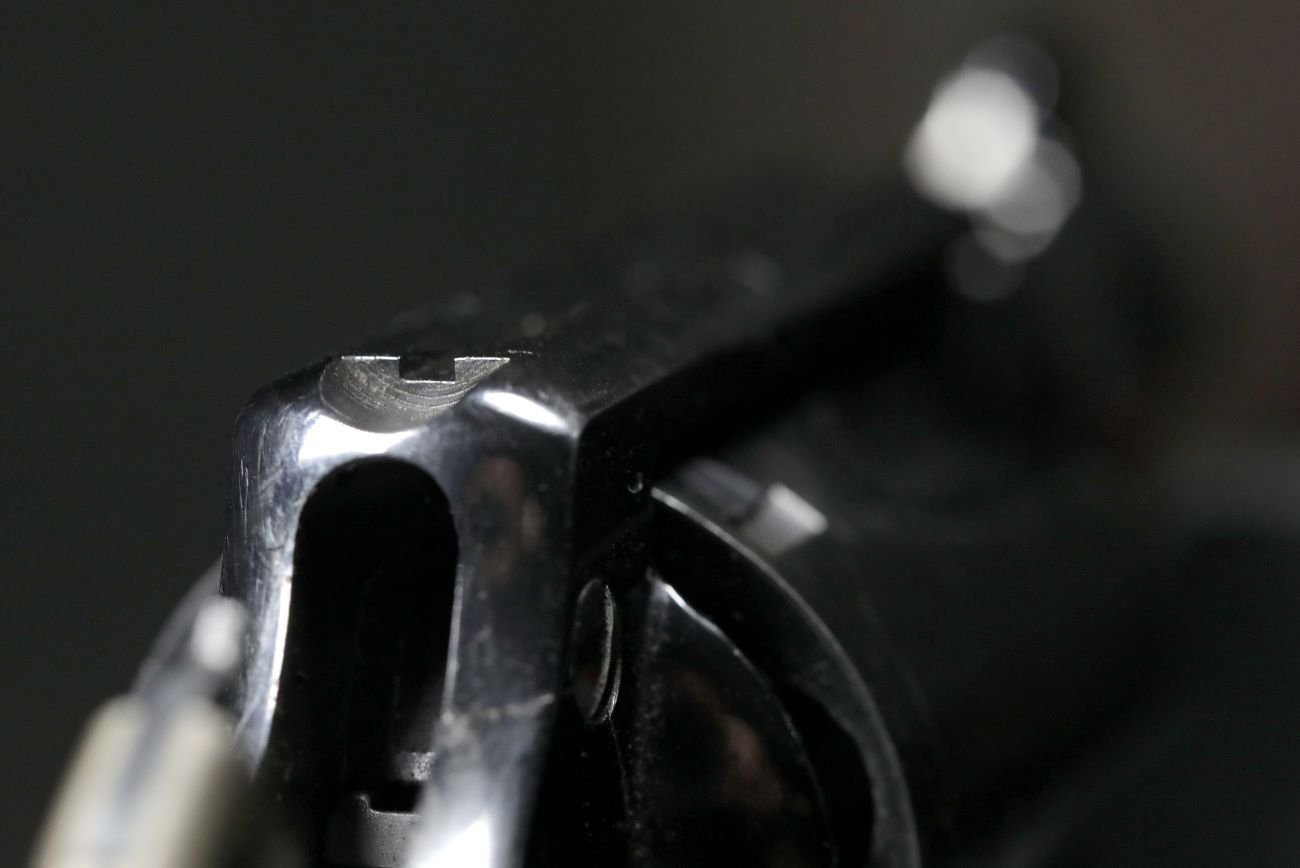


While Smith & Wesson has since gone on to trademark the Chief’s Special and make it almost a brand of itself over the past 73 years, there is only one "original" Chief Boyko Special. We here at Guns.com are proud to have it and eventually will pass it on to its next caretaker for future generations.
Perhaps S&W will make a limited run of “Boyko Specials” for collectors to share the love. The Chief would probably like that idea.