5 Must-Know Skills for Shooting around Corners (VIDEO)
In order to shoot around corners and barricades with the minimum amount of body exposure, these five things are absolutely essential to add to your tactical toolkit. These five things will allow shooters to perform well while standing and shooting strong-handed around either side of the barricade, wall or other structure, without having to switch to a non-dominant or weak side shooting position.
1. Feet Close Together and Parallel with the Barricade
By keeping your feet close together, the risk of exposing a foot or a knee around a corner for a malefactor to shoot, declines. Feet should be flat with toes pointing at the wall or barricade. You may have a slight off-set between either the left or the right foot, but the shooter should be careful not go so far as to cant his/her entire body. If the body is canted, an improper and less effective pie-ing technique will occur. By keeping the feet in, the legs are kept in, allowing the shooter to pie out by leaning over the hips.
2. Lean Over the Hips
Since the idea of pie-ing the corner is inevitably to see and get a shot on a target without exposing a lot of the body, leaning the torso over to the left or right will help. Many shooters have a tendency to lean backwards, putting them off balance. Instead, shooters should have an aggressive, forward-leaning stance with their feet close enough together—a stance that it doesn’t expose their lower half to in-coming, unfriendly fire and allows them to maintain balance.
3. Torso Square with the Barricade
The torso should also face parallel with the barricade. When a shooter twists or cants his/her upper body, it puts strain on muscle and doesn’t use the body’s natural point of aim supported by the skeleton. Bone is sturdy; muscle fatigues. Further, twisting the upper body while pie-ing around a corner or a barricade will put the shooter in a position that does will not allow them to adequately perform a quality technique on either the left or right hand side of the barricade. With the torso square to the threat, shooters have better stability, mobility and balance. Think of it: we don’t unnaturally cant or twist our bodies when we’re standing still or when we’re walking. Why would we do it when shooting?
4. Heads Up
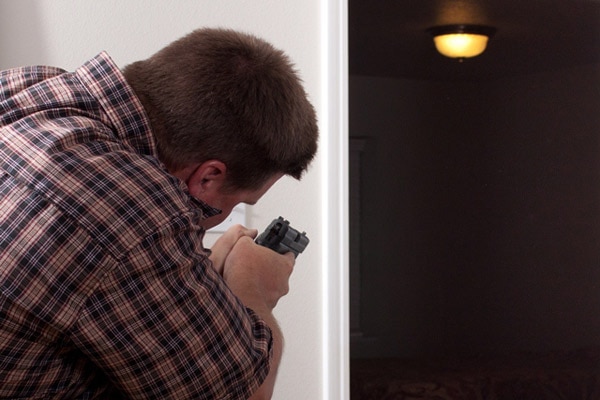
Keep your head in line with your torso when moving out to shoot.
When moving to take a shot, the shooter’s head should remain mostly straight (not exaggerated by touching the ear towards the shoulder) while the shooter’s waistline is bending towards the outer edge of the barricade. Keeping the head in a natural position, allowing maximum vision and ability to scan, is important when considering multiple (or unknown) threats and whether using a handgun or a long gun, the head should not be exaggerated to either the left or the right side. Just think about it: we don’t walk around that way. We don’t stand that way when we don’t have a weapon, right? That’s because if our head is exposed before a threatening person on the other end detects the muzzle of the gun or the dominate eye lining up the sights around the corner, it’s B-A-D.
5. Buttstock on the Collar Bone
When it comes to tactics and CQB, when using a long gun, the buttstock should be placed in the collar bone area, not in the pocket of the shoulder. Placing the buttstock on or near the collar bone allows the head to be upright, the torso to be parallel with the threat, and shooter to have maximum concealing ability around the corner of a barricade. Inevitably, this will lead to shooters having a quality pie technique.
In sum, by noticing and perfecting these five items, shooters will certainly gain a lot more kudos in the tactical world. Most importantly, it may save their lives.
Until next time, continue to hone your skills and keep adding to your tactical toolbox.
Pictures courtesy of J. Moosman Photography
Read More On:
Latest Reviews
-
Great Lakes GL-10 Rifle Review: Sub-MOA AR-10 on a Budget
The GL-10 in .308 Win has been very reliable and highly accurate, though a tad heavy. Despite the standard trigger and relatively low price for an AR-10, I can shoot sub-MOA groups at 100 yards all day with match ammo.
Read More -
The Canik SFx Rival-S Delivers Big Performance for the Money
The Canik SFx Rival-S is a steel-framed pistol that costs a lot less than many top-tier race guns but can still give the competition a run for its money.
Read More -
Taurus TX9 Review: Is This Affordable 17+1 Pistol ‘Duty’ Ready?
The TX9 is one of the most affordable, optics-ready duty-size guns out there right now. It proved to be reliable, ergonomic, and accurate out to 20 yards. Plus, its modularity is another big win.
Read More -
6.5 Creedmoor Gets Hotter, Faster with Federal +Peak Alloy Technology
At its root, the 6.5 Creedmoor +Peak is a high-pressure version of the decades-old 6.5 Creedmoor round. The dimensions remain unchanged, yet these young rounds are loaded to 80,000 psi.
Read More