With the U.S. Air Force's 75th birthday this week, we salute the servicemembers who ply the "Wild Blue Yonder."
While Ben Franklin theorized using airships to deliver troops to battle behind enemy lines as early as 1783 and the Union Army fielded a balloon service in the Civil War, today's Air Force traces its origin to the heavier-than-air machines of the U.S. Army's Aeronautical Division, founded in 1907-- just four years after the Wright brothers first flew. After service in Army green during both World Wars, the Air Force became an independent branch of the military in 1947 with the first Secretary of the Air Force named on Sept. 18 and its first Chief of Staff named on Sept. 26.
Machine guns and aerial cannons as large as 75mm guns were a facet of Army Air Force planes going back to 1912 when Captain Charles deForest Chandler fired a Lewis gun from a Wright Brother's Flyer.

The most popular guns in Great War aircraft were Vickers guns synchronized to fire through the props of the biplane fighters of the day.

Meanwhile, during World War II, the .50 caliber Browning M2/AN became almost universally standard with the USAAF's P-47 Thunderbolt and P-51 Mustang carrying as many as eight such guns mounted in the wings. With a combined rate of fire of 850 671-grain bullets per minute, the eight forward-firing .50 caliber Brownings of the P-47 could deliver almost 11 ounces of incendiary tracer per second on a target.

Long-range heavy bombers such as the B-24 Liberator and B-17 Flying Fortress could carry even more machine guns than fighters in addition to their bread-and-butter load of high explosives. The B-17G model mounted a baker's dozen .50 cals including two in a powered Bendix chin turret and two pairs in Sperry turrets in the belly and roof of the bomber.

We caught up to a working Sperry belly turret from a B-17 a couple of years ago at the Big Sandy Shoot in Arizona.

Meanwhile, the B-25 bomber was versatile enough to mount as many as 15 machine guns or leave some behind in place of a forward-firing 75mm howitzer capable of sinking a ship.

The USAAF planned to field a plane that was essentially a flying gun, the XA-38 Grizzly.

Besides aircraft-mounted guns, aircrews carried a mix of either .38 caliber revolvers or .45 caliber M1911A1 pistols for use in the event they had to bail out over unfriendly territory.

Meanwhile, WWII gunners both assigned to base defense and tasked with manning the .50 cals on bombers would learn their trade with shotguns and sporting clays, then graduate to blasting RC target planes before getting to know their machine guns. The Army acquired almost 50,000 commercial 12 gauges from Ithaca, Remington, Stevens, and Winchester during the war, largely to help train these men. The gunnery school at Tyndall Field during 1943 alone burned through no less than 56 million rounds of .30-caliber ammunition, and 12 million rounds of .50-caliber ammo in addition to pallets of shotgun shells.

Guns are even in the very first verse of Air Force Anthem, a song first written as an ode to the old Army Air Corps during WWII:
Off we go into the wild blue yonder,
Climbing high into the sun.
Here they come zooming to meet our thunder,
At ‘em now, Give 'em the gun!
Korea
With the Air Force now a separate military branch, and the jet age a reality, it still stuck to its guns. The service's jet fighters deployed to Korea in the 1950s still used Browning .50 cals as their primary weapon with the P-80 Shooting Star and early F-86 Sabre variants each carrying six of the guns. Further, they put them to effective use.

Likewise, the M1911 was still riding along with aircrew.

Cold War
The Air Force in the 1950s and 60s, with its own R&D money, put a lot of thought into small arms that were vastly different from those used by the rest of the U.S. military. New to the arsenal were the M4 Survival Rifle-- a four-shot .22 Hornet caliber bolt-action rifle with a 14-inch barrel and collapsible buttstock made by H&R-- and M6 Air Crew Survival Weapon– a double-barrel break action .410 shotgun over a .22 Hornet– were included in the bailout kits on several aircraft.

Armalite’s AR-5, a floating semi-auto rimfire rifle that could be stowed inside its buttstock, was adopted as the M1A but never put into production, leading the company to produce it for the commercial market as the AR-7. Likewise, the M6 has also gone on to be produced commercially in various configurations. Other experimental survival guns brainstormed by the USAF in the late 1960s included a .221 Fireball chambered Remington XP100 with a forward grip and no furniture and a Colt "arm pistol" in the same caliber.


At the same time, the Air Force remained very old school, with Gen. Curtis LeMay picking the S&W .38-caliber Model 15 K-38 Combat Masterpiece as the standard sidearm of the Air Force Police, a force that later became today's USAF Security Forces. Colt even made a special (but unsuccessful) all-aluminum .38 snub nose for bomber crews who might have to hit the silk over Siberia.
For high-profile details at Strategic Air Force installations-- the ones related to nuclear warfare-- LeMay formed the SAC Elite Guard.

The Air Force would continue to use the Model 15 up until very recently, including service in the Middle East.

Phasing out traditional machine guns and cannons for air-to-air combat due to the adoption of guided missiles, the USAF upgraded its airborne gun armament in 1954 with the M61 Vulcan 20mm Gatling gun on the F-104 Starfighter.
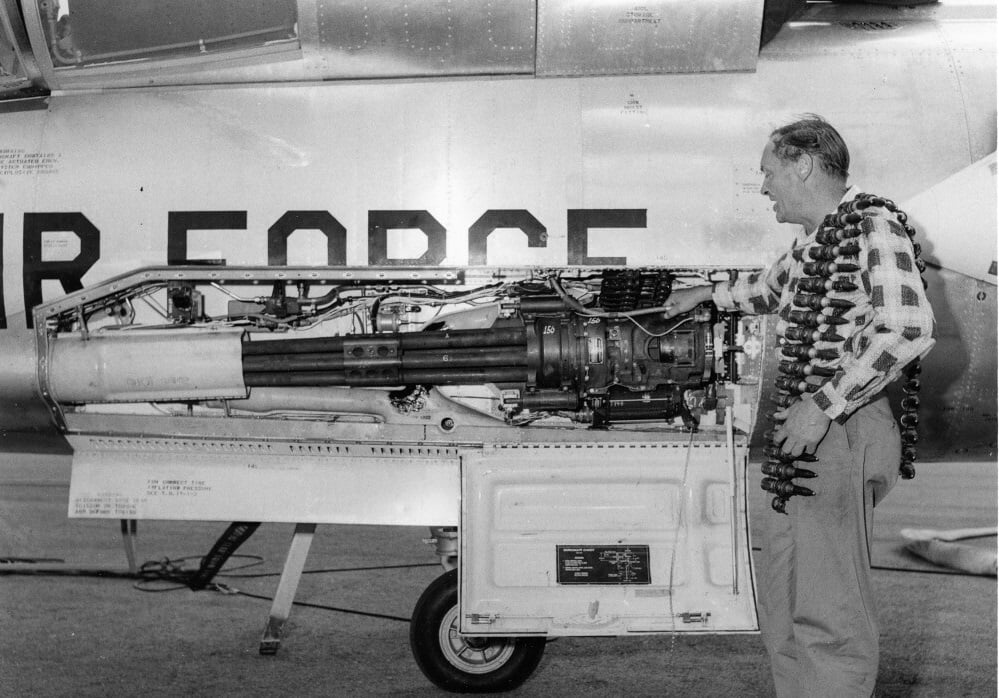
Capable of a rate of fire as much as 6,000 rounds per minute-- capable of exhausting the magazine of a fighter carrying it in seconds-- the Vulcan is a joy to behold. We caught up with one a few years ago on the ground at Big Sandy.
Vietnam
Faced with the very real threat posed by Viet Cong sappers infiltrating USAF bases in Vietnam and sabotaging multi-million dollar aircraft with grenades and satchel charges, the Air Force's Security Police beefed up for war. This included an order for the first AR-15 Model 01s made by the U.S. military. Personally championed by LeMay himself, the first contract for Eugene Stoner's 5.56 caliber black rifle was issued to Colt Firearms in May 1962, three years before the Army took interest in the handy new carbine. The service even experimented with the Oxford gunsight, one of the earliest active-laser red dots.


The Air Force likewise in 1967 adopted the GAU-5/A, the branch's designation for the Colt 610 XM177/E1 style "submachine guns" that were essentially just shortened M16s with 10-inch barrels and redesigned furniture. The GAU-5 would famously be used by Army Special Forces in the Son Tay POW camp raid.

Of note, Vietnam-era USAF Security Police that went on to contribute substantially to gun culture include Carlos "Chuck" Ray Norris, who walked a beat in South Korea where he took an interest in martial arts, and well-known gun writer Leroy Thompson.
Besides lots of gun use on the ground in Vietnam, at the same time, pilots and aircrew still carried .38s and .45s.

And, to help support isolated bases and hammer infiltration along the Ho Chi Min Trail, the USAF built a series of flying gunships. Known variously as "Puff the Magic Dragon," "Dragonships," or just "Spooky," the AC-47 gunship, a converted transport with its broadside battery of three General Electric GAU-2/M134 miniguns, was a sight to behold. Capable of firing up to 6,000 rounds of 7.62 NATO in a minute as it lazily circled a target, these aircraft made lots of friends.

The Air Force saw the value in a gunship fleet and by 1968 was upgrading C-130 transports to AC-130 Specter gunships, complete with 20mm Gatling guns and a 40mm Bofors cannon. Later variants included a 105mm howitzer in place of the Bofors.
Post-Vietnam
The 1980s and 1990s saw upgraded small arms including the M9 Beretta taking the place of WWII-era .45s in the USAF's armories while the M16A1 models were replaced by the newer M16A2s.


This came as the force was preparing, literally, for World War III.
Termed "Base Ground Defense," Air Force Security Police had to be able to contend with unannounced assaults by North Korean commandos or Soviet paratroopers in the hours before an all-out war. This meant lots of training on small arms up to .50 cal and 40mm machine guns while 90mm recoilless rifles and light mortars were added to the armory as well.

Besides standard base defense and security missions, the Air Force established a "15 in 5" standard in the 1970s that required a 24/7 ability to respond to any incursion at a site containing nuclear weapons-- be it an ICBM silo or an air base with nuclear bombs, cruise missiles or alert aircraft-- with at least 15 well-armed men in under 5 minutes.
This increase in training led to the USAF turning to several different enhanced devices such as MILES (think laser tag but way more expensive), Firearms Training System (FATS), and the Engagement Skills Trainer, the last two incorporating air compressors, lasers, and video simulations in an indoor environment with no brass or ammo.


However, the venerable Model 15 K-38 remained very much in service throughout this time, especially with military working dog teams.

And GAU-5/As continued to pop up as well.

As before, the M61 Vulcan remained in front-line use.

While, in an answer to 50,000 Soviet tanks, the Air Force introduced the flying 30mm GAU-8 Avenger cannon mounted to the A-10 Thunderbolt II, a plane so homely it is best just known as the Warthog. As the expression goes, though, she may not be pretty, but she sure can cook.
The 1990s also saw the last fixed-wing aircraft in the USAF's inventory with .50 caliber Brownings hang up its guns. In 1995 the B-52G Stratofortress had its four-gun remote-operated tail gun system removed, although the B-52 would endure long past that time. It was the first time the Air Force was without the .50 cal on fixed-winged combat aircraft since the 1930s.

21st Century
Soaring into the present, the Air Force remains very "gun" oriented with its Security Forces still engaged in its traditional missions and special operations Air Commando units such as Pararescue, Combat Control, Tactical Air Control Party, and the grey berets of the Special Reconnaissance teams very much on the sharp end of things. They saw lots of service in Iraq and Afghanistan and continue to be engaged around the globe.


The service has also continued to update its small arms. Gone are the M60s and M16A2s, replaced by M240 series GPMGS and M4 models.
Meanwhile, the USAF in 2020 moved to acquire some 125,000 new M18 series Modular Handguns from SIG Sauer for $22.1 million. Based on the P320 platform, the M18 will replace the Air Force's M9 Berettas, smaller numbers of the M11-- which is a version of the all-metal SIG Sauer P228 used by the Air Force Office of Special Investigations-- and the long-serving .38-caliber Smith & Wesson M15 K-frame revolver, which is used in training military working dogs.
Last year, the service moved to order 3,015 modification kits to upgrade some M18s to essentially mirror SIG Sauer's P320 XCompacts. The kits include a 3.6-inch barrel and its accompanying slide, complete with X-Ray day/night sights and an optics plate, as well as the XSeries grip module and matching 15-round flush-fit magazines.
The service has also ordered a small quantity of B&T USA's APC9K PRO platform, a compact 9mm blowback action three-position select-fire SMG that fires from a closed bolt at a cyclic rate of 1,080 rounds-per-minute.
Other new small arms contracts for the USAF include almost 1,500 new M110A1 Squad Designated Marksman Rifles, a variant of HK’s 7.62 NATO G28/HK417 rifle. The SDMR includes offset backup sights, a Geissele mount, an OSS suppressor, Harris bipod, and Sig Sauer’s 1-6x24mm Tango6 optic.

The Air Force is using the SDMR to replace the legacy bolt-action Remington M24 Sniper Weapon Systems in use with base ground security forces. Additionally, it will replace the Knights M110 Semi-Automatic Sniper Systems rifle with the service's elite pararescuemen and Guardian Angel recovery teams, reportedly shedding 5 pounds in gear while on missions. Finally, it will replace older platforms used by explosive ordnance disposal Airmen for what is termed standoff munitions disruption.
Finally, the Air Force is also building a new generation of "bailout" guns for its aviators. Dubbed the Aircrew Self Defense Weapon, it is designed to stow inside a 16x14x 3.5-inch ejection seat compartment. The ASDW gets that small due to the use of an M4 style collapsible stock, flip-up backup iron sights, an Israeli FAB Defense AGF-43S folding pistol grip, and a Cry Havoc Tactical Quick Release Barrel (QRB) kit.

Although missiles and lasers are in vogue today, the Air Force is still very much in the gun business and, we bet, will be for at least the next 75 years or so.