Junction
While most of the hunting rifle market moves to ultralight synthetics stocks and specially coated metalwork, it’s refreshing (at least for us traditionalists) to see accessible yet premium rifles being built with quality high-grade walnut furniture and a Monte Carlo stock.

The Junction offers just that. At 7.5 pounds, the Junction has the look and feel of a quality old-school hunting piece of wood and steel. There’s a stainless receiver, adaptive controlled round feed, three-position safety, and adjustable trigger.

The inclusion of an aluminum integrated M-LOK rail at the forend is unusual on a wood gun, but practical for bipods and other attachments.
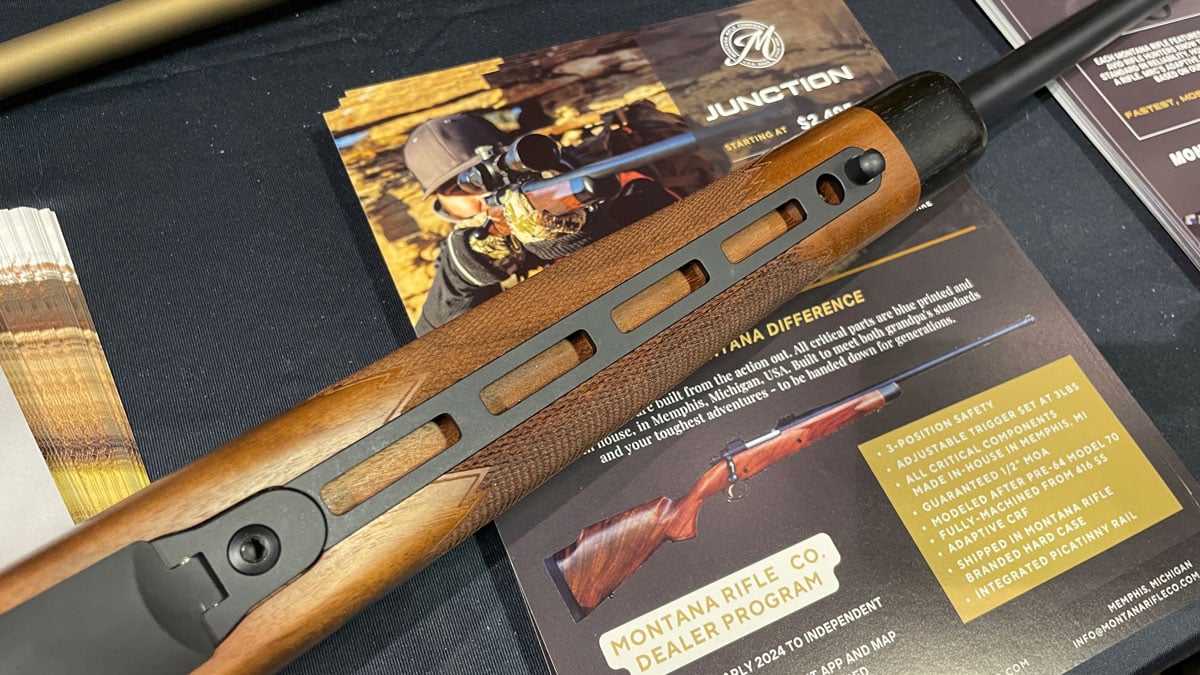
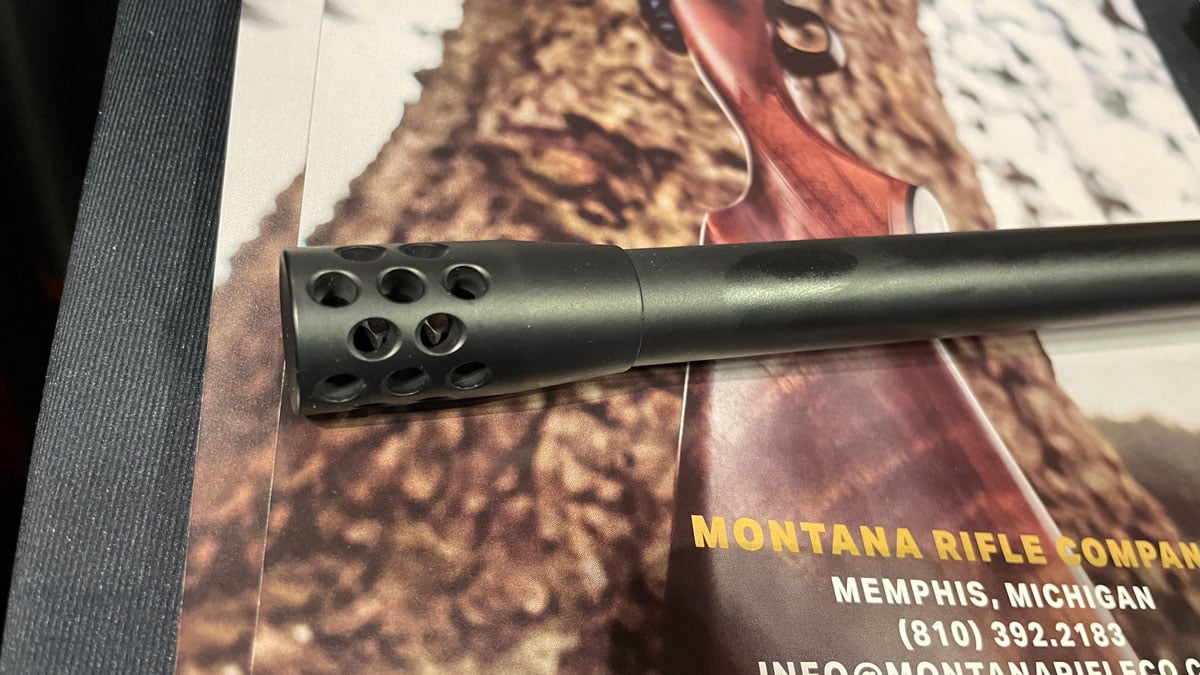
The Junction’s accuracy guarantee of 1/2 MOA is a leader in its class. Retail pricing is set at $2,495. Current chamberings include .308 Win, 6.5 Creedmoor and .300 Win Mag, with the 6.5 PRC, 7 PRC, and .375 H&H soon to follow. Additional chamberings including .270 Win, 28 Nosler, .280 Ackley Improved, 7mm Rem Mag, and .300 Rem Ultra Mag, along with left-handed variants, are coming soon.
Highline

The new Highline carries many of the same base features as the Junction, but in a synthetic, lighter-weight package. The 1/2 MOA guarantee, adjustable trigger, integral Picatinny rail, and hand-lapped barrel remains.

But this rig sits in a McMillan carbon fiber game hunter stock with a grippy speckled finish. Burnt Bronze Cerakote covers the metal for a clean and smart aesthetic.
Like the Junction, the barrel is threaded and fitted with a brake. The same suggested retail of $2,495 tags the Highline, but the rifle comes nearly a full pound lighter, starting at 6.8 pounds. The same list of chamberings and coming releases applies to the Highline. The rifles ship in a branded hard case and are ready to hunt.
About Montana
Though the original state namesake remains, Montana Rifle Co (MRC) is now owned by Grace Engineering Co, an all-American company based in Memphis, Michigan. Many hardcore hunters were saddened to see the original MRC shutter its doors, but fret no more, the brand is back. From what we can see, it’s looking better than ever under Grace steerage with guidance from some longtime industry leaders like Ronald Petty.

The Grace owners are all about precision, drawing from a lengthy background in designing and manufacturing broadheads for the archery hunting world under the G5 Outdoors name. All MRC rifles are designed and manufactured in Michigan, with “all critical parts blueprinted and built in-house” per company advertising.
Hot Features
A handful of features are especially noteworthy for hunters. Surely every hunter has heard of controlled round feed bolt-action systems, the gold standard admired on early Mausers and the revered pre-64 Winchester Model 70s. Montana’s rifles are clearly modeled after both, with a healthy dose of modern advancements in the mix.

The remarkable upgrade is MRC’s advancement to what the company calls Adaptive Control Round feed, whereby shooters have all the benefits of both control feed and push feed, meaning they can single feed a round without inserting it into the magazine, while maintaining the reliability of CRF. Claw extraction remains.
The Model 2022 receivers are made in-house, drawing from the company’s original along with pre-64 Model 70 design, but 100-percent machined from a 416 stainless-steel blank. Many of the MRC’s original machinery remains, but even more has been updated and replaced to meet the tightest tolerances and to allow Grace to craft these receivers from start to finish at the factory.
MRC is one of few companies to still use the Mauser 98 style barrel ring and feed cone. The original 1999 receivers used castings, where the new 2022 receivers reach a higher degree of precision while parts become interchangeable. Production begins with a 10-pound bar of 416 stainless, removes over 90 percent of the material to end with a sub-1-pound piece that is lighter and more precise than its cast sibling.

Lastly, a feature unique to this duo of MRC rifles is the patent-pending inset lower rail, built of high-thickness anodized aircraft aluminum, found on both the walnut Junction and synthetic Highline. It offers both an M-LOK interface along with the more traditional sling stud and a QD socket. Perhaps most importantly, every rifle is tested for accuracy prior to leaving the plant, and company reps are clear that if a rifle does not meet that 1/2 MOA guarantee, it will not ship.
A Bright Future
From continuing support for earlier Montana rifles to driving forward the pair of fresh designs, the Grace family at MRC continues working to improve, innovate, and build intuitive rifles for hunters. Meeting the Grace family at SCI was a pleasure. Their passion for precision engineering shines through, as does the legacy of third-generation family business roots with a steady eye on the future.