Heritage History

Heritage Manufacturing, a Taurus subsidiary out of Bainbridge, Georgia, has built a well-earned reputation for making some of the most affordable .22 LR plinking guns on the market since its founding in 1992. The Heritage brand is all cowboy, with a few recent twists, and its largely built around its flagship singe-action Rough Rider handgun.
Related: Heritage Rough Rider Revolver – Let Your Inner Cowboy Out
With the exception of its lever-action Settler rifles, Heritage guns are all based around the American-classic Colt Single Action Army. It doesn’t get more gunslinger cool than an old single-action Colt, even if the Heritage lineup is chambered for only .22 LR and .22 Mag. Bringing the design into the 21st century, the company even jumped on the steampunk trend with its retro-futuristic “tactical” revolvers.
Budget-friendly value is at the core of the Heritage brand. Despite this, its guns have also gained a reputation for reliability, helped along by a fairly simple design and the gentle recoil of common .22 LR ammo.
Specs & Features

While it’s technically a six-shot single-action-only revolver carbine, the Rancher is not intended to host more than five rounds when carried around loaded. The barrel of the gun is even marked with a warning to never carry the gun with a round under the hammer, and that’s in keeping with the standard carry practices of the original Colt Single Action Army.

Loading is done through a gate behind the cylinder. If you’re just plinking away at the range, feel free to simply load a complement of all six rounds and fire away. Unloading spent casings is done with a spring plunger attached to the underside of the barrel.
If you are considering carrying the gun around, there are several ways to load the cylinder so that you can safely lower the hammer on an empty cylinder. I prefer the method below that loads two and then skips the third round:
Here’s a quick rundown of the basic specs for the Heritage Rough Rider Rancher:
Weight: 3.92 pounds
Length: 32 inches
Barrel Length: 16 inches
Sight Radius: 13.75 inches
Length of Pull: 14.25 inches
Trigger Pull: 2.63 pounds (10-pull average)
Twist Rate: 1:16 right-hand twist

As an added safety measure, Heritage departed from the original design by adding a very simple hammer-block thumb safety on the left side of the hammer. I’ll be honest, I’ve caught myself pulling the trigger only to hear an unsatisfying click after forgetting about the safety. It’s hardly my favorite feature, but it’s easy enough to overlook given the very low price of the Rough Rider lineup. Some shooters may even prefer the safety.
The single-action-only design requires you to manually thumb the hammer before each shot. The hammer cocks to three stages while rotating and finally locking the cylinder. The first stage locks the trigger and cylinder. The second releases the cylinder so it will spin freely for loading and unloading. The final stage has two audible clicks while it rotates and locks the cylinder and sets the trigger.
This model came with a straight walnut stock and a surprisingly nice leather sling. The frame is made from an aluminum alloy with an alloy steel used for the barrel and cylinder. The wood stock and the plastic butt plate are both textured.


There’s a spur on the trigger guard that’s meant to help you grip the gun with your support hand. I cannot stress this enough – DO NOT hold the barrel with your support hand. This is still a revolver, and there’s a cylinder gap that spits out a decent amount of fire, gas, and debris.

I personally prefer to place the middle finger of my shooting hand on the spur and use my shooting-hand thumb to work the hammer. The other option is to place your support-hand pointer finger on the spur and use your support-hand thumb to work the hammer.
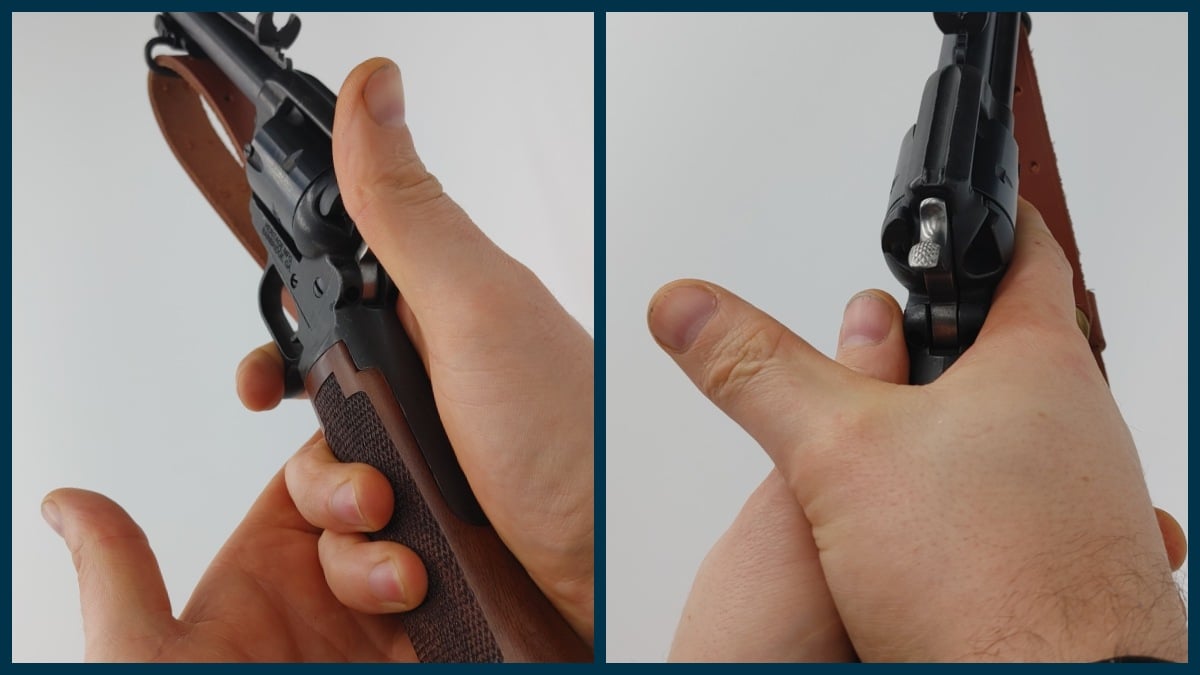
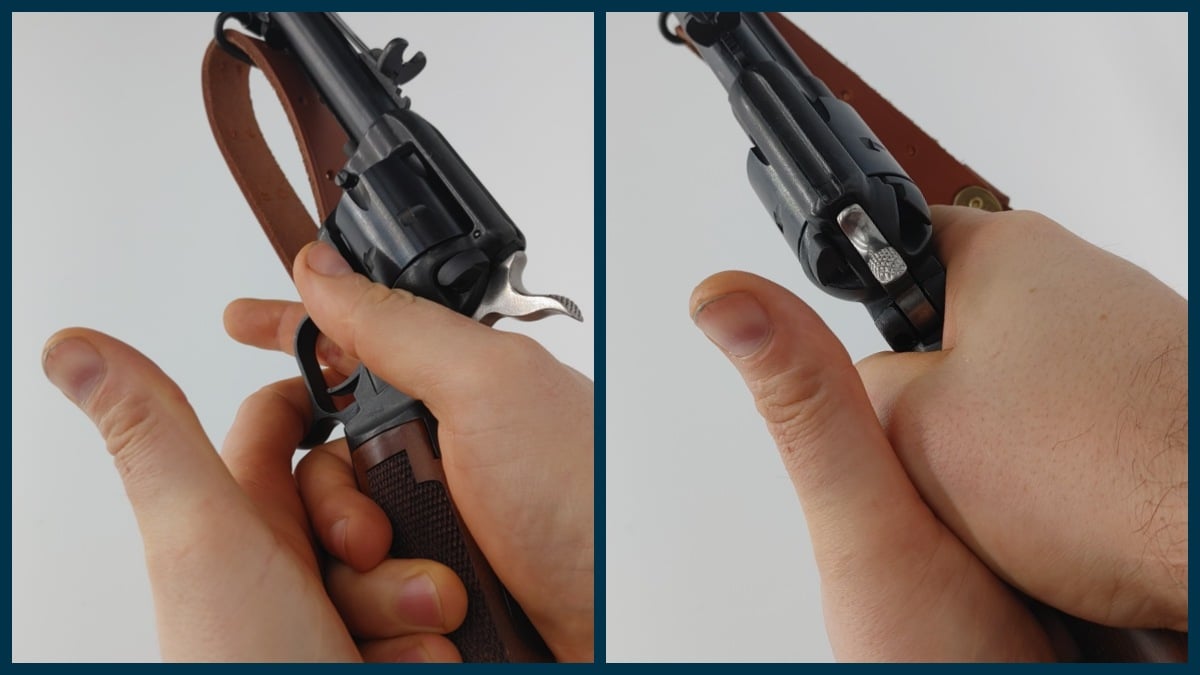

The gun is hardly the “Big Iron” of Western lore with its standard .22 LR chambering. However, for a few extra bucks, you can swap out the cylinder for a .22 Mag option to bump up your range and power. Again, mind your hand placement.
Related: 2-in-1 Revolvers – Heritage .22 Mag Cylinder Review


Finally, we get to my favorite feature. The buckhorn sights on the Rancher are far superior to the crude blade/notch affair on most of the Rough Rider handguns. The sights are adjustable for elevation in the rear, and the front blade can be drifted for windage. There’s also a brass bead on the front blade.
Shooting & Accuracy
I did my accuracy testing with offhand shooting instead of from a rest for two reasons. First, I think that’s the way most shooters are going to plink or hunt with this gun. Second, the cylinder gap creates a problem if you shoot the gun off a bag or block. The gas and debris tend to spit back into your face if you block the gap while resting the barrel on something.

It’s not terrible, but you will notice it. As always, never shoot without proper eye protection. That’s especially true if you’re going to hold your face close to the cylinder gap of a revolver carbine. On that note, I’ll also add that the length of pull is a bit short at just 14.25 inches, and that puts the cylinder gap just 6.5 inches away from my shooting eye. While .22 LR isn’t exactly a powerhouse, that still makes this gun a bit noisier for the shooter.
I started my offhand shooting at 10 yards and walked it out to 50 yards. Here’s what I came away with between 10 and 25 yards.
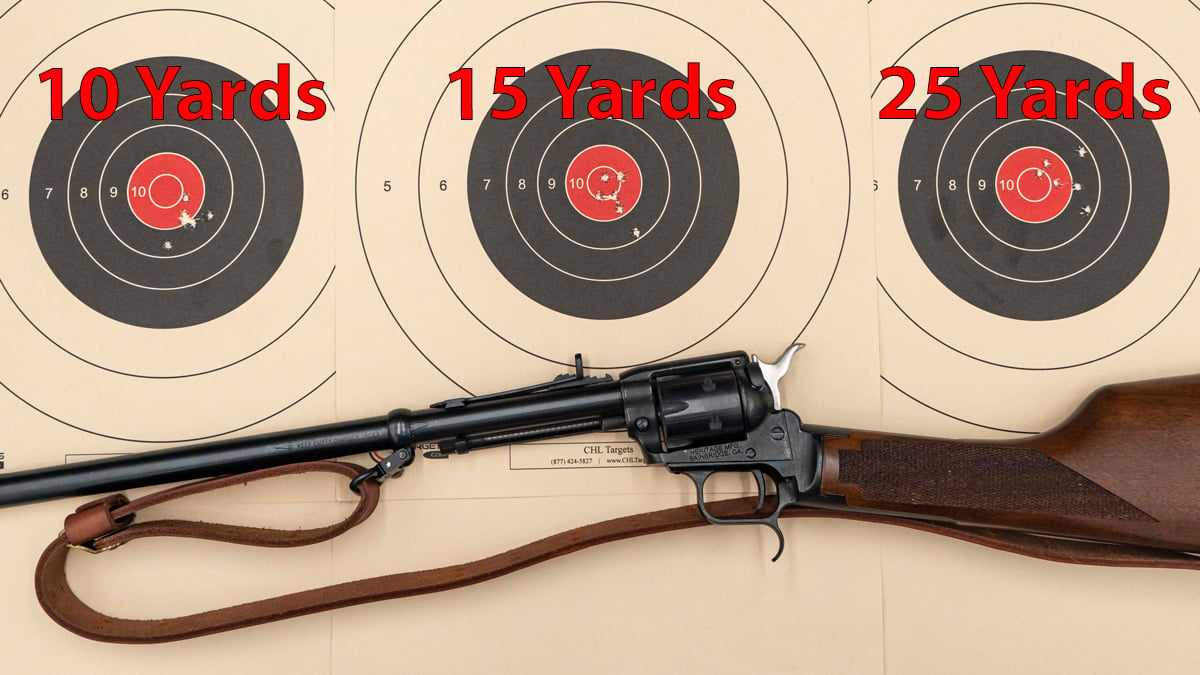
That’s about what I expected, and the slight drift to the right was consistent. If this were my personal gun, I would simply adjust the front blade for windage. The pattern does open up as the distances increase. Part of that is my lack of experience with the buckhorn-style sights.
The sight radius is short for a carbine, at just 13.75 inches, and the front sight becomes a relatively large dot on your target even at 25 yards. Still, with some practice, I could see this gun serving as a decent squirrel hunter at closer rangers.

By the time I got out to longer distances like 50 yards, my groups opened up considerably and were somewhat unpredictable. I think this is pushing the gun and the sights a bit at this range, but there’s an option to add a scope or red dot now with the new Tactical Rancher carbine. That version has a top Picatinny rail. Past testing with the Tactical Cowboy handgun offered some nice precision results even with the shorter 6.5-inch barrel.
Related: Heritage Tactical Cowboy Review – Optics-Ready .22 LR Revolver
Shooting accuracy proved to be more or less what I expected. Reliability was the same. I’ve taken this Rancher to the range several times over the winter and never had any issues. I also appreciated the fact that the revolver design meant I never needed to adjust my shooting hand or support hand while on the range. This isn’t true of bolt, lever, and pump .22 rifles.
Pros & Cons
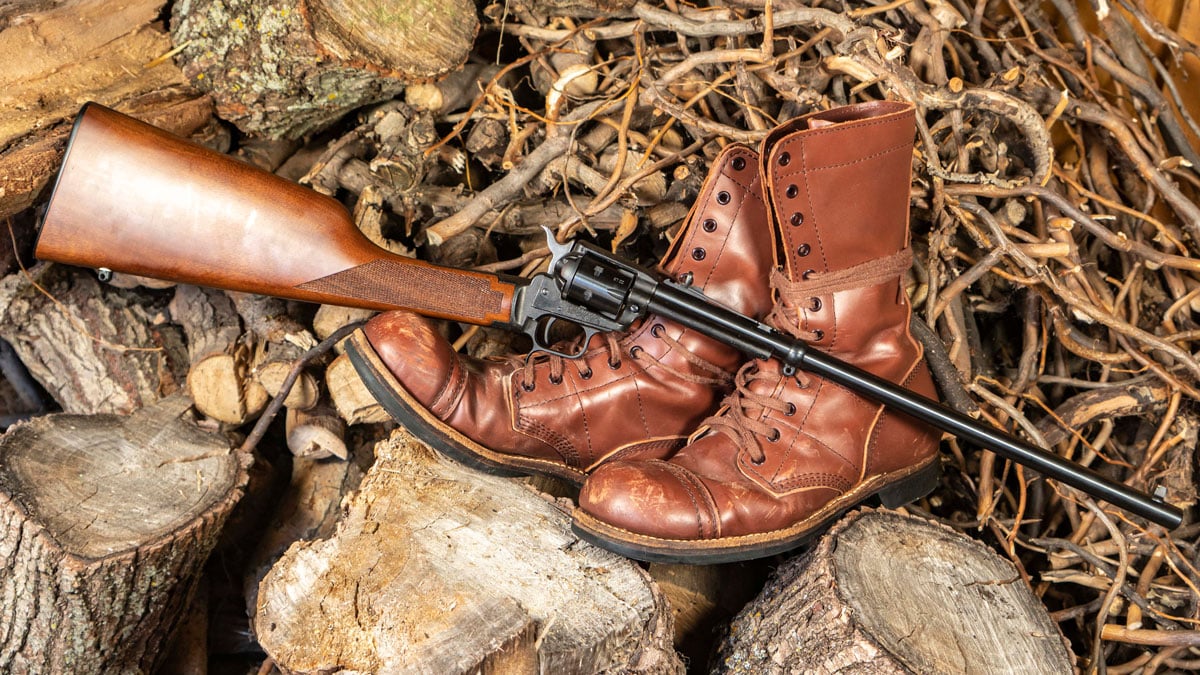
Here’s my short list of the pros and cons for the Heritage Rough Rider Rancher Carbine:
Pros:
- Very affordable .22 LR carbine option
- Wild West feel
- Reliable
- Relatively accurate
- Cylinder options: .22 LR and .22 Mag
- Budget-friendly ammo
- Nice leather sling
- Lightweight and easy to carry
- Adjustable metal sights
- Manual safety for those who like that
- Easy to clean and maintain
Cons:
- Not a precision shooter
- No scope attachment options
- Cylinder gap requires unique grip
- Limited six-round capacity
-
Slow to load and unload
Final Thoughts
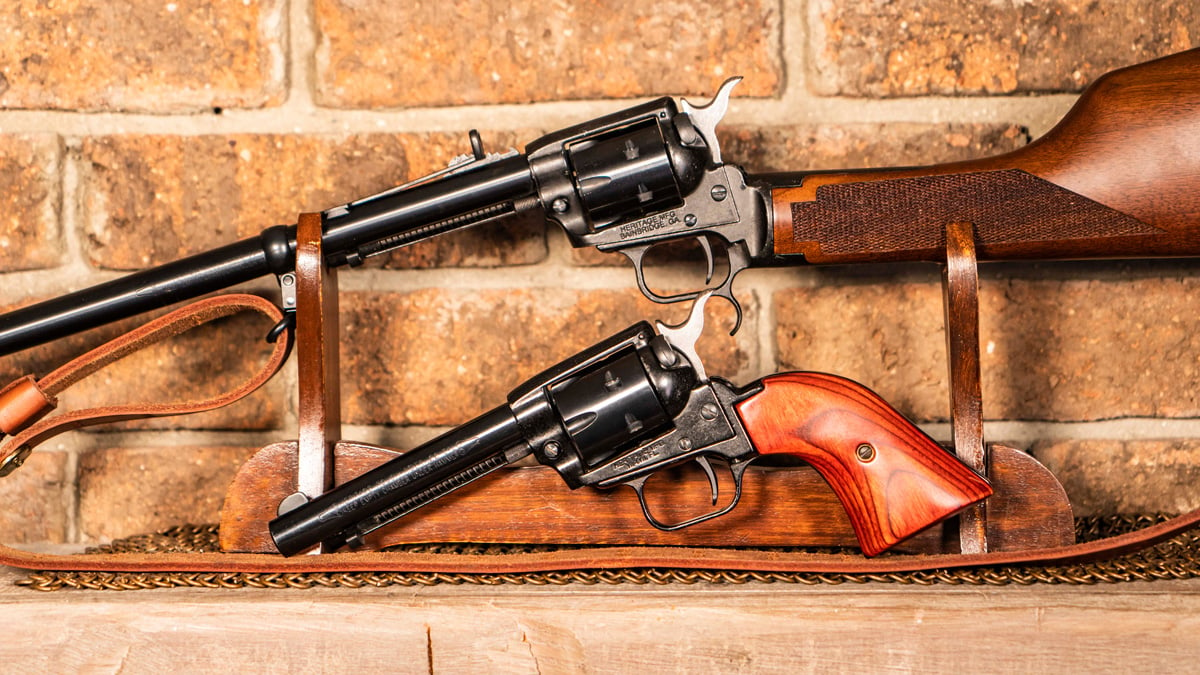
For my money, adding a simple .22 LR plinking firearm to any gun collection is the most cost-effective way to dramatically increase your range-time fun on a dime. After years of shooting Heritage revolvers, I have been impressed with how well they hold up for the price.
If you’re looking for an affordable plinking handgun, carbine, or both, it’s really hard to beat the Rough Rider handguns and carbines from Heritage.
These guns are just plain fun to shoot, and they are right at that price point that makes them low-guilt impulse buys. I’ve been shooting my personal Heritage .22 LR handguns for years, and they’re still just as fun as the day I bought them.