Red Dot Sights
Red dots have the benefit of having unlimited eye-relief and being parallax free, so they are very fast on target. This is why they are so popular as long gun sights.

Aimpoint has reigned king of rifle red dot sights (RDS) for decades, but in the past few years, Holosun has surpassed it, at least on the civilian market. Holosun is now seen as having similar quality and durability at a fraction of the cost.
Related: Holosun Heats Up SHOT Show with New Releases
The Optics
Now, the first things to judge a sight on are the glass and dot emitter. Holosun has the reputation of having very good user-grade optics, and the SCRS maintains that reputation. Everything is good – not great, but an excellent value for the money. It is more than usable, and only an optics snob would notice imperfections.

The glass is crisp and clear, and there are no distortions. The notch filter, which is the color tint used on the glass to make the dot show up better, is hardly noticeable to the shooter.
The dot emitter itself is also good. There are no issues with the refresh rate. I did not notice any flickering and didn’t have any problems during fast transitions.
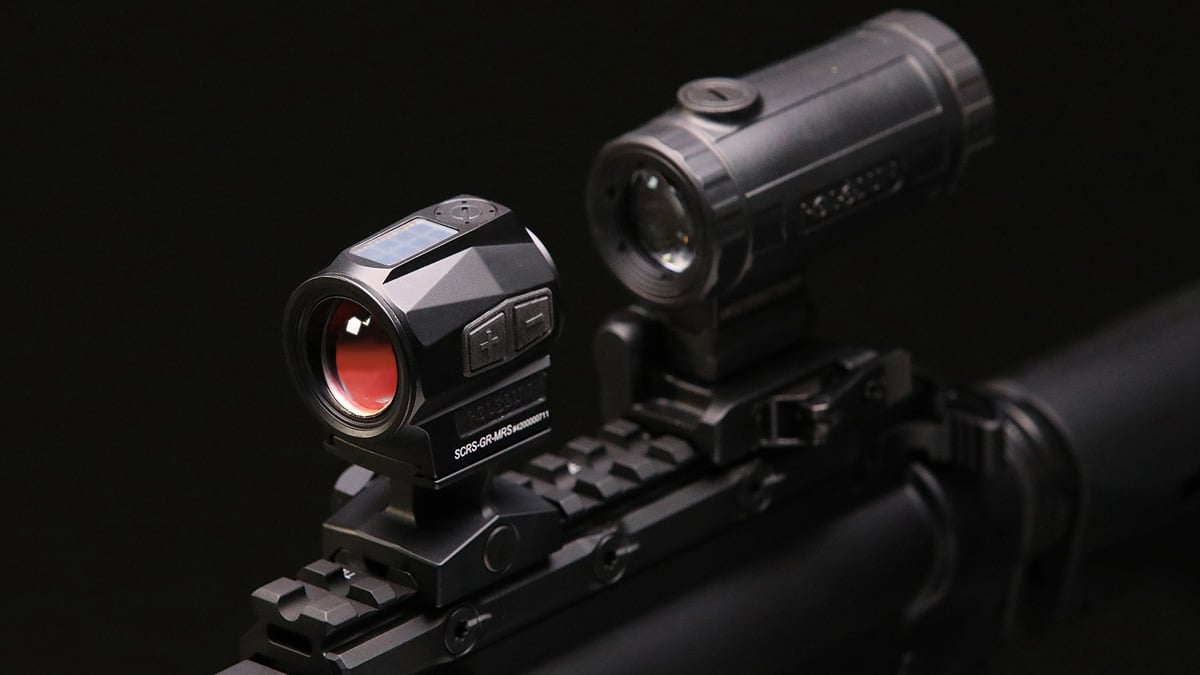
Because of my astigmatism, some dots appear to bloom to me. Holosun dots do have a slight starburst effect for my eye. This tells me that the emitter is not the worse, but it is also not the best. With my prescription glasses, the bloom almost totally goes away.
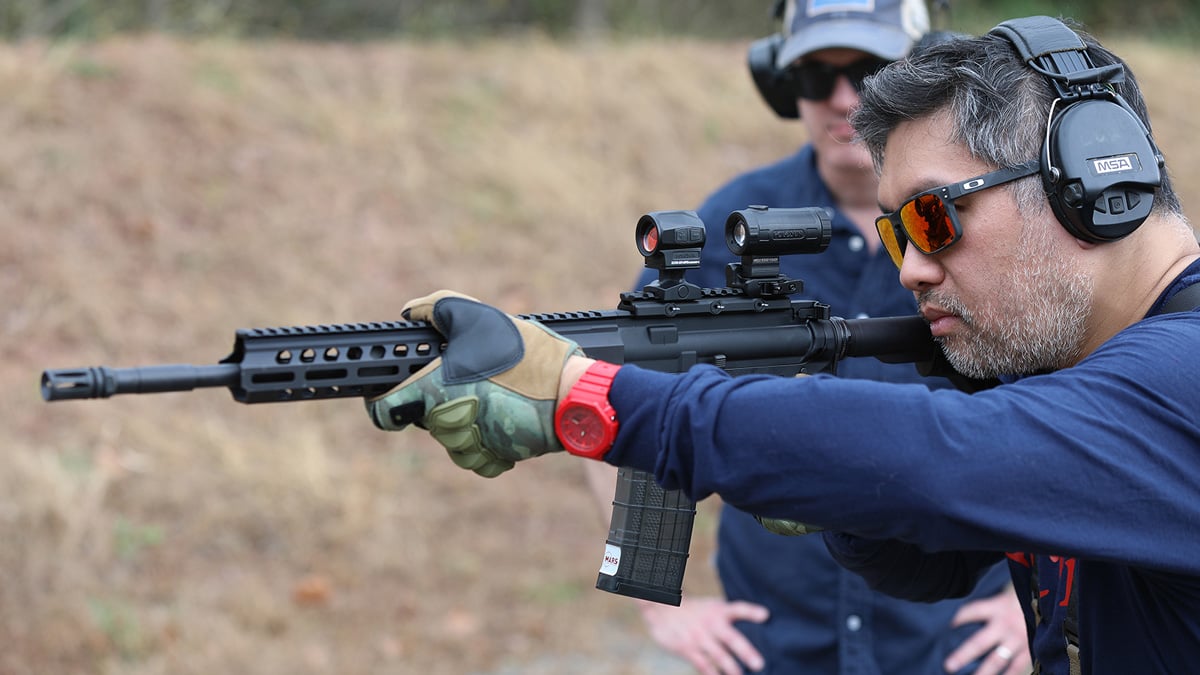
The dot also becomes clearer used in conjunction with a magnifier. I used a Holosun 3X magnifier with the SCRS, and they worked beautifully together.
Solar
Recently, Holosun has been doubling down on capacitor and solar technology. Last year, I looked at Holosun's Solar Charging Sight (SCS) for pistols, which really impressed me.

The SCRS rifle sight uses the same basic capacitor technology of the SCS pistol sight. This family of optics doesn’t have a traditional external user-serviceable battery. Instead, it uses an internal battery charged by a sophisticated capacitor that uses the integrated solar panel.
The battery life alone is rated at 50,000 hours. That’s over five years, so theoretically you could store this optic turned on in a box for five years and it would still work. But combined with the shake-awake technology, that optic in a box would turn itself off unless it were moved, which would extend that five years to many, many more.
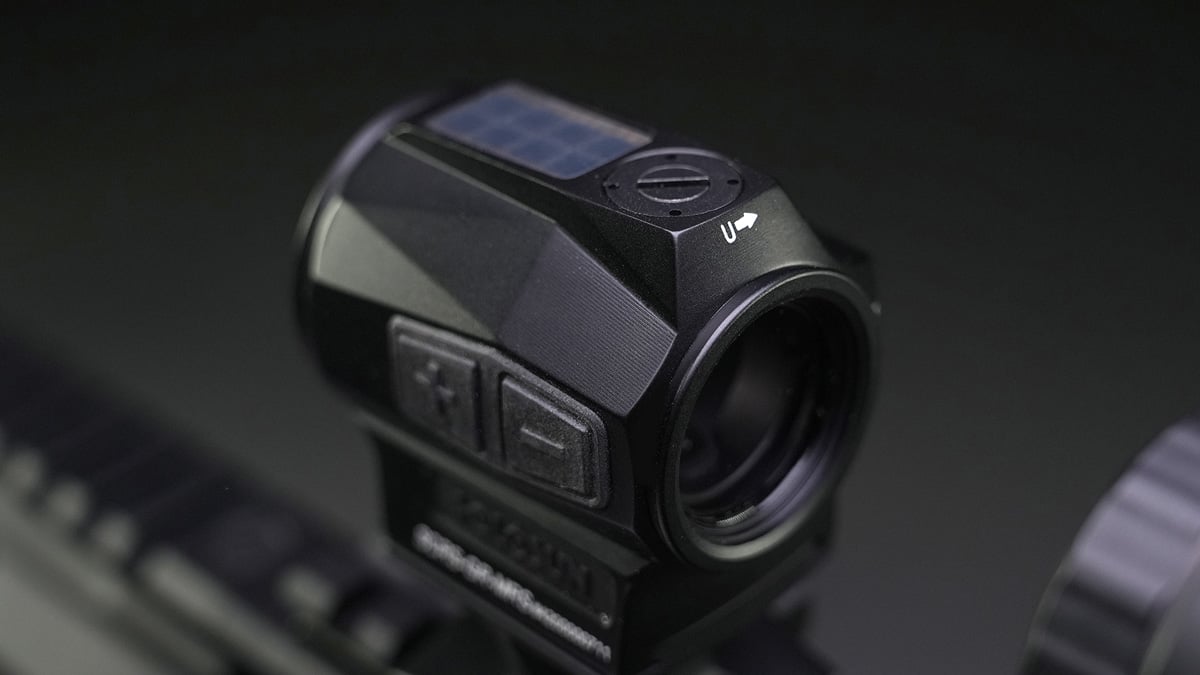
The solar technology comes into play every time you use this optic as it recharges itself with the ambient light. The solar panel can use sunlight or artificial light.
Specs
Because the battery is internal and there are few points of ingress, the sight is IPX67 waterproof rated.
Also, because of the design features, the sight is very small and light. Compared to the Aimpoint T-2, the SCRS has a larger tube diameter and is half an ounce lighter. The SCRS has a 20mm tube made of 7075 aluminum. There are 12 brightness settings, four of those night-vision compatible.

Just like on the SCS, the SCRS has an auto-adjust feature. Some people don’t like auto-adjust brightness, but it worked very well for me. The most difficult situation for most auto-brightness systems is when the optic is in a dark area, but you are looking into a bright environment. The key on the SCRS is to set the initial brightness above setting 6. If your initial setting is 6 or above, the auto-adjust will not lower the brightness below setting 6.
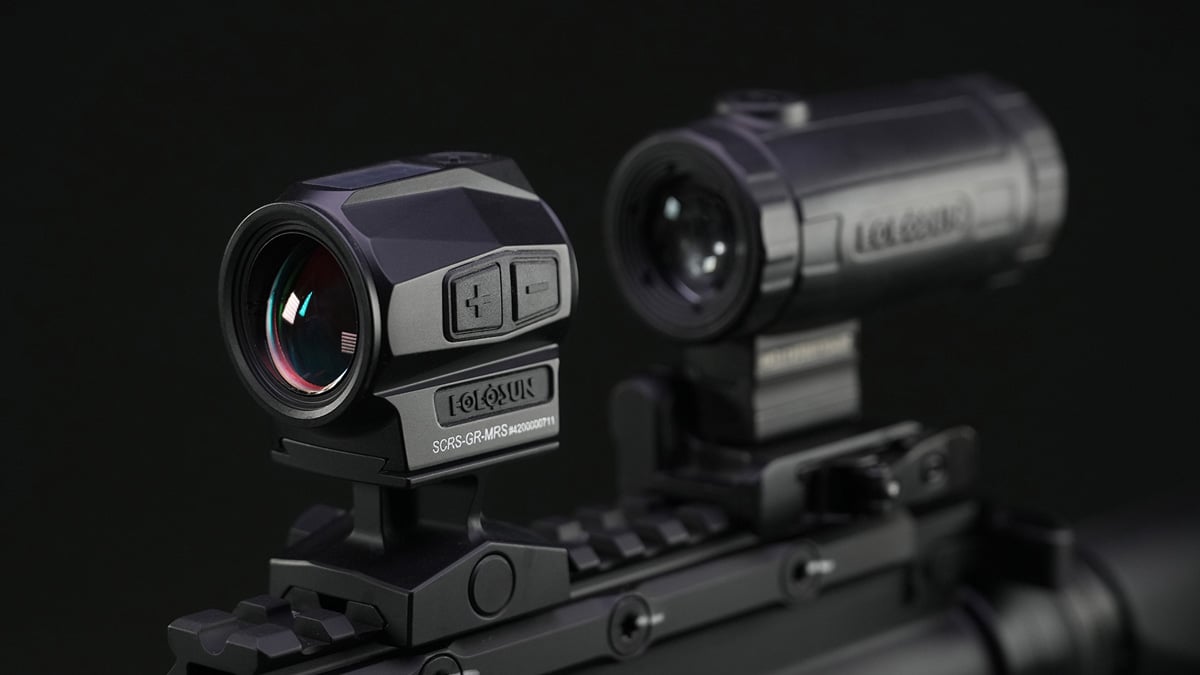
Brightness in both auto and manual modes are set with buttons on the left side of the body. Left-side buttons make it easy for right-handed shooters to use their support hand to adjust the brightness.
Models
There are four models in the SCRS lineup: a red and green version of the Multi-Reticle System (MRS) and red and green versions of the 2-MOA dot reticle. The MRS models have the option of either a 2-MOA dot, a 65-MOA circle, or a reticle that has both a 2-MOA dot and a 65-MOA circle.

Personally, even though my test optic from Holosun was a Green MRS, I like the Green 2-MOA dot version best. Green shows up brighter for my eye, and I don’t find the circle reticle any faster. It just clutters up the sight picture for me, as I like a simple dot to aim.
MSRP on the various configurations ranges from $271 up to $353. In comparison, an Aimpoint T-2 starts at $929.
Accessories
All SCRS dots come with a rubber cover, CR2032 battery, manual, tools, and two mounting options. There is a lower-third co-witness mount, which puts the center of the optic at about 1.57 inches, or there is a taller mount that puts the center of the optic at 1.63 inches.

Personally, I’ve been enjoying the trend of putting red dots a little higher. Heights of 1.93 inches, 2.26 inches, and 2.33 inches have been gaining in popularity. The reason is threefold.
One, higher optics allow for a more natural head position when standing offhand, which allows more speed and movement. Two, higher mounts allow the optics to clear night vision aiming devices. IR illuminators can sometime be bulky and block lower positioned optics. Also, when using RDSs for passive night vision aiming, a higher mount allows the shooter to get behind the sight with a night vision monocular or goggle. And three, higher sights allow shooters with gas masks to use the optic.
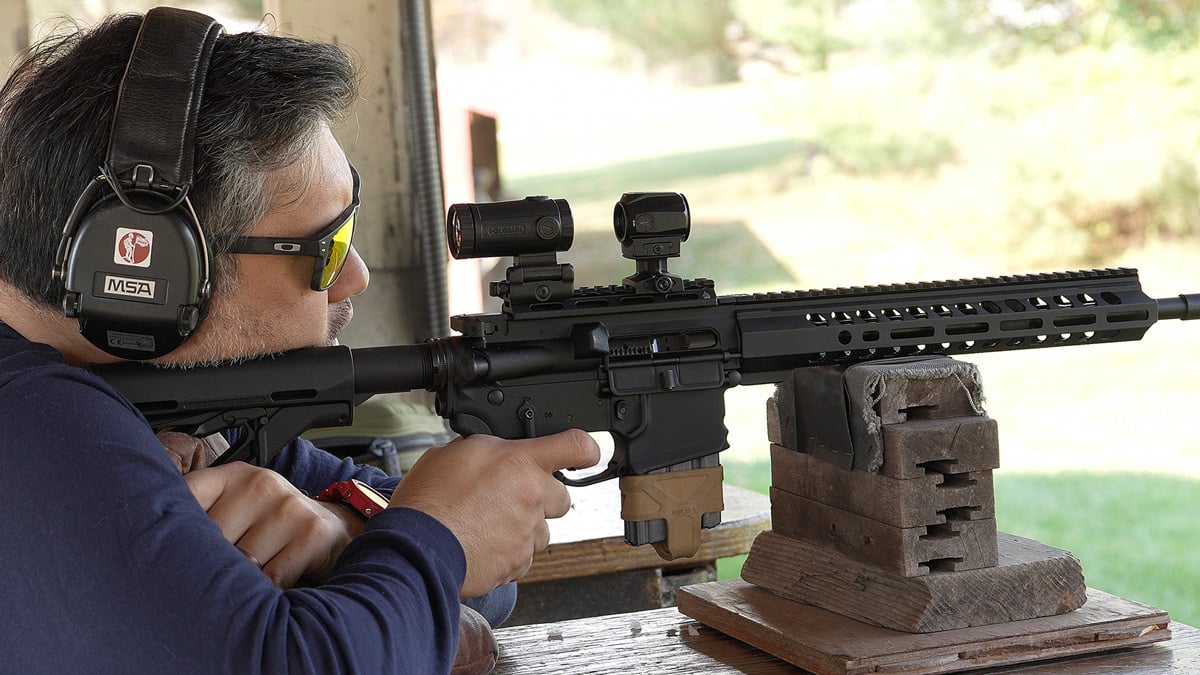
I’ve used 1.93-inch red dots for a while now, and I really like that height. It works well for me, but I wanted to try some of the other newer heights. Most of these higher mounts are niche and expensive, so I decided to order a half-inch ATG Leapers Picatinny Rail Riser. Combined with the included Holosun 1.57-inch mount, it gave me an optic with 2.13-inch height.
Honestly, I didn’t notice much of a difference, but I haven’t tried it with a gas mask or NVGs. The only real drawback for high optics is that the prone position might not be as comfortable.
Pros & Cons
I only see two real downsides to this sight. First, the mounting footprint is that of a Holosun 507T. I get that it is a Holosun footprint, so it makes sense why Holosun wants to use its own footprint, but the 507T is a pistol sight. The SCRS is a rifle sight, and Holosun doesn’t recommend it be used as a pistol sight.
A few manufacturers make rifle mounts for the 507T, but it’s not the industry standard. There are many more Aimpoint T-2 options.

The second con is that it is unproven technology, and there is no real-world data as to how long the internal battery will last. As we all know with our cell phones, all batteries eventually wear out and don’t keep a charge for as long as when they are factory new.
When will this happen to the SCRS? Even Holosun doesn’t know, as it really depends on how the sight is used and how often the battery is charged and discharged.
I believe Holosun estimates it has at least a 10-year service life. That’s about how long tritium sights last before they become dim, but I think the service life for your average civilian user will be much longer. Once the SCRS battery starts to lose charging life, one can send it to Holosun for battery replacement.
Pros:
- Potentially has a 10-year battery life
- Solar charging capability
- Good glass offers great value for the price
- Includes two mounts
-
Compatible with Holosun magnifiers
Cons:
- Holosun 507T mounting footprint designed for a pistol sight
-
Technology yet unproven in the real world
Conclusion
To sum up, I think this will be the new standard for rifle sights. The quality is fantastic for the price. We know this about Holosun optics. It’s now the industry standard. But now, you no longer need to worry about the battery for 10-15 years. What more can you ask for?