Another HIT from Seekins
Seekins Precision is a long-standing big name in the precision shooting community. I remember back when Glen Seekins sold his products to the rest of us on shooting forums. In the decades since, his business has become a giant in the industry, so it comes as no surprise to at least this author that Seekins has developed such a great line of shooting products.

The Seekins Havak HIT is a chassis gun built around the Seekins HIT action. The action itself features a flat bottom and built-in recoil lug. Up top, it has a 20-MOA integral scope rail for optics mounting. Inside the action you will find a spirally fluted bolt, which can be disassembled without tools. Using dual stacked bolt lugs, the HIT has four engagement surfaces and a 90-degree bolt throw.
Toolless bolt disassembly is handy, because swapping bolt heads is all part of this rifle’s multi-caliber personality. Changing out the barrel itself is done by loosening a lock screw and threading the barrel out. Again, the precise modern machining allows for tight tolerances between parts. This is what makes it possible to jump back and forth between barrels.
Range Preparations
Before heading to the range, we prepped the rifle with some accessories. First up was a good scope. I chose the US Optics TS20X mounted in an Arken 34mm scope mount and attached it to the HIT’s 20-MOA scope rail.

Next up was a Harris bipod that attached perfectly to the chassis M-LOK slots with a KDG Kinect QD Mount. Lastly, I attached a sling using the QD cups cut into the chassis at various places.
The rifle we tested came with both a .223 Wylde barrel and a 6.5 Creedmoor conversion. So, apart from the accessories, I also brought the necessary tools to switch calibers in the rifle. It made sense to me that Seekins had threaded both barrels 5/8x24, as it would allow the shooter to use the same suppressor for both barrels.
It’s common practice when using multi-caliber guns to get a suppressor in the largest caliber you might use. It can obviously be used for the smaller calibers as well. For that purpose, I grabbed the Maxim Defense PRS .30-caliber suppressor.
Shooting the Seekins Havak HIT
After adjusting the buttstock and comb, we bore-sighted the scope and set to zeroing the rifle. A few shots and quick adjustments, and the HIT was making groups exactly where I wanted them. Even the inexpensive Hornady Black ammunition shot .7 MOA five-shot groups.

The action feels smooth, though I do think it might need a touch of a break-in. The feeling of the straight bolt handle is fantastic, and it cycles cartridges effortlessly. An immaculate trigger pull came as no surprise. I expected that from a TriggerTech.

Shooting prone with the Seekins felt right. The design of the chassis, grip angle, and bolt operation all seemed to enforce good shooting position, and it felt fantastic putting one round after another downrange. With its significant weight, the rifle barely moved under recoil.

The interesting dust door on the rifle is very effective, sealing out debris from the action. The door opens when the bolt is rotated, allowing easy access to the breech.
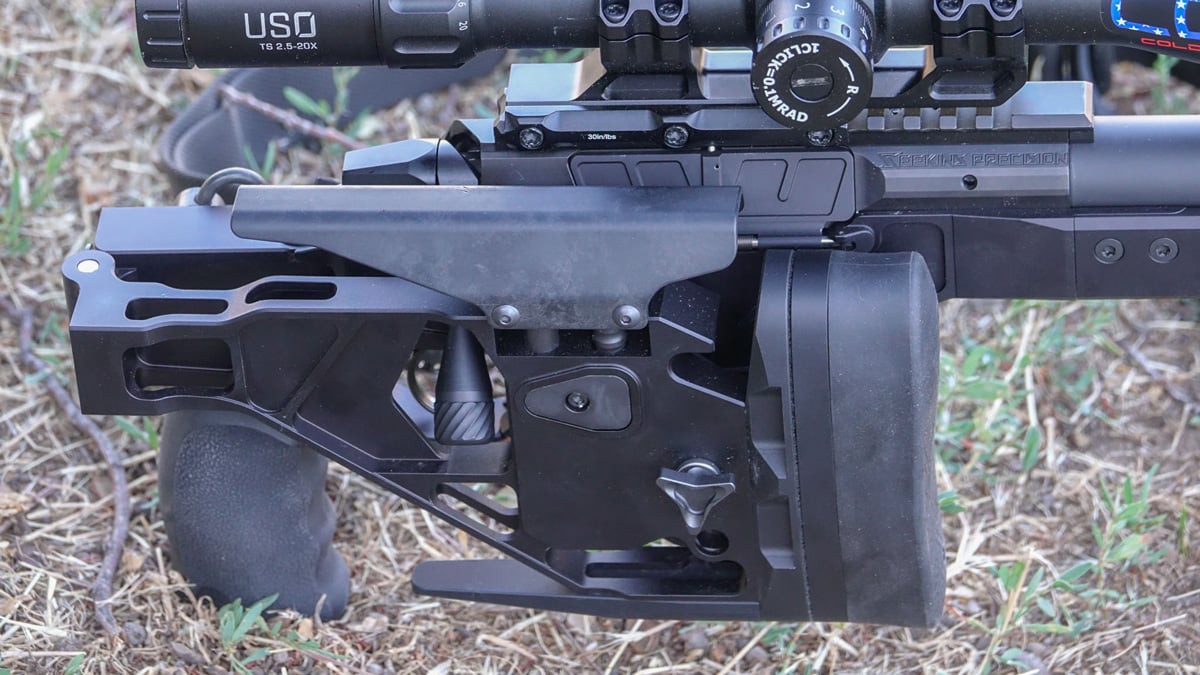

The chassis of the rifle has several welcome features. Adjustable length of pull and comb height are nice to have, but the addition of a folding stock is a huge bonus, particularly for transportation. A bag rider on the bottom of the buttstock is handy for positioning the rifle. M-LOK connecting points are everywhere up front, and there is even a place to mount a night vision bridge over the barrel, if you’re into that.
Caliber Change
After proofing the first caliber, I wanted to swap to the 6.5 Creedmoor. The process is pretty straightforward. There’s a screw clamp at the front of the action. Loosening this T15 screw allows you to thread the barrel out of the action, which is simply hand-tight. Once removed, I screwed the other barrel into the action, hand-tight again, before torquing the screw down to 25 inch-pounds.
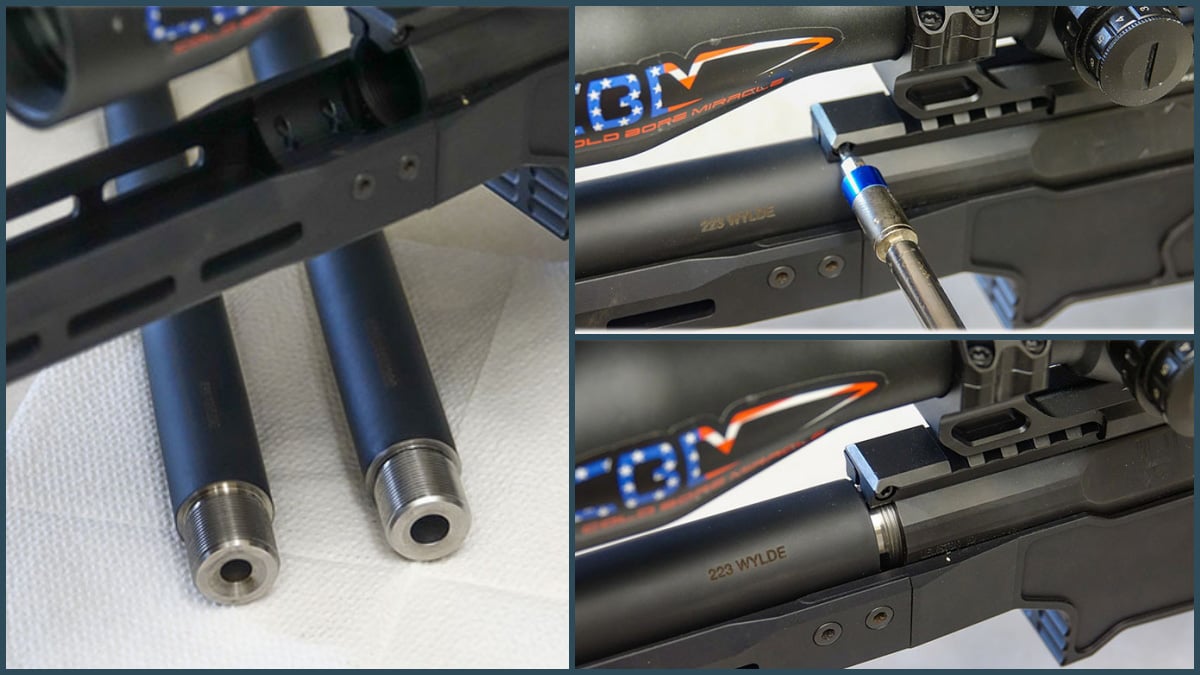
Of course, the bolt head needs to be changed as well when going between these two cartridges. Removing the bolt from the action is easily done, and the bolt itself is disassembled by rotating the bolt shroud and removing the firing pin assembly. With the pin out, you can push out the cross pin and swap the bolt head by pulling it out the front.


After putting the bolt back into place, all that was left was to swap magazines for the appropriate cartridge. With the rifle now chambered in 6.5 Creedmoor, I went back to my target and fired a few rounds. I corrected for the shift in impact and was right back at it. Obviously, the Creedmoor has a bit more recoil, but it was still very mild.
Pros & Cons
There are many things to like about this rifle, and only a few things you might dislike.
This rifle is built like a tank, and the weight is immediately noticeable. Both barrels are quite thick in the profile, but to Seekins’ credit, they open-source the barrel schematics so you can have a barrel of any profile made.

I hate when folding buttstocks are too rickety and loose. The Havak chassis is quite the opposite. It is so snug it almost takes a little more effort to fold than I would like, but that is certainly better than the alternative.
The overwhelming advantage of this rifle system comes from its modularity. If you want two rifles in different calibers, you will spend significantly more money than on one multi-caliber rifle like this. Especially when you consider two scopes, accessories, and so forth. Consolidating all that into a single rifle will save you money, and familiarity will make you a better shot.

I mentioned above something about a break-in. This action is smooth, but it seems to have gotten better with use. It has been perfectly reliable other than a couple of feeding issues from the .223 MDT magazines. I’m not sure if that was magazine-related or shooter-induced, so I’ll leave it at that.
The only other change I would make to the HIT is perhaps to slightly enlarge the magazine release paddles. It took a very deliberate effort to find and push them. A slightly bigger release would be nice.
Final Thoughts
Seekins is a great name in accurate and innovative rifles, and the Havak HIT is certainly a great example of these attributes. The rifle shoots very well – half MOA with match ammunition. Its robust action and chassis system give an excellent performance and reliability. And the ability to swap from one caliber to another gives the rifle an added value that’s hard to put into a dollar value.
That said, I think this rifle is such a great buy it’s almost silly to not consider it. My first custom rifle cost me only a few hundred dollars less than the current price for the Havak HIT, and that rifle didn’t have half the features. Technology has made accuracy not only more common but more adaptable and affordable, too.