First Looks
I recently wrote about why I chose a Colt Single Action Army to commemorate my 40th birthday. The single-action revolver remains a timeless symbol of the American West, but finding an old Colt, or snagging a brand-new one, tends to be a little pricey. Thankfully, companies like Uberti, Taylor’s & Co., and Cimarron make it easy to enjoy the classic feel of wood and case-hardened steel at a fraction of the cost.

This model is not a classic six-gun, but rather a 10-shot single-action 1873 clone in .22 LR. Uberti also offers models in all the popular revolver calibers plus several capacity options in your favorite rimfire ammo. The Italian company’s lineup includes the Cattleman series that is 1:1 ratio, and somewhat confusingly, a secondary designation of Stallion, which is 7/8 scale.

There is nothing quite like picking up a Single Action Army – the heft, the iconic look, and the stunning case-hardened steel. This Stallion features a small departure from the standard with a brass grip and smooth walnut panels. Mixed with the blues and gold of the finish, it looks classy. I immediately noticed how tightly built this gun feels, with little to no “end shake.”
The finish work and similar functionality to the real thing set it apart from budget options by other gunmakers.
Compared to a Colt SAA…
When I first opened the box and picked up the Cattleman, it seemed small. Colt has the New Frontier and the Frontier Scout, and while the names can be confusing, what isn’t as apparent is that these models are 7/8 the size of a Single Action Army. Similarly, the Uberti designation of “Stallion” denotes a 7/8 scale as well. They even cloned the perplexing naming conventions!

As best I can tell by reviewing the specs on Uberti’s site, the Cattleman versions are actual size. If you need a .22-caliber Single Action Army to scale, there really isn’t another choice. Still, the Cattleman Stallion demands comparison to the real thing. Fortunately, I have a Colt Single Action Army in .44 Special from 1978. The obvious size difference aside, the vibrant color case hardening on the Uberti looks legit when side by side with the original. Even in photos with great lighting, it can be hard to convey how superb these finishes are.
The departure from steel to brass on the grip also creates a slightly different look and feel. Coupled with wood, it gives a custom gunfighter vibe. I would say these are faithful reproductions that do justice to the historic look and finish of the original. One notable difference is that this model has three audible clicks, and not the four that supposedly spell out C-O-L-T. I believe that may be due to the size ratio.

To nitpick, the finish work and smoothness is better on the Colt, both on the frame and barrel. The cylinder on the Stallion shows more tooling marks and some import stamps, which is a product of unfortunate import laws. The good news is that they are not pronounced and don’t detract much from the overall aesthetic.
The loading gate swings open with ease at a half-cock, which I noted being much farther back that the notch is on the real deal. Sometimes this is just a function of the .22, so I believe it may be more faithful on the full-size six-guns. The cylinder rotates faithfully in the correct direction, making loading and unloading 10 rounds smoother and true to form. Original Colts have the firing pin on the hammer, while these copies feature a more modern design. If we’re not directly comparing, the Italian Stallion feels great on its own.
…And Ruger/Heritage
It’s worth noting that I quickly sold a Ruger Wrangler in the past due to how difficult the gate was to open and close. It was hell on my fingers and took away from the fun of plinking. The bi-directional rotation also didn’t feel as classic. Loading and unloading happens often when you are having fun shooting, so that was a real deal-breaker.

It was nice to see that the Uberti stays true to the original here, and with four additional bullets to go through, extends the fun a bit. The Wrangler and the Heritage line of budget guns cannot compete with the form and function of the Uberti, though you can get a similar vibe at about half the cost.

The Italian replicas do an excellent job of staying true to the design of old. The Cattleman revolvers share space with the Ruger Single-Six and Bearcat. While those are excellent options, they are their own designs and quite a departure from the 1873 and its replicas. Based on what I can find, shooters across the country tend to choose between the Rugers and these doppelgängers for competition to save some cash. The clones are more authentic, while the Rugers feature more modern designs and safety features.
Cattleman Specs
I was only able to find the specifications of the Cattleman series, but if you do some quick math, you can get to the final answer. I did want to note that Uberti makes a couple .22 versions of the Cattleman, and the specs match the Colt 1873 closely.

- Height: 5.5 inches
- Weight: 2.3 pounds (1.91 pounds on the Stallion)
- Length: 11 inches
- Barrel: 5.5 inches (same on the Stallion)
- Caliber: .22 LR
- Sights: Fixed blade front with “U” notch rear
- Capacity: 10, but versions in 12 and 6 are also available
Range Testing
Plinking became a favorite American pastime about the minute .22 LR was invented. There is nothing quite like putting holes in pop cans or ringing steel with the ol’ rimfire, and the steel and brass of the 1873 eats up the modest recoil with ease. I have always found this to be an absolute blast and agree that these are great options for first-time shooters. Having to slow down, load your cylinder, and prep the hammer for each shot lends to being careful and sure of where your finger is, your target, and beyond.

From a range perspective, it can allow you to assume the role of local sheriff dealing with a roaming gang circa 1880. Running the hammer as fast as you can, without fanning of course, makes you realize how fast these old firearms can run.

Contrary to that is the cumbersome reload. Thankfully, the 10-round capacity helps extend the fun, and as mentioned before, the loading gate is quite easy on your fingers. You’ll likely get good at this manual of arms, since it’s easy to keep putting rounds downrange.

Range time was just plain fun. I had a few light strikes, which could have been my Federal ammo or the gun. It happened enough to be annoying, but it gave me the chance to practice how fast I could cycle through to the unfired round. These single actions will help you appreciate living in the current era of firearms.
As you might be able to tell, this not being a practical defensive pistol, my goal was just to have fun and enjoy some target practice. The fixed front with “U” notch is more an intuitive sighting tool than precision aiming device.
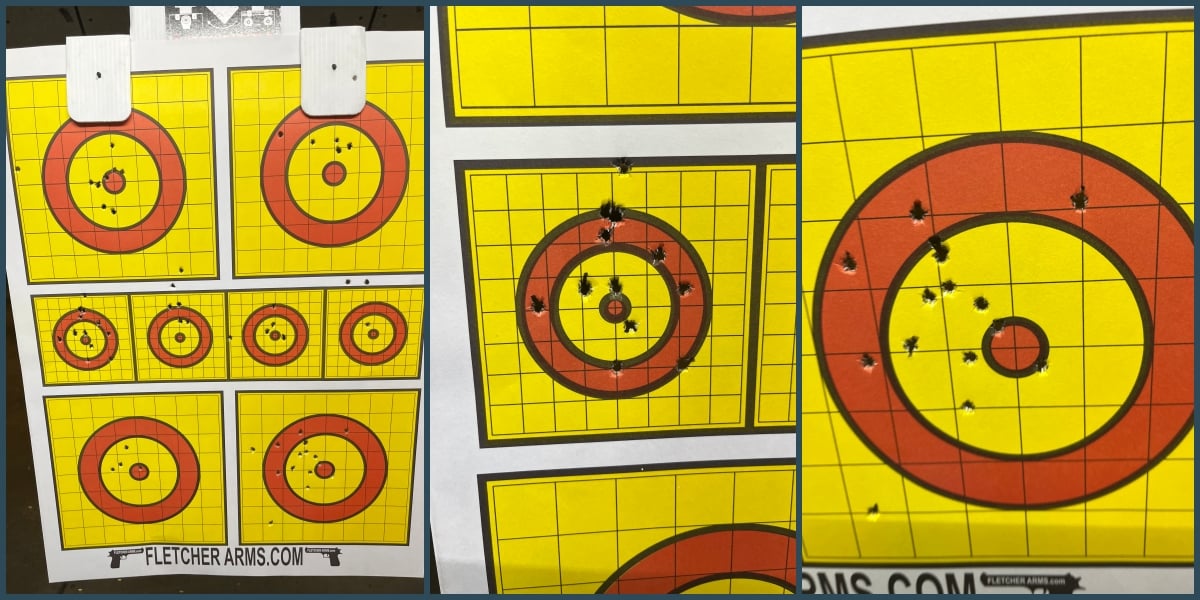
Rimfire is typically not super accurate – at least mass-produced box ammo – yet I was able to group decently at 10 yards. Precision is attainable. I hit inside the red bullseye on occasion and produced decent groups. There were a few fliers, as well as less tight groups, when I was trying to run through the cylinder quickly. I was just enjoying my time this trip rather than bearing down and aiming for precise groups.
Final Thoughts

The Uberti 1873 Cattleman Stallion is a great option if you’re trying to split the difference between something that looks and feels like a Colt but doesn’t cost a mortgage payment. If you want something you can shoot the heck out of and still have a to-scale version, you may want to try the Cattleman. If size is not a deal-breaker, then the slightly smaller Stallion gets you that same beautiful look and feel in a smaller size at a fraction of the cost.