First Impressions
My first thought when I opened the box and pulled out this scope was, “Wow, this thing is meaty.” There’s a noticeable weight to this optic that is often lacking in other budget-friendly spotting scopes. Yet, it’s not just the weight that stands out.

The green and black panels feature a rubberized texture that is both firm and easy to grip. This weatherproof and shock-resistant design feels just right in my hands.
All the dial controls have striations for enhanced texture, and the ocular and objective lenses are protected by quality covers that are captured to the scope body. That’s appreciated because I often lose those items, and this spotting scope feels like it was made for hard use.
However, what truly caught my eye – literally – was the generous eye relief, which made the optic far easier to use than my old spotting scope.

I also appreciated the extras that Vortex threw into the mix, such as a high-quality neoprene body cover for added shock and weather protection, those attached lens covers, and a large lens cloth.
What was missing was a tripod to mount the scope. This will need to be purchased separately, but Vortex offers a range of quality tripods.
Specs & Features

Vortex’s Crossfire HDs are really a family of optics that range in size from the small 12-36x50, medium-sized 16-48x65, and the large 20-60x80. These are further broken down into straight and angled options.

The angled Crossfire HD 20-60x80 offers a minimum magnification of 20x and a maximum magnification of 60x. While I focused mostly on the optic’s range applications, it’s designed to hit the wilderness with hunters.


Rubber armor gives the scope shock-resistant qualities as well as a non-slip grip. You can also install the included neoprene cover over the entire body of the optic for further protection.
The scope is nitrogen-gas purged and O-ring sealed to prevent fogging or water penetration. Meanwhile, the HD Optical System includes fully multi-coated lenses and anti-reflective coatings that improve light transmission and provide a sharp image.


Here’s a breakdown of the basic specs:
Objective Lens Diameter: 80mm (3.15 inches)
Magnification: 20-60x
Eye Relief: 0.71 inches
Linear Field of View (FOV): 105-53 feet at 1,000 yards
Angular Field of View (AFOV): 2°-1°
Closest Focus Distance: 26 feet
Weight: 3.31 pounds
Nitrogen Purged & O-Ring Sealed: Yes
It’s worth noting a few definitions for the above specs. The angular field of view (AFOV) tells us the maximum viewing angle, depending on the magnification, that the scope can cover. The linear field of view (FOV) tells us how wide that space is at 1,000 yards.
Of the Crossfire family, the 20-60x80 offers the narrowest field of view (105-53 feet) with the smallest viewing angle (2°-1°). The small 12-36x50 offers the widest field of view (173-89 feet) and the largest viewing angle (3.3°-1.7°). However, the 20-60x80 has the strongest magnification.
If that’s all gibberish to you, then let me just say the overall scope specs are great for your average and even experienced shooter at a sub-$500 price point. If you want better, expect to easily double or quadruple the cost for fairly small improvements.

As a hunting option, this spotting scope is a heavier item to add to your pack at 3.31 pounds. Compare that to the budget KonuSpot-60C which comes in at just 2.18 pounds. That weight is compounded by the 15.6-inch length and a wide front end that offers a fat diameter of 3.81 inches.

I see this larger optic as a great range spotting scope. I’m not sure I would want to carry it for any extremely long distances, but it can certainly get the job done. That said, at 80mm, the objective lens is large enough to have great light-gathering qualities in low-light conditions.

Lastly, Vortex offers a lifetime, transferable VIP warranty, which the company defines as a “very important promise” warranty. In short, the company states, “We will repair or replace your Vortex product in the event it becomes damaged or defective – at no charge to you.”
OK, that was a lot, but I think performance is where we can demonstrate this optic the best.
Range Performance
For full transparency, my normal range optic is a hand-sized Vortex Solo 10x25 monocular. It’s only really good for spotting shots, somewhat poorly, out to about 50 yards. That gets a bit harder with the smaller calibers like .22 LR, .223 Rem, and 5.56 NATO.
I’ve had a 20-60x60 KonuSpot-60C for several years now. It’s generally about $100 cheaper than the larger Vortex Crossfire HD 20-60x80. It worked fine for the money, but it was a bit finicky with the controls, had a small field of view, and limited eye relief.


Hence, I rarely felt the need to pack that Konus for the range. It just wasn’t worth the hassle. That’s not the case for the Vortex Crossfire HD.
For starters, gaining a clear, full picture through the ocular lens is a breeze. The eye relief is fairly generous, and all I have to do is put my eye close to the ocular lens to get my sight picture.
Unfortunately, I only had a universal phone camera adapter, which made it a bit of a chore to get clean shots at the range. Plus, these are only phone-quality images taken right after the first frost of the year in the Midwest, so the light and moisture played with the sharpness of the images.
Here are some comparison shots. Note, in particular, the differences in clarity between the Vortex and Konus scopes, regardless of the camera quality.


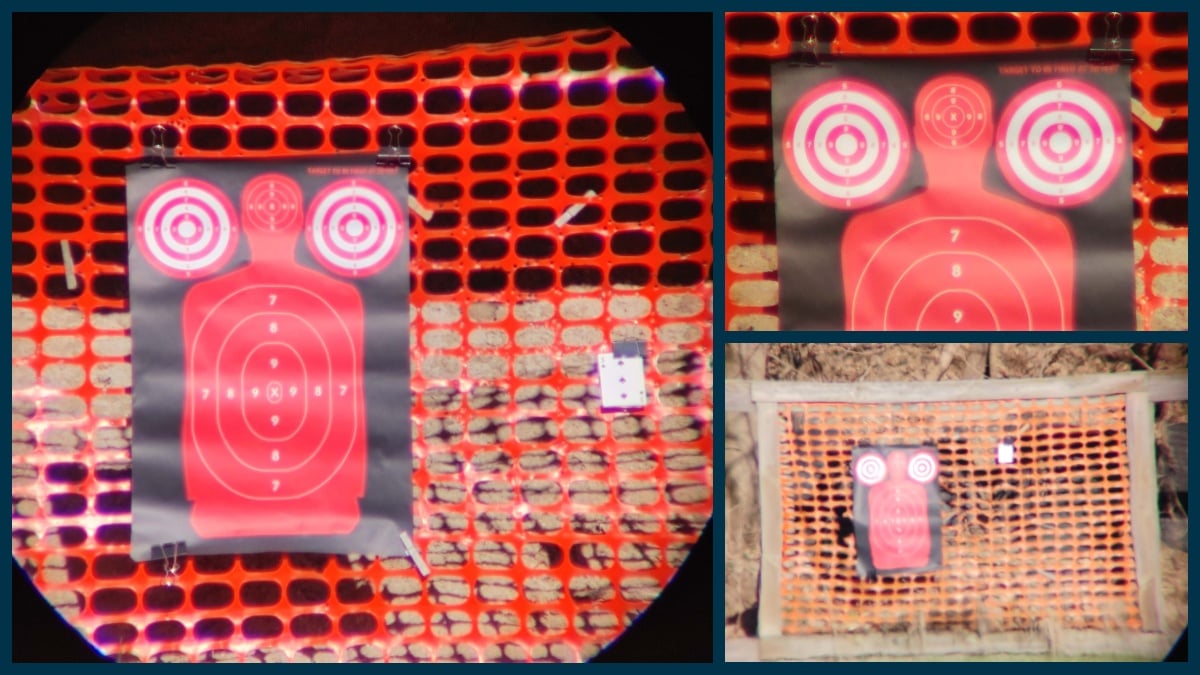
OK, so I was personally disappointed with the picture quality above, but it illustrates the dramatic difference between the budget-friendly Crossfire HD and other similarly priced options.
I did get one other chance to show just what the Vortex can do. This cellular tower is a quarter mile from my house. I took these shots during a dense fog advisory:
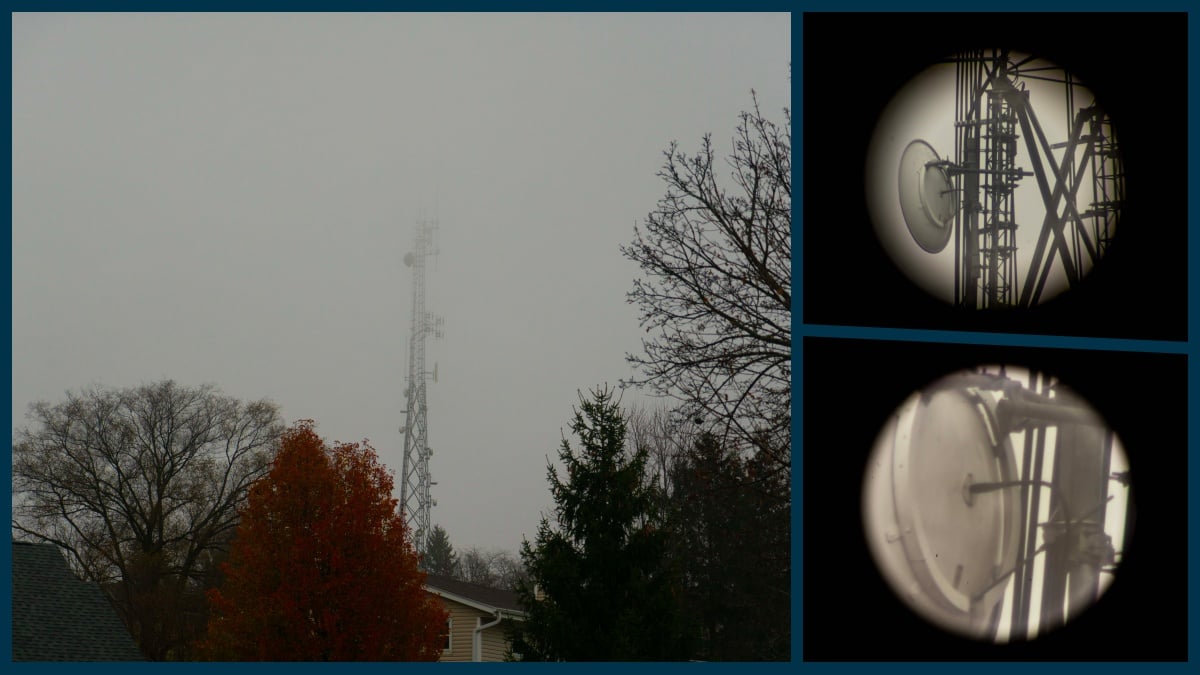
Dollar for dollar, I find it hard to beat the performance of the Crossfire HD. I do have some complaints. First, it’s very large and heavy, but there are smaller alternatives. Second, adjusting the magnification generally takes two hands because the ocular lens can spin freely. You have to hold it still and then adjust the magnification.


On the other hand, I like the large textured helical focus (the center adjustment ring) that focuses your image. The placement is just right, and it’s large enough for me to make precise corrections. The Konus, on the other hand, boasts a very small helical focus that is hard to tweak with precision.
In basically every way, I find that the Vortex Crossfire HD offers better quality than any budget alternative I’ve tested.
Pros & Cons

Pros:
- Powerful 20-60x magnification
- Robust construction
- Nitrogen-gas purged and O-ring sealed
- Effective lens coatings for sharp image/glare prevention
- Sharp image at long ranges
- Easy-to-use controls
- Great price point for the quality
- Large 80mm objective lens for capturing light
- Included neoprene scope cover
- Strong replacement warranty
Cons:
- Tripod sold separately
- Large size
- Relatively heavy
-
Controls often require two hands
Final Thoughts
Do you really need a spotting scope? Well, that depends on how much time you spend shooting out to longer ranges. I’ve had very poor success with even quality binoculars and monoculars beyond 50 yards.
Over the years, I’ve wasted untold amounts of range time – not to mention ammo – just walking back and forth to targets at 100, 200, and 300 yards or beyond. It’s more than a hassle. It can really kill the fun of a range trip.
For my money, the Vortex Crossfire HD 20-60x80 spotting scope is a value investment for both its cost and quality. It falls well within the budget-friendly side of spotting scopes, but it provides clarity, image stability, a wide field of view, and powerful 20-60x magnification at a very fair price.