Overview
One would be remiss to jump right in to the Tisas Raider without mentioning the M45A1. We'll give the 10,000-foot view just to make sure everyone is on the same page.
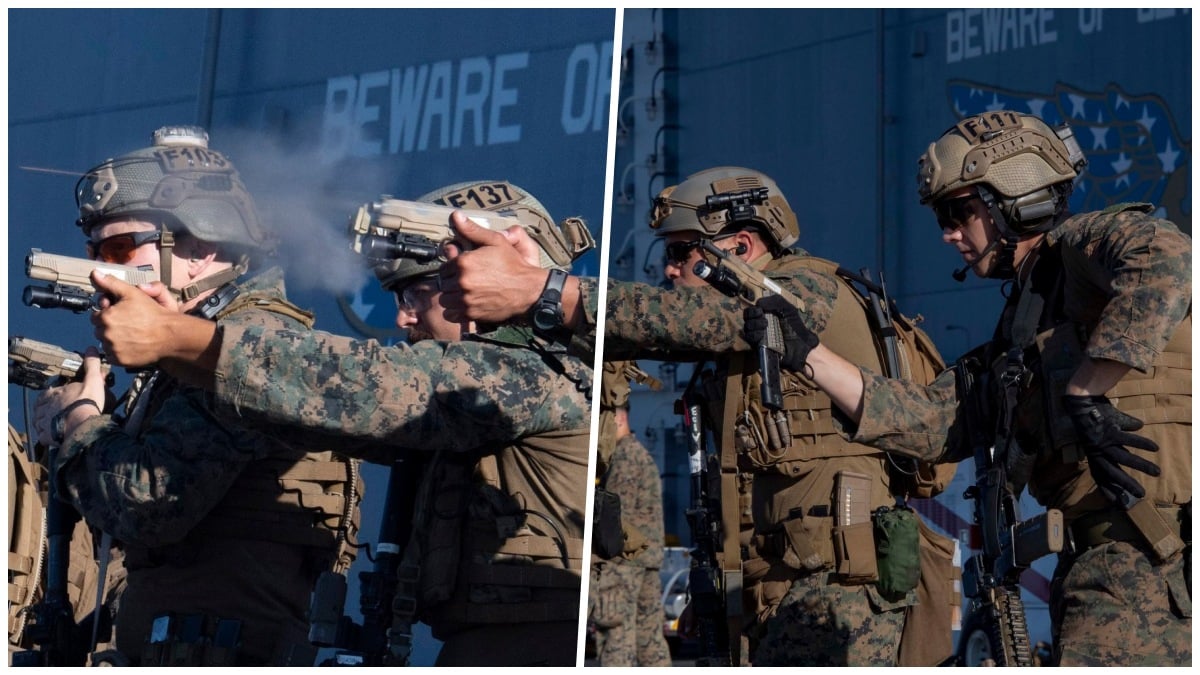
In a paragraph, Colt won the $22.5 million U.S. Marine Corps Special Operations Command (MARSOC) Close Quarters Battle Pistol contract in 2012 to deliver as many as 12,000 new 1911s to the service. These, designated the M45A1s by the service, would replace the in-house developed MEU(SOC) Pistol made by the Marine's RTE & PWS shops, and legacy M1911A1s still floating around from WWII. Based on the circa 2009 Colt Model O railgun – so named as it sported a MIL-STD-1913 accessory rail on the dust cover just forward of the trigger guard – the M45A1 carried Novak tritium night sights, a flat mainspring housing, Series 80 internals, a desert tan Cerakote finish over a stainless steel frame and slide, and synthetic grips.

Entering service in 2013, the gun deployed with Marines in the Fleet immediately – with some issues – and was only recently set to phase out due to the service switching to an all-M18 9mm option for handguns.
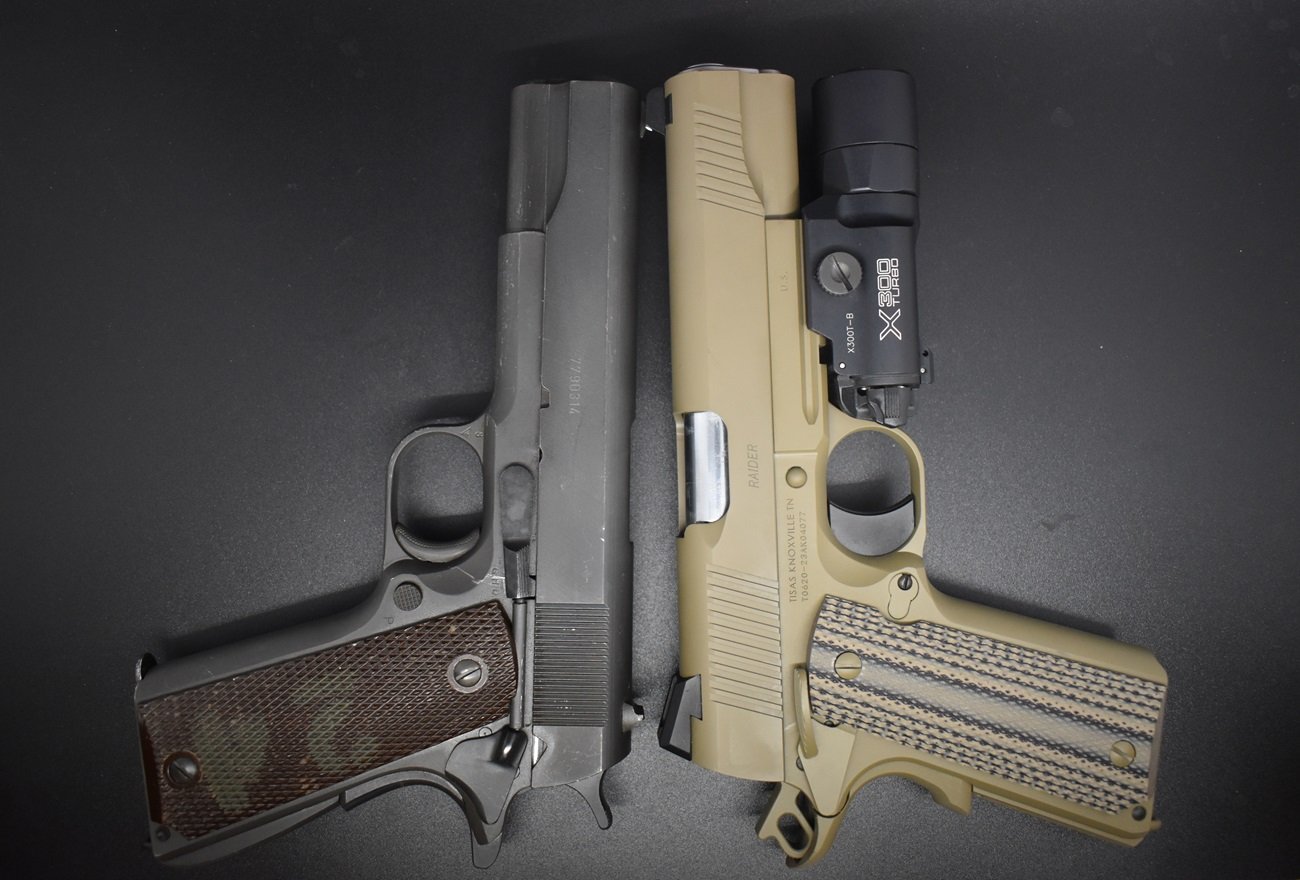
This brings us to the Tisas 1911 Raider B45RDG as imported from Turkey by SDS Imports of Knoxville, Tennessee, with the name being an obvious salute to the famed Marine special operations units that date back to World War II.

If you don't know Tisas, you should, as it has earned a great rep over the past several years for affordable but well-built 1911s. In a quick comparison against the Colt railgun, it is forged steel rather than stainless – with the former being arguably more durable – uses 70 Series internals and has simpler Novak three-dot sights.

For full disclosure, SDS supplied Guns.com with this pistol for T&E purposes. All testing was done on this one gun.
The Specs
- Caliber: .45ACP (9mm available)
- Capacity: 8+1 magazine, two Mec-Gar branded included
- Trigger Pull: 4.5 pounds, S/A (10-pull average, right out of the box)
- Weight: 41.5 ounces, unloaded
- Barrel Length: 5 inches
- Overall Length: 8.5 inches
- Height: 5.75 inches from top of rear sight to bottom of lanyard ring
-
Width: 1.5 inches across outside of ambi safety levers (widest component)
Features


Trigger
The aluminum trigger on the Raider is decent, especially with the gun's Series 70 internals, which a lot of 1911 purists prefer. It is a "long" trigger compared to other 1911s and has a straight-back half-inch pull that comes to an almost immediate wall and a 4.5-pound break right out of the box that reduced to just under 4 pounds by the end of the testing. The reset is short and audible.
Observe:
Reliability
With a forged steel frame and slide, the absence of MIM parts, and the Series 70 internals, the Raider is about as "old school" an M1911A1 as it comes, except for its accessory rail, FDE Cerakoted finish, G10 grips, and ambi surface controls.
We tested it with a variety of 230-grain .45 ACP ammo over the course of 500 assorted rounds on the gun right out of the box with no extra lube. The loads used on the range were primarily drawn from Federal American Eagle, South Korean-made PMC Bronze, Winchester white box, and Monarch-branded (made by PPU in Serbia) brass-cased FMJs. When it came to defensive loads, we ran 100 rounds of Federal's 230-grain Hydra-Shok jacketed hollow points. We cycled these through the factory magazine as well as some Chip McCormick, Ed Brown, and Wilson Combat mags that we had on hand.
Jams and issues to report: we had two stovepipes and a failure to load the last round on the factory mags using the PPU, as well as two instances of the slide not locking back on an empty mag. No malfs with any other mags or rounds and I recommend picking up some quality mags. About the worse thing we can report was that the grip screws loosened enough by the end of the testing that they audibly rattled. A screwdriver and some light thread locker should fix that and, while at it, the screws could probably be replaced with a set of T10s with O-rings.
It likes to run, and its ergonomics make it controllable.
Accuracy
One of the things that help keep 1911s so popular is that they tend to be inherently accurate between the long sight radius and a single-action trigger. The Raider did not disappoint and showed a proclivity to drill out the center of the point of impact from the 15.

Pros & Cons
Pros
- Forged steel slide and frame
- Stainless steel barrel
- Series 70 internals
- Decent trigger, albeit "long" rather than "short"
- A price point much lower than the M45A1
Cons
- Trigger could be a little better.
- Accessory rail could limit holster choices.
Conclusion
The Tisas Raider looks good, shoots good, and faithfully recreates the aesthetic railgun used by the Marines in recent years without just slaughtering your bank account. I'd personally like some better sights and a trigger job to remove the "bounce" in the trigger, or a swap out for a shorter aluminum trigger but then again that would start cutting into that aesthetic that it so clearly strives to meet. It is ready for the range or for home defense but beware that, if carrying, holster fits could be funny due to the rail.
The wonderful thing about the price is that you can use that saved cash to buy more ammo, a Kabar, and contribute the Toys for Tots program.