Comparison Overview
It would be beyond confusing to try and complete a comprehensive ballistic test for all the possible loads on so many calibers. But we can do a fairly apples-to-apples comparison of these guns and their chamberings for a high-level look at them as viable self-defense options.

While there are tons of specialized rounds on the market, I decided to stick with the most basic version of each of our caliber selections. I only used simple FMJ rounds instead of specialized self-defense ammo. That’s a test for another day. Besides, for any specialized round in one caliber, there will be a host of others for another caliber to compete with it.
The point here was to simply look at what the various calibers and handgun platforms can achieve relative to each other without adding any extra complexity to the process.

Testing was done using a 16-inch 10-percent ballistic gel block with four layers of denim in front of it. Each round was fired into a separate part of the same block. While hardly comprehensive, the idea was to simply see what these guns with the most basic FMJ ammo could do. Calibers included .22 LR, .22 WMR, .25 ACP, .32 ACP, and .380 ACP to cover the most common chamberings for mouse guns.

Here's a look at each gun starting with our smallest caliber contestant, .22 LR.
.22 LR: Beretta 21A Bobcat

The small tip-up Beretta 21A Bobcat chambered for .22 LR offers shooters a compact yet refined package for such a small gun. This double-action/single-action pistol is one of my personal favorites when it comes to mouse guns.
Related: Baby .22 Range Buddy – Beretta 21A Bobcat
That’s partly thanks to Beretta’s fine craftsmanship that shows in the gun. But a huge part of it is that the gun just plain shoots great for such a small platform. Here’s a look at one of my targets shot at 21 feet:

As for the ballistic performance, I elected to use Federal’s 29-grain Punch Rimfire .22 LR ammo. This is a round that is designed as more of a custom self-defense round, but it was also the only fully jacketed .22 LR ammo I had on hand for testing at the time.
Here’s a quick rundown on the ballistics for that round going from 0 to 25 yards:

And here’s what we got when we shot it into our 16-inch ballistic gel:

There are plenty of other micro semi-auto and revolver .22 LR handguns on the market. The Beretta .21A just happens to be one of the most popular and my personal go-to .22 LR mouse gun.
Here’s a quick rundown of the specs for our test Beretta 21A:
Weight: 0.69 pounds
Length: 4.93 inches
Barrel Length: 2.44 inches
Sight Radius: 3.45 inches
Height: 3.61 inches
Width: 1.14 inches
DA Trigger Pull: 10.5 pounds
SA Trigger Pull: 4.7 pounds
Capacity: 7+1 rounds .22 LR
The Beretta 21A was popular enough to inspire copycats in the mouse gun game, such as the tip-up Taurus PT-22. I pitted both against each other in a head-to-head comparison, which did have the Beretta 21A coming out on top but at a higher price point.
That testing brings me to some of the downsides of .22 LR. The round is the smallest on this list, but it’s also one of only two rimfires. Between the cartridge’s rimfire design and relative power, I’ve found it to be the least reliable chambering on the list.
The fixed-barrel blowback design of the Beretta 21A has also resulted in a handful of stove-pipe malfunctions over several years of testing. These issues have been rare, but they’re worth pointing out for any self-defense handgun.
.22 WMR: NAA Mini Mag

It doesn’t get much smaller than North American Arms’ extremely tiny Mini Mag revolvers. These little five-shot single-action-only guns are the definition of a gun that’s meant to serve as a last line of defense.
This gun is exceptionally concealable but hosts only a crude front sight and must be manually cocked for each shot. I selected NAA’s revolver for this test because, well, your options for mouse guns chambered in .22 WMR are very limited.
The more powerful round with its longer case makes it hard to downsize semi-autos into true mouse guns for the caliber. This puts NAA’s mini revolvers at the top of the concealed carry list for mouse guns chambered in .22 WMR.
Related: NAA Mini .22 Mag Revolver Review – CCW Winner or Waste of Time?
Even though the sights are very limited, I found I could wield the little .22 WMR Mini Mag quite well at reasonable self-defense distances. Here’s a look at one of my targets shot at 20 feet:

The shooting process is certainly slower and more complicated thanks to the single-action-only design and the gun’s incredibly small size. However, the .22 WMR might surprise you when it comes to its ballistic potential. Here’s a look at what a 40-grain CCI Maxi-Mag FMJ .22 WMR has to offer from 0 to 25 yards:

That boost in power over the .22 LR propelled our test bullet even deeper into the ballistic gel:

Offering just five shots at a slow rate of fire, these revolvers are also difficult to reload with any sort of speed. The process requires removing the entire cylinder after plucking out the cylinder pin.
Still, it’s hard to argue with the size, as this represents the smallest of all our mouse guns when it comes to weight and concealability. Here’s a quick rundown of the specs for our test NAA Mini Mag:
Weight: 0.39 pounds
Length: 4.6 inches
Barrel Length: 1.19 inches
Height: 2.78 inches
Width: 0.85 inches
Trigger Pull: 4.83 pounds
Capacity: 5 rounds .22 WMR
As a single-action-only revolver, I’ve never had any issues with the gun itself malfunctioning. It’s still a rimfire firearm, which may raise questions about ammo reliability. However, I’ve also found malfunctions with .22 WMR ammo itself to be few and far between.
.25 ACP: Colt Automatic

This little .25 ACP Colt Automatic is essentially the same gun as the famed Colt 1908 “Vest Pocket” based on John Moses Browning’s FN Model 1905/1906 design. The only real exterior difference from the classic “Vest Pocket” is the addition of a raised rear notch sight.
Along with the Baby Browning, which was itself effectively an FN Model 1905/1906, these little pistols represent what was perhaps the golden age of mouse guns chambered for .25 ACP.
Related: Browning’s Extra-Small .25 ACP – Classic Mouse Gun Caliber History
While the centerfire .25 ACP round has largely fell by the wayside, it’s still manufactured today with plenty of little pocket guns floating around to shoot it. This particular gun came from the Guns.com Certified Used Vault.
Although its’s slightly larger than both the .22 LR and .22 WMR, the .25 ACP offers the lowest velocities of any round on our list. This is further reflected in a 50-percent reduction in foot-pounds of energy when we compare it to its slightly larger .32 ACP cousin.

Not surprisingly, the overall lack of power behind the .25 ACP translated into its performance on our ballistic gel:

There are lots of pocket guns based on Browning’s design on the used market today. Here’s a quick rundown of the specs for our test Colt Automatic:
Weight: 0.72 pounds
Length: 4.48 inches
Barrel Length: 2.08 inches
Sight Radius: 3.7 inches
Height: 3.18 inches
Width: 1.04 inches
Trigger Pull: 4.4 pounds
Capacity: 6+1 rounds .25 ACP
There’s a reason newly manufactured .25 ACP pistols are rare. Between the improvements in performance and reliability of .22 LR and .22 WMR and the general popularity of those rounds, the .25 ACP has failed to keep pace.
.32 ACP: KelTec P32
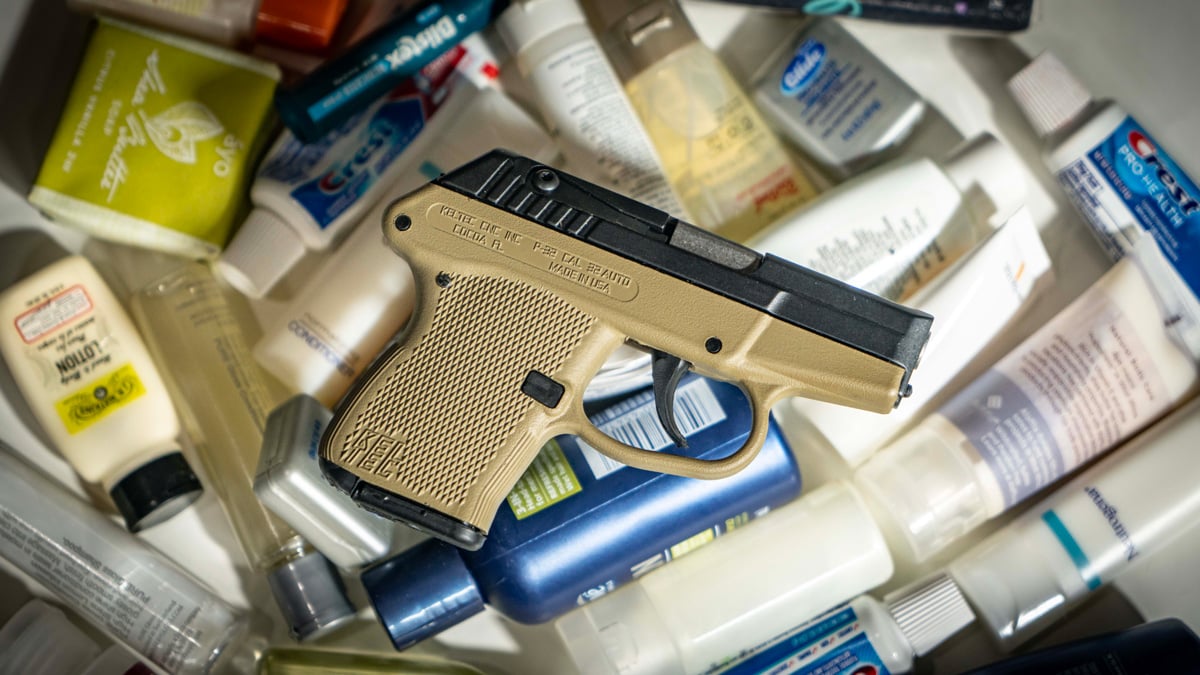
John Moses Browning’s first cartridge, .32 ACP, was once a dominate caliber for military, law enforcement, and civilian pistols. It has largely waned in popularity since the rise of micro .380 ACP pistols, but guns like this brand-new KelTec P32 still make for exceptionally light and concealable options.
Related: Browning’s .32 ACP – The Tiny Bullet That Changed Handgun History
With a featherlight weight of just 0.44 pounds, the P32 remains very controllable. As far as mouse guns go, I’ve even found it to be quite pleasant to shoot. The slightly larger .32 ACP only has an increase of around 140 fps over the .25 ACP, but it makes up for that with the foot-pounds of energy it delivers on target:

In fact, that increase in terminal performance resulted in our 71-grain Federal FMJ .32 ACP passing cleanly through 16 inches of ballistic gel.

These guns are still in production and have a cult-like following among shooters who love extra-small guns. Here’s a quick rundown of the specs for our test P32:
Weight: 0.44 pounds
Length: 5.1 inches
Barrel Length: 2.51 inches
Sight Radius: 3.95 inches
Height: 3.56 inches
Width: 0.75 inches
Trigger Pull: 5.01 pounds
Capacity: 7+1 rounds .32 ACP
It’s no longer a very popular caliber, but .32 ACP and several guns chambered for the round are still manufactured today. The P32 is one of the most popular, and it rolls in at a weight that rivals the diminutive North American Arms revolvers.
.380 ACP: KelTec P3AT

The KelTec P3AT started a trend of .380 ACP mouse guns that has continued to this day in the form of pistols like the incredibly popular Ruger LCP, LCP II, and LCP Max. It boasts a design that is basically an upscaled version of the KelTec P32, but it somehow manages to only increase the weight by fractions of an ounce.
Related: KelTec P3AT Review – Trendsetting Fun-Sized .380 Mouse Gun
The P3AT has a long trigger pull and very crude sights. Yet, I found you can still get effective shots on your target within reasonable self-defense ranges. Here’s a look at one of my targets shot at 20 feet.

It is a snappier pistol to shoot, and I would certainly not call it a pleasant range plinker. However, at 6+1 rounds of .380 ACP with options for extended 10-round magazines, the P3AT is a powerful companion for such a small platform. Here’s a look at the ballistics for some Federal 92-grain FMJ ammo I used for testing:

Not surprisingly, our FMJ .380 ACP bullet passed cleanly through our 16-inch ballistic gel block:

Ruger more or less copied the P3AT for its LCP pistols, but it did not match the original P3AT’s lightweight and size. Here’s a quick rundown of the specs for our test P3AT:
Weight: 0.49 pounds
Length: 5.15 inches
Barrel Length: 2.75 inches
Sight Radius: 4.07 inches
Height: 3.56 inches
Width: 0.82 inches
Trigger Pull: 6.56 pounds
Capacity: 6+1 rounds .380 ACP
Unfortunately, the P3AT is no longer in production, but plenty of similar .380 ACP pistols are rolling off assembly lines as we speak. The .380 ACP chambering has largely come to dominate the mouse gun category as far as new pistol designs go for the calibers on this list.
Ballistic Test Summary
If we’re staying true to the FBI’s ballistic test protocol and measurement standards, there are some definite shortcomings for some of these calibers when fired from our test mouse guns.
First, the FBI standard holds that a passing score requires a total penetration of between 12 and 18 inches. Both our 29-grain .22 LR and 50-grain .25 ACP fell just short of 12 inches of penetration.

Second, the .22 LR and .25 ACP both had very minimal wound channels. The .22 WMR zipped to 12.5 inches of penetration and even ended with the bullet reversing itself and facing backwards. It’s hard to see, but the .22 WMR also had larger wound channeling than either the .22 LR or the .25 ACP.

Both the .32 ACP and .380 ACP FMJ bullets passed completely through our 16 inches of ballistic gel. They also had the largest wound channels. Unfortunately, my second gel block did not survive winter storage, so I was unable to capture those two bullets. Regardless, they certainly met – possibly exceeded – the 12 to 18 inches of penetration required by the FBI.
Related: .380 ACP vs 9mm for Self-Defense Ammo – What’s the Real Difference?
To my mind, this might imply there would be a benefit to using something like a jacked hollow-point bullet for your .380 ACP and, perhaps, even the .32 ACP. Since all our tested rounds used fully jacketed bullets, I would question the merits of a hollow-point bullet for self-defense on either the .22 LR or .25 ACP.
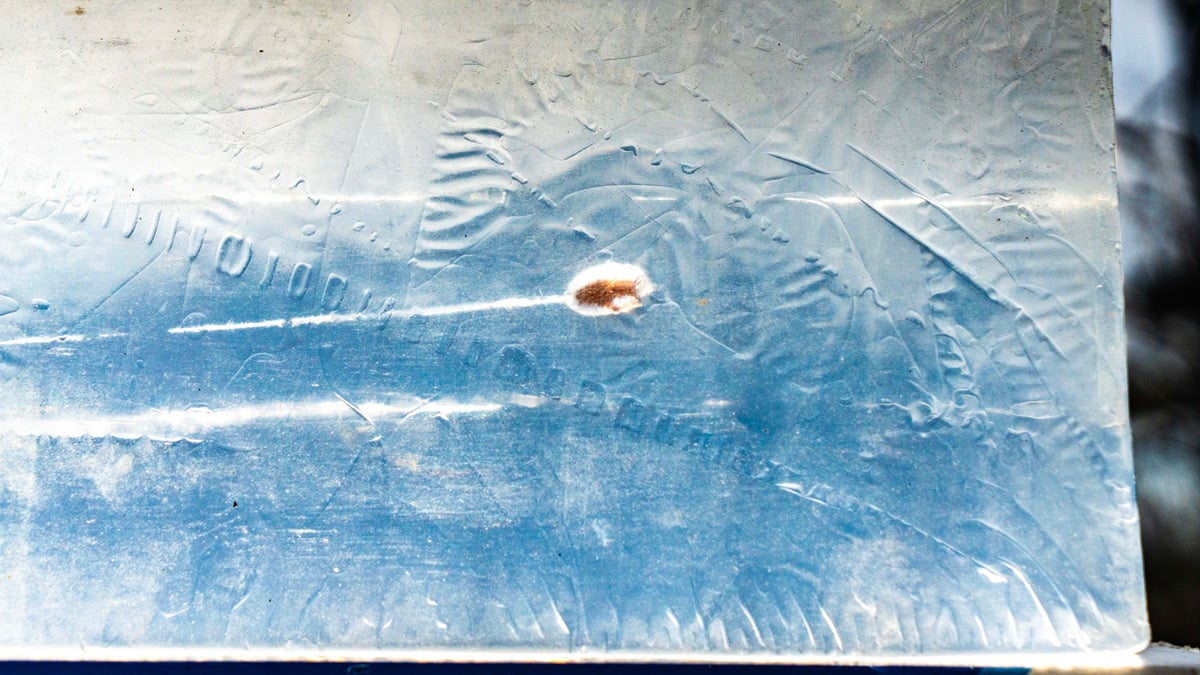
As far as penetration, the .32 ACP KelTec P32 and KelTec P3AT were the obvious winners and should offer options that meet the FBI’s standards. The .22 WMR is a dark horse when it comes to the FBI standards, and it seems like your round selection would be key.
Both the .22 LR and .25 ACP fall on the feeble side of our list and did not pass the FBI standards for penetration in this test. That doesn’t mean the rounds cannot pass the test, but they clearly fall on the anemic side for foot-pounds of energy and subsequent penetration.
Pros & Cons

Here’s my short list of pros and cons for mouse guns in general:
Pros:
- Small size
- Fun to collect and shoot
- Highly concealable
- Can have effective penetration depending on caliber
- Lightweight
- Easy to carry
- Plenty of holster options
Cons:
- More difficult to shoot accurately.
- Fewer options these days for .25 ACP and .32 ACP
- Penetration can be an issue
- Limited capacities
- Crude sights
-
Some have snappy recoil
Final Thoughts

I thoroughly love collecting and shooting mouse guns. However, they are unquestionably limited by their micro-size requirements when it comes to shootability and power. With that said, I will echo the saying of a long-time firearms instructor and friend who said, “I don’t want to get shot by any bullet.”
It’s not complicated. Mouse guns are not tactical, but they can be very practical. They have self-defense potential. It just comes with limits to their terminal performance on a target depending on the caliber you select.