About Gunsite
I was both humbled and revitalized by a recent visit to Gunsite Academy, one of the world’s foremost facilities for firearms training. Founded in 1976 by the now-legendary Colonel Jeff Cooper, Arizona-based Gunsite covers over 3,000 acres, 20-plus ranges, and some of the most advanced and realistic simulators, not to mention the top instructors in every field.

I was there not for defense, but rather a unique course created for Mossberg’s all-women SIREN’s group, the training curriculum blending Gunsite’s Hunter Prep and Safari Prep. The lessons I learned after long days behind a Mossberg Patriot in the Arizona sun may be of some benefit to all hunters.
Some of the most accomplished hunters and shooters I’ve ever met have also been the most humble. Though they seem to have mastered every skill, they are always putting in the work, while keeping an open mind to learning better methods and improved skills.
Related: Experiencing Gunsite Academy – My Trip to SecureIt FIRE 2023
I myself have fallen into this trap, but if you find yourself thinking what you do is “good enough” or “has worked well enough all these years,” take a step back and consider there are always ways to advance. Gunsite staffs over 100 of the finest instructors in the world, yet every single one I met was constantly training to be better.
Practice Field Positions
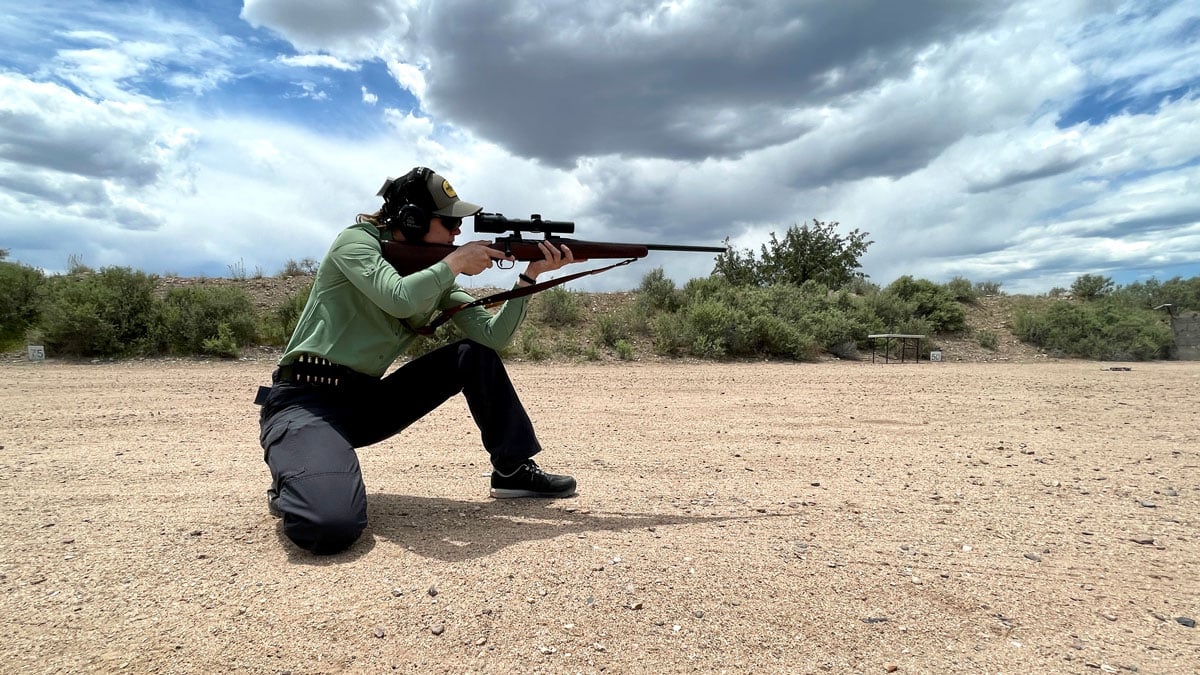
Our team of six women with varying backgrounds and skill levels was firing Mossberg Patriot bolt actions in all different model variants and chamberings. In an intensive three-day course that saw 300 rounds fired, only a handful were done from the bench, and even then, only for the sake of verifying zero. The emphasis on practicing field readiness was abundantly clear.
Before any hunt, I practice shooting from the positions I’m likely to use on that particular adventure, be that off shooting sticks, prone on a bipod, or sitting in a tree stand. Yet seldom have I truly worked on proper stance and mechanics or taken the time to train for offhand work or snap shots.
We learned braced kneeling using a specialized sling, and even managed to shoot surprisingly well from a standing bipod. The final day not only meant putting together skills we’d learned during the course, but also having the opportunity to shoot automated targets.
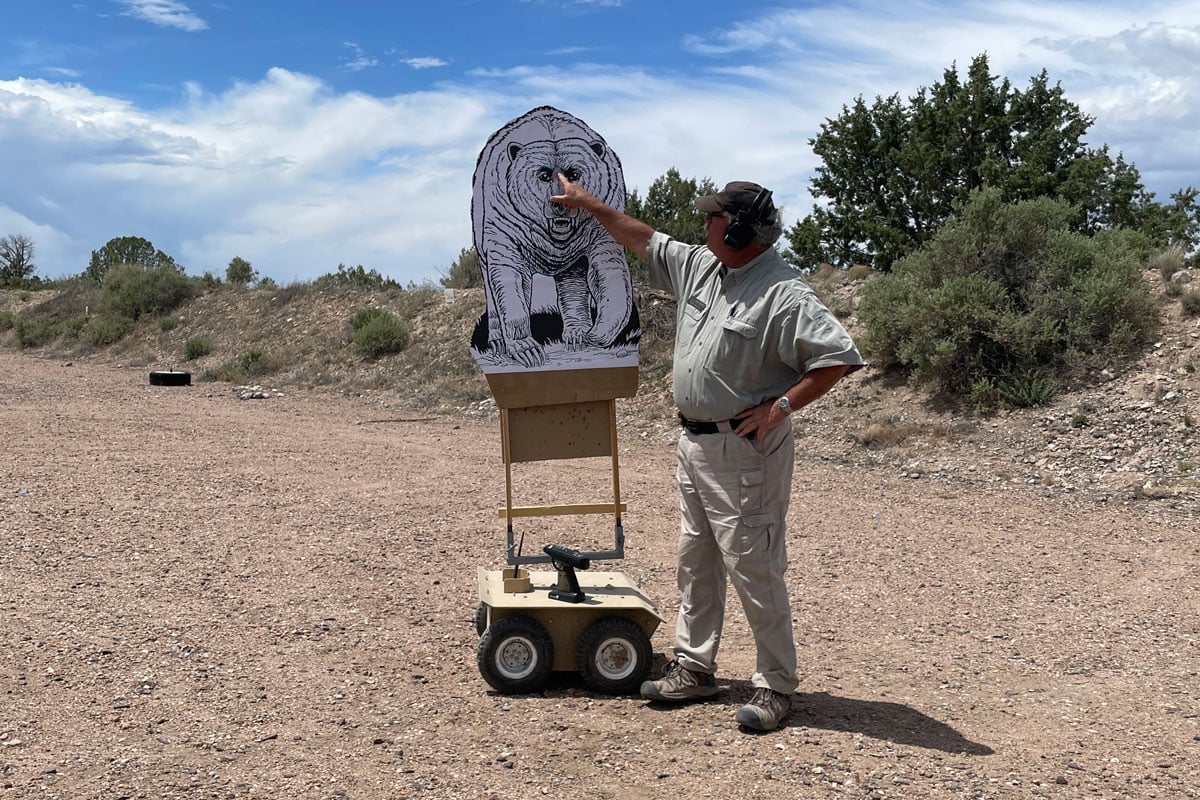
Shooting and reloading with rapidly crossing Kudu, a charging grizzly, and a surprise leaping lioness add to the practicality of the training. Though few of us have such automated opportunities for regular practice, we can focus on our actual hunting plans and work toward being faster, more accurate, and prepared when the opportunity presents itself.
Know Your Limits
The key with any of these field positions, whether from a solid rest or the most awkward offhand, is knowing your effective, ethical range. Not that of the gun, your buddy, or some TV hunter – you and you alone. And then stick to it.
The nice thing about training, especially at a place like Gunsite, is that you will extend your effective range by doing things the right way. For instance, on a past safari and based on the game pursued, I limited myself to 50 yards offhand, 125 on sticks, and 250 when prone with a sound rest. Those numbers will be different for every hunter and situation.

After only a few days at Gunsite, I can confidently say I have the tools to extend my ranges significantly, as well as adding a fast-acquisition braced kneeling option – with continued work, of course. This reaches into a topic I’ll explore in another piece, but it’s worth noting that Gunsite does not offer a long-range hunting course, and for good reason.
While advancements in equipment make wildly long shots more possible than ever, a game animal is not a paper target, and many variables remain out of our control as ethical hunters. The point of this rant is not to berate distance shots while hunting, but rather, to circle back to the original topic. Know the range at which you yourself can, with 100-percent certainty, place a shot into the center of the vital area of the game pursed.
Back to Trigger Basics
How hard could it really be to pull a trigger well? Some of my biggest areas of improvement came in the most basic areas. These were skills I figured I had mastered long ago. But having the best instructors in the business (this time Il Ling New and Mario Marchman) studying your every move reveals weaknesses that can be amended.

I always thought I had a nice, even trigger press, but they quickly noticed that I often started off smoothly but tended to apply too much rapid pressure just before the break. Focusing on tuning this one, seemingly minor, skill paid major dividends on target.
Others were coached on trigger control, by holding that trigger rearward for a second after the break. It’s all part of following through on the shot. They advised having a friend observe your trigger pull during safe dry-fire practice. What you learn might just be a surprise.
Focus Hard & Aim Small
Likewise, I realized how little I truly focused on the reticle, not the target, in hunting situations. The nature of the hunt tells us to visually lock onto that prey; however, Gunsite preached the importance of crosshair focus.

Of course, we’re always very aware of both the quarry and the safety of what is beyond, but before that bullet leaves the barrel, I’ve learned to focus intently on that reticle’s center against a very small section of the target. That is to say: don’t aim for a pie plate behind the deer’s shoulder, but rather, a singular hair tuft, crease, or coloration.
Related: Aim Small, Miss Small – How to Train for Better Shot Placement
The human eye and brain are indeed a supercomputer (an analogy used in class) and are well aware of the nuances of the larger target itself while the eye locks onto the aiming point. By shooting several revolutions of a drill whereby all us shooters focused on this single task, groups tightened up considerably.
Invest in Yourself
These are but a few of many lessons learned, new skills to practice, and building blocks for improving my own level of proficiency. Many of you likely already know and use this, but I am indeed a better shooter for the training.

For years, I put off attending Gunsite because of it being too far away, too costly, or not seeing a need. Don’t make the same mistake.
At the very least, read quality training books, watch videos of good teachers, and give yourself patient range time. But if you can make it happen, go to this mecca of shooting and hunting instruction. Keep an open mind. Ask questions. Step outside your comfort zone. Cultivate a new mindset. You’ll find a warm welcome from like-minded people, and I’m sure, no matter how good you already are, you’ll come away happy you went.