What is Comfortable?
Often, beginners think a comfortable grip is what they want, but this could be a mistake depending on what “comfortable” means to the individual.

“Comfortable” might mean a smooth-feeling grip; however, the lack of grip texture might mean the gun will slip around in the hand when firing. “Comfortable” might also mean that the grip fills the hand, but if the grip is too large it will be difficult for the shooter to exert enough grip pressure to securely hold the pistol.
I would recommend a prospective buyer learn to shoot first before making a purchase. I’m not talking YouTube videos. I’m referring to real, hands-on instruction on how to grip a gun. In addition, I recommend trying multiple pistols to get exposure to the firing characteristics of different guns. I can’t tell you how often I’ve loved a pistol grip in the gun shop, only to find it didn’t work for me on the range. The opposite has also happened where I hated the grip initially, but after shooting, I loved it.

I can give you some general guidelines, though. Unfortunately, everyone’s shooting style and hand shape is different, so I can’t give you any hard and fast rules. Just keep these recommendations in mind when checking on ergonomics. I have listed four primary considerations and two other secondary, less important ones.
Primary:
- Surface Area
- Trigger Reach
- Texture
- Hot Spots
Secondary:
- Control Reach
-
Angle
Surface Area
The more surface area on a grip, the more the controllable the gun – up to a threshold. Surface area distributes the recoil energy and gives more points of contact to the hands for control. All things being equal, larger grips are easier to control.

But remember to keep things in context. Low-powered rounds don’t need a lot of surface area for control, because they don’t kick much. Grip size is not a big consideration with a .22 LR pistol, but you better have a big grip for a .44 Magnum.
There is a point of diminishing returns, though. Once the grip gets too big, the hand no longer has the strength to grip the firearm. Much more force can be put into squeezing a tennis ball as opposed to a basketball. So, in general, the stronger your grip strength, the larger a grip you can handle. In the converse, if you have a weaker grip, look for a slimmer pistol.
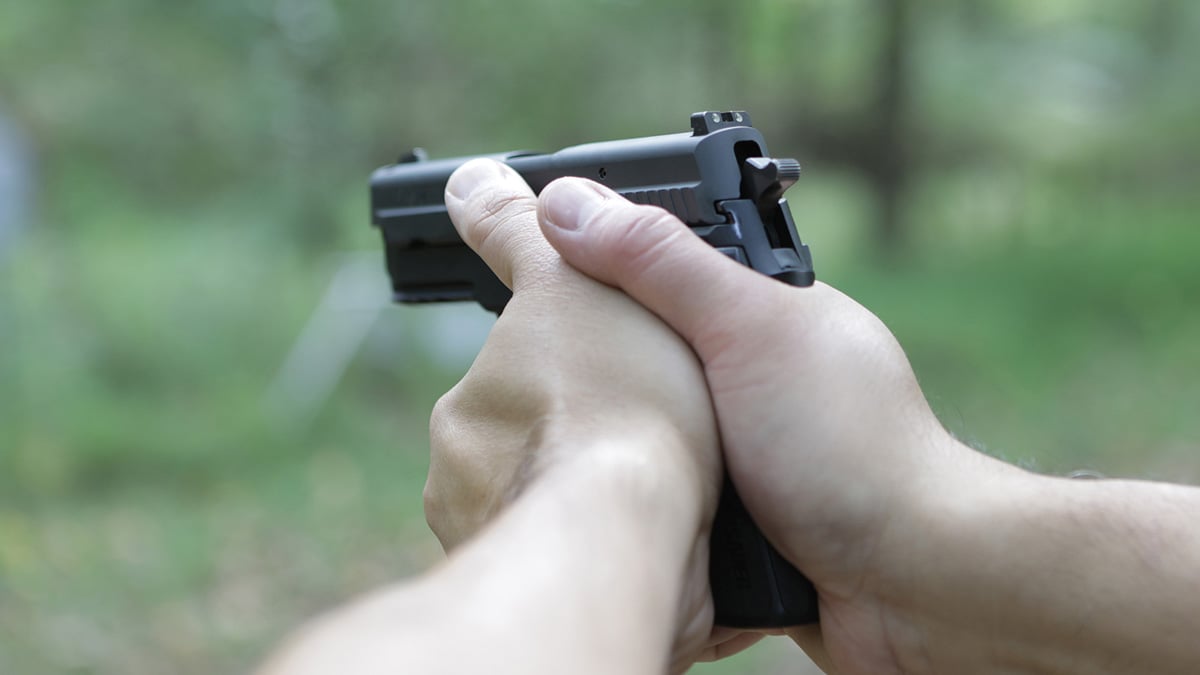
Additionally, don’t just focus on your primary shooting hand. If you plan to shoot with both hands, make sure the grip has space for your secondary hand to contact the grip and add support. Otherwise, your off hand is just gripping your dominant hand.
Trigger Reach
Trigger reach is probably one of the most important ergonomics concepts. This is because it’s very difficult to change on a handgun, and it is also challenging to correct with training. Your trigger reach is defined mostly by your anatomy. It is also related to the trigger weight. The more difficult it is to pull the trigger, the more optimal your trigger reach needs to be so you can use all your force to pull the trigger.

Ideally, your trigger finger should be at around 90 degrees at the second knuckle. In addition, there should be some space between the frame and your trigger finger. This will give you the most power and best feel on your trigger. The closer a particular gun’s trigger reach is to your ideal length, the more trigger control you will have with that firearm.
Of course, it is up to you how important trigger control is to your use case. It is probably very important for a competition bullseye pistol. For a short-range plinking gun, it might be a low priority.
Texture
You want as aggressive a texture as possible without irritation. This is because a secure grip is essential for recoil control and making repeated accurate hits on target at speed. Grip slippage is a major reason why novice shooters cannot get fast and accurate hits.

I often see beginners take a shot, then have to adjust their grip to take another shot. This is because their grip slipped during recoil. It might be because they were not gripping tight enough, but the better the grip texture, the less energy needed to grip the gun.

The caveat is that you also need to keep in mind the carry method of the firearm. If it is meant to be a pocket pistol, a sticky rubber grip will catch on cloth and make it difficult to draw. If the gun is going to be carried against the skin, you don’t want the texture to abrade your skin and cause you not to want to carry the pistol.
Hot Spots
Pay a lot of attention to any sharp protrusions or uncomfortable angles. They will all be amplified when the gun is fired. Keep in mind the energy of the caliber and where that power will be distributed into your hand. The heavier the recoil, the more important it is to consider.

Short grips are notorious for producing hot spots. Short grips aid in concealability, at the expense of controllability. One of the reasons is because all the recoil gets dumped into the heel of the gun in the palm of your hand.
Related: Why It’s Worth It to Spend More on a Quality Handgun
Control Reach
I’ve seen many people preach that a properly fitting grip will allow the manipulation of magazine release and slide stop without rotating the grip. I’ve said this in the past as well. However, upon reflection, I’ve experienced many great grips that deliver on shooting mechanics but still require a little bit of grip adjustment to actuate the controls.

I would say that it is a bonus if you can hit the slide release and mag button without twisting your grip, but it should not be a deal breaker. Many top shooters rotate their pistols. It seems like most guns in the hands of the majority of the population require re-gripping to activate controls. It’s really just a part of shooting.
Angle
Grip angle is a hotly debated topic, and it’s been that way for decades. Right now, the two major camps are the Glock grip angle versus the 1911 grip angle. I hate to burst the bubble, but they both work. It’s about what you are used to shooting. With proper training, anyone can adapt to either grip.

The more precise question is whether you want to spend the time and energy learning a different grip angle. I choose not to carry certain pistol lines because I would have to adapt my habits. It’s also why I don’t use Samsung phones. Those are great phones; I just don’t want to learn the new interface.
To identify if a pistol grip angle is what you are used to, look at a target, close your eyes, and present the gun. Do this a few times. If the sights are on target when you open your eyes, then that gun works with your practiced presentation muscle memory. If not, you will have to do some work.