Direct Thread
The first way to mount a suppressor is the simplest. Direct-threading it to a barrel is the oldest, most tried-and-true mounting system.
Direct thread has its advantages and disadvantages. The major advantage is that it is easy. There are no extra parts to cost money or add weight. Additionally, direct thread can have a better seal and be quieter than some systems, also preventing carbon lock (an issue we will discuss shortly).

On the flip side, one of the downsides to direct thread is that the thread pitch can be permanent. This can limit what platforms the suppressor can be mounted to without an adapter.
Direct-thread suppressors can also walk off and loosen through shooting. This can be fixed with the addition of Rocksett or Loctite, but that makes them more of a permanent fixture.
Tri-Lug
One of the easiest ways to attach a pistol-caliber suppressor is called tri-lug. This design features three lugs on the barrel. The suppressor is pressed onto the end with a spring-loaded locking mount and given a quick quarter turn. Then, the spring tension helps lock the suppressor into place.

The tri-lug design was invented by H&K and is most common on the MP5 platform. The downside to the tri-lug is that it can be louder than other locking systems because it does not seal as tightly.
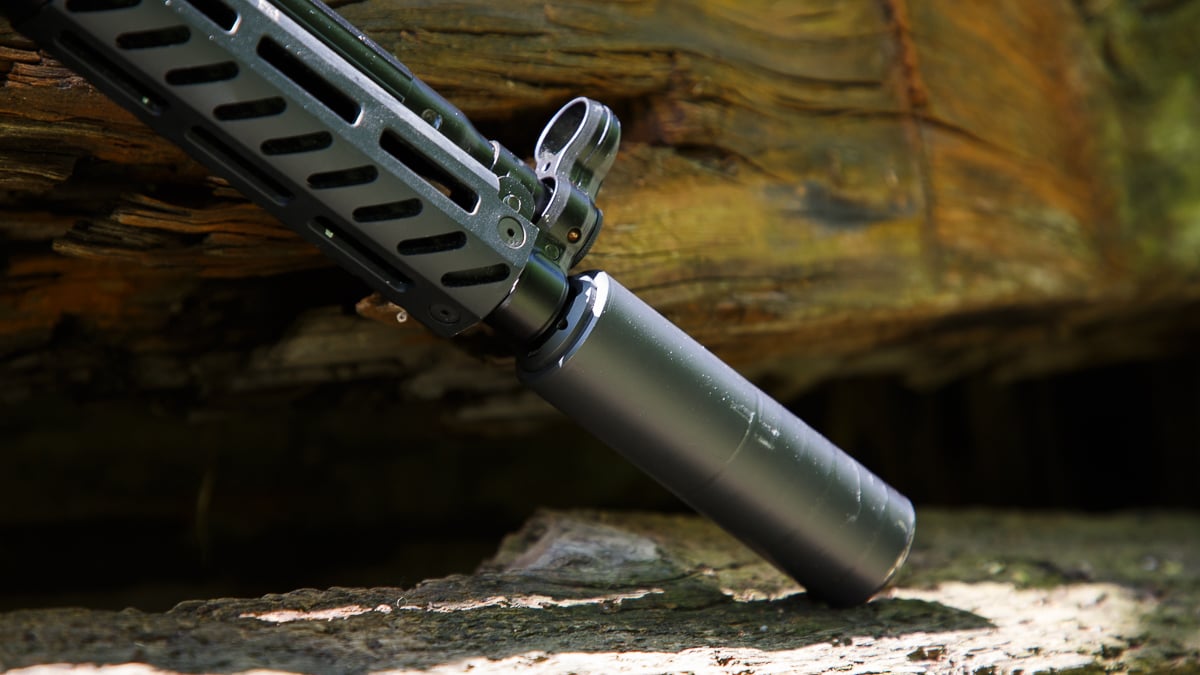
While tri-lug is mostly relegated to pistol calibers due to the lower pressures, that could be changing with some innovations that I’ll discuss shortly.
AK Suppressors
Due to an odd thread pitch and the fact that the front sight post sits against the threads, the AK is one of the most difficult platforms to suppress. AKs also use a muzzle device retention pin that is spring-loaded on the threads to lock the muzzle device in place and help time it.
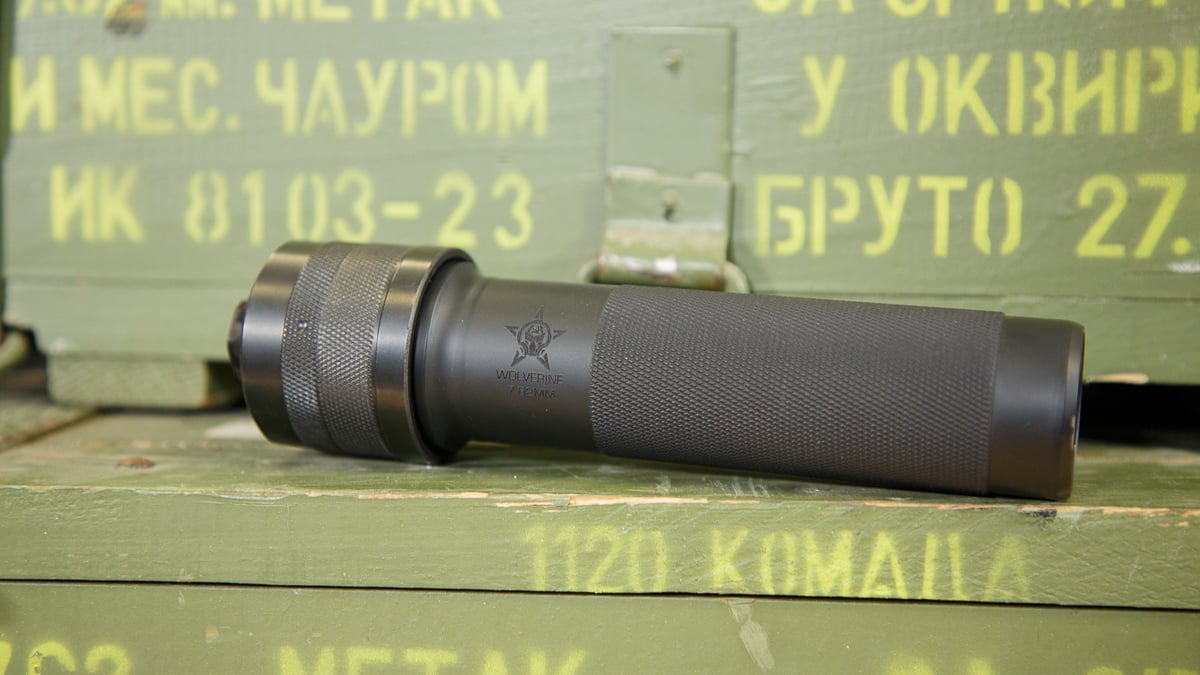
Finding an AK suppressor is difficult, but Dead Air’s Wolverine fits the bill. A copy of the Russian PBS-1 suppressor, this can comes in the 14x1 left-handed thread pitch that is so odd and has slots for the retention pin. Dead Air is one of the most innovative suppressor companies, and the Wolverine is one of my favorite products.


The other downside to suppressing AKs is the inconsistency from rifle to rifle. I pulled a VSKA from our inventory to show off the unique mounting system, but the VSKA threads are too long for the suppressor to engage with the retention system. On some AKs, the threads are not concentric to the bore, which can lead to baffle strikes.

The HUB System
The new trend with suppressors is the HUB (hybrid universal base) mounting system. This concept uses a 1.375x24 thread pitch, which allows the user to mount one of several different HUB interfaces. This opens the suppressor to everything from quick-detach muzzle devices to direct thread interfaces. Most newly manufactured suppressors feature this HUB mounting style, as the standardized 1.375x24 thread pitch has become extremely popular.

The HUB finds its roots with SilencerCo. The company’s active spring retention mount introduced the ability to have a muzzle device that can accept a suppressor. The advantage to this is that you can have a bunch of muzzle devices and place them on different firearms, making it easy to move them from platform to platform, with each firearm having a muzzle device and protected threads.
In fact, if using a chambered muzzle brake, the muzzle device can even act as extra baffles at the rearward connection point of the can.

The HUB system has a few downsides relating to QD muzzle devices. The first is weight, as an added hub adapter and muzzle device can add excessive weight to the end of your muzzle. Adapters and hubs also cost money, and some muzzle devices can get pricey.

The other issue I alluded to earlier is carbon lock. Since the QD attachment point has looser tolerances than that of direct thread, there is a considerable amount of carbon buildup in the HUB. This carbon can act as Loctite on the threads, requiring some brake cleaner, a wrench, and some good ol’ elbow grease to remove the suppressor. Sometimes, the carbon lock can defeat the purpose of the “quick” part of quick detach.
Types of HUB Mounts
I want to list a few notable mounting systems. I have experience with all of these and find them to be some of the best on the market.
SilencerCo ASR
I have had a SilencerCo Chimera 30 for several years. This suppressor uses the ASR mount, and throughout thousands of rounds and some questionable uses, I have never had an issue with this mount.

This HUB mount is designed to go with the SilencerCo ASR muzzle brake. There’s a simple sliding lock toggle on the HUB. The HUB simply threads onto the brake, then you slide the locking collar over to the locked position, and the suppressor is secured.
As I said, I have thousands of rounds on this suppressor. I have never experienced carbon lock, and the mount has always come on and off with ease.
Breek Lok 3QD
The Breek Arms Breek Lok 3QD has quickly become one of my favorite mounts. It is basically a tri-lug design beefed up for rifle pressures.


The Breek muzzle device has three locking lugs, and the hub is a simple connector with a ratchet system to lock it in place. An arrow indicator on the hub aligns with the top of the muzzle device for indexing. Once indexed, the HUB slides on, gets a quarter turn, and then is ratcheted down for a tight fit. This is quick, easy, and secure.

This mount is also very light, and while this Anechoic Anechox 30L is a long suppressor, the light weight of the suppressor and HUB is extremely impressive.
SureFire/ROTEX Mount
SureFire holds several major contracts with law enforcement and military units, and that popularity has increased demand for SureFire-pattern HUBs. In fact, B&T, one of the leading suppressor manufacturers in the world, has developed its own version of the SureFire connection, called ROTEX.


This pattern of HUB simply slips over a SureFire/ROTEX muzzle device, takes a quarter turn, and ratchets down. While similar to the Breek Lok 3QD, there are no indexing marks, so it can take some rotating to figure out the locking point. Once the HUB is locked over the muzzle device, simply spin the ratchet to lock the suppressor in place. This system is also fast and fairly light, but it can be one of the pricier avenues.
Dead Air Xeno
I recently got a few Dead Air suppressors with the company’s new Xeno mount, and I have been impressed – mainly with one major feature. While the Xeno mount is lighter and cheaper than the popular Keymo, the big advantage is that the HUB-to-muzzle-device threads are in the reverse direction of the muzzle-device-to-bore threads.

The muzzle device is a standard right-handed pitch, while the HUB to muzzle device is left-handed. This is intuitive because if you are suffering from carbon lock, you won’t accidentally torque off the muzzle device as you try to torque off the hub. I do not understand why more companies don’t do this. I have trapped several muzzle devices inside suppressors by taking the device off with the can.
B&T NATO Adapter
B&T’s NATO adapter is one of the coolest mounting systems. This HUB simply clips onto any standard A2-style birdcage. As it slips over the standard A2 birdcage, a locking collar clips it into place, and a ratchet system secures it tightly.


This mount is especially impressive because, while it is an expensive HUB, it runs off of the most inexpensive and common muzzle device. I have even been in gun shops where A2-style flash hiders are $5 a pop, making it easy to get a bunch for all of your firearms. It may be more limited in calibers and thread pitches, but this is an innovative way to mount a suppressor to your firearm.
It’s worth noting that Griffin Armament also makes a NATO adapter.
Handgun Mounts
Lastly, mounting suppressors to handguns can be a bit more complicated than most people think. Considering that most handguns run off a Browning-style action with a tilting barrel, they require suppressors with a piston, or Nielsen device. To ensure reliable function, the suppressor needs a spring assist to help the tilting barrel maintain enough energy to cycle reliably.

While a handgun requires a piston and spring, if mounting a suppressor to a fixed barrel like a PCC, it is important to have a piston spacer. This spacer replaces the spring and locks the piston in place. On a fixed barrel, you don’t want the suppressor to bounce around and cause a baffle strike.
So, while technically your 9mm Glock and 9mm AR have the same caliber, they may require two different mounting systems.
Summary
It can be intimidating trying to figure out a suppressor mounting system, but hopefully, this helps you weigh the pros and cons of each. Be sure to check out all our suppressor articles for more on shooting civilized.