"Don't fire unless fired upon. 
But if they want war, let it begin here!"

-Militia Captain John Parker,
Before the Battles of Lexington & Concord, April 19, 1775


Offering a muzzle velocity of around 1,000 fps with a massive .69-caliber lead ball, the Brown Bess flintlock musket from the American Revolutionary War was no slouch on the battlefield. She may be obsolete now, but that seemingly ancient powder rod might have been even more deadly than we give it credit for today.

For the 250th anniversary of the Battles of Lexington and Concord on April 19, 2025, we decided to bring a well-aged Brown Bess back to life for some testing with modern ballistic gel. 

So, without further ado, let’s fire up the old lead spitter and kill some over-taxing, underrepresenting Clear Ballistics 10-percent FBI gel … for science and stuff.


Table of Contents

Ballistics Gel Test Videos
Dissecting the Results
Brown Bess Basics
Final Thoughts

Ballistics Gel Test Videos


We did our testing at 20 feet, which was partly due to the need to protect the gel block from burning powder that could have ruined both our gel and the view of the wound channels. 

The result on our single block was somewhat surprising, and I did not expect the ball to pass so easily through both the 16-inch, 10-percent FBI gel block and two large water jugs. So, in another attempt to capture the projectile, I set up two blocks for a total of 32 inches of gel. This was also backed by a large water jug. The result is below. 


Alas, that test also led to another ball blowing clean through all our gel and water jugs. 
 

Brown Bess Basics


Andrew Scheff, left, 96th Cyperspace Test Group Detachment 1 cybersecurity engineer, and a Lincoln Minuteman, fires a musket during a community parade to celebrate Independence Day. (U.S. Air Force photo by Todd Maki)
Andrew Scheff, left, a Lincoln Minuteman, fires a musket during a community parade to celebrate Independence Day. (U.S. Air Force photo by Todd Maki)


The Brown Bess came in several lengths with various modifications over the years, but its general form served as the main weapon of the British infantry for over a century. Even before the Revolutionary War, it was also a common firearm among the American colonists, many of whom were expected to maintain both a musket and ammunition for militia and other duties.
 

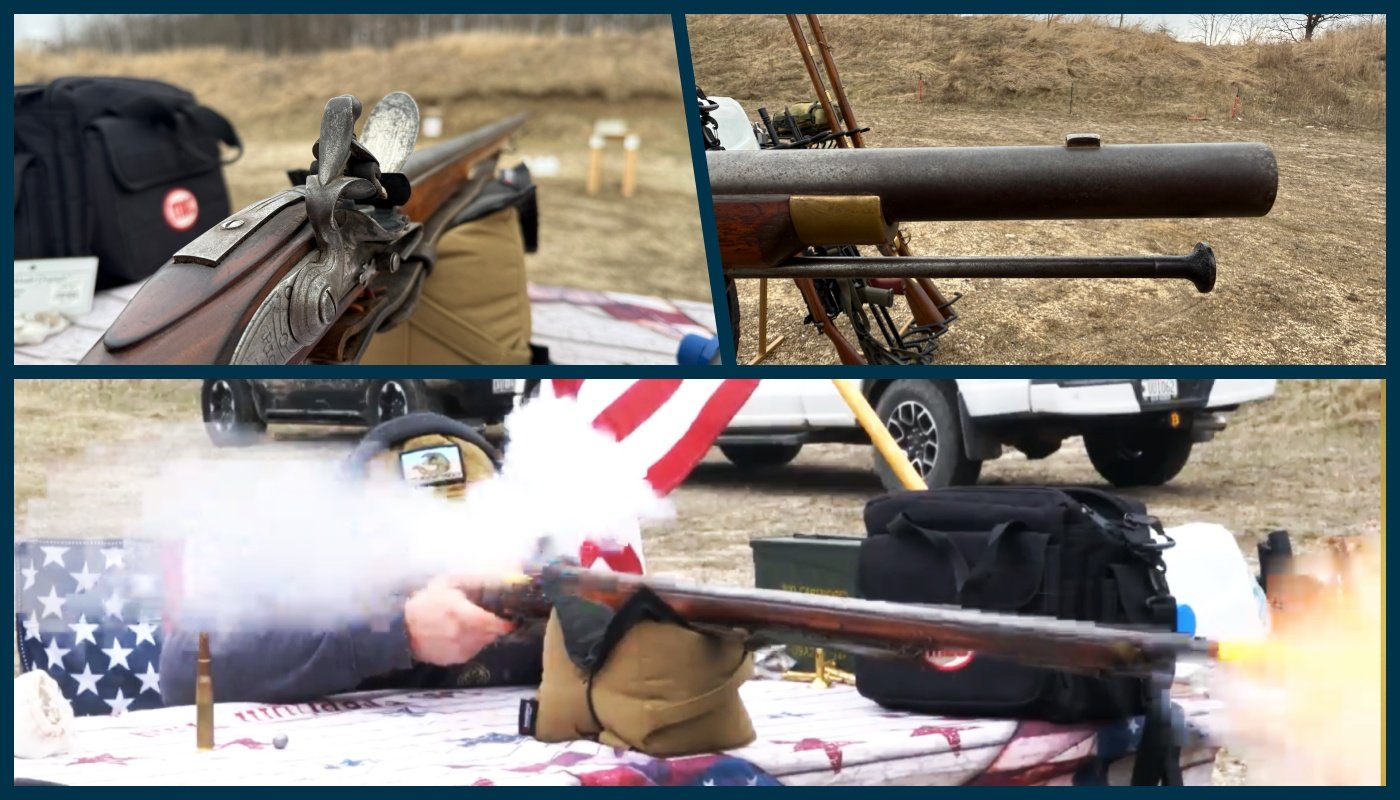
The Brown Bess generally featured a barrel that had a caliber of around .75 inches, which launched a heavy lead ball that measured around .69 inches. (Photo: Paul Peterson/Guns.com)
Ammo for a Short Land Pattern Brown Bess (2nd Model)
I used 110 grains of modern 2F black powder for the charge and a small amount of 4F powder for the flash pan. The standard service charge of black powder for the Brown Bess was listed in some sources as 165 grains, though that was less of a reality in the field. For our testing, we used a Short Land Pattern Brown Bess (2nd Model) with a .75-caliber barrel and a .69-caliber lead ball. (Photo: Paul Peterson/Guns.com)
A sampling of the British and Colonial musket balls recovered from Lexington and Concord. Many of the guns at those battles that were carried by the militia were "long fowlers," or hunting pieces, of assorted calibers, along with a smattering of British (.77 caliber) and Dutch-made (.78 caliber) martial muskets and some French infantry muskets (.60 and .62 caliber) captured in the French and Indian War. Meanwhile, the British regulars were armed with 46-inch barreled Long Land muskets and 42-incher Short Land muskets in .75 caliber. As bullets of the age were often molded to much smaller diameter than the bore (for instance the British used .69 caliber balls in their .75 caliber muskets), to aid in rapid loading as part of a paper cartridge, this only adds to the curious array of balls recovered not only in this early battle but in many Revolutionary War sites. One analysis of just 32 balls recovered at the Parkers Revenge site spanned from .449 to .702 in diameter. (Photos: Chris Eger)


We don’t really have the space and time to dig into variances in modern powder, period powder, and loading practices from the Revolutionary era. Suffice it to say that lower loads of powder around 110-115 grains were not unheard of during the war, and some relics have even been found loaded with similar charges. 

We went ahead and loaded our Brown Bess with 110 grains for testing, which only means we could have actually made it even more potent, but we didn’t need to do that based on the results.


Related: Muskets to M16s – How the ‘Modern Flintlock’ Defines 2A Today


That load included a .69-caliber lead ball with a weight of 584.6 grains. Accuracy is limited by the smoothbore design, loose ball fit, powder charge and ball variances, and crude sights. Even so, accuracy on man-sized targets between 50 and 100 yards is good enough that I wouldn’t want to be downrange regardless.
 

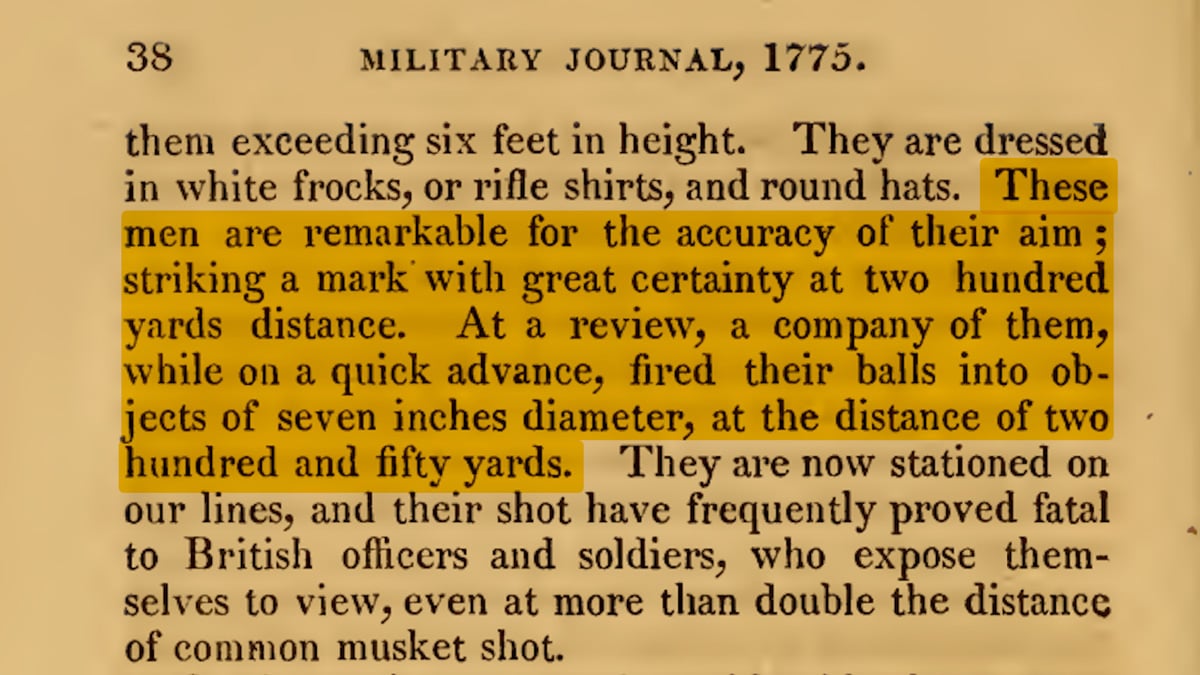
Here are just a few first-hand accounts of the bone-shattering results of musket fire during the American Revolution. You’ll also note that some of the wounds described likely happened at far greater distances than just 50 to 100 yards, with the musket ball remaining under the flesh of one wounded soldier. It’s possible that the wound described on the bottom left was caused by a shot from far away, or it was a ball that passed through another person or ricocheted before finding the unfortunate soldier’s forehead. (Images: The military journal of Dr. James Thacher, (1754-1844), surgeon in the Continental Army)
The military journal of Dr. James Thacher
Thacher also noted the significantly extended range of American riflemen when compared to the standard infantryman with a musket. Of note, the British Army also fielded many rifles of their own during the war. (Images: The military journal of Dr. James Thacher, 1754-1844, surgeon in the Continental Army)
Short Land Pattern Brown Bess (2nd Model)
The sights are crude for aiming, but it's not like you can maintain a great sight picture anyway. (Photo: Paul Peterson/Guns.com)


Even during the Napoleonic Wars (1803 - 1815), British Maj. George Hanger mocked the musket for its inaccuracies, stating: 

“A soldier’s musket, if not exceedingly ill-bored (as many are), will strike a figure of a man at 80 yards; it may even at a hundred; but a soldier must be very unfortunate indeed who shall be wounded by a common musket at 150 yards, providing his antagonist aims at him; and as to firing at a man at 200 yards with a common musket, you may as well fire at the moon and have the same hope of hitting him.”

There’s certainly a level of truth to this. I would also point out that American shotgun hunters have been downing game with slugs fired from smoothbores at decent distances for a very long time. So, take that with a grain of salt.
 

Dissecting the Results
 

, PPeterson, Brown Bess, Brown Bess Musket, Musket, Revolutionary War, Revolution,
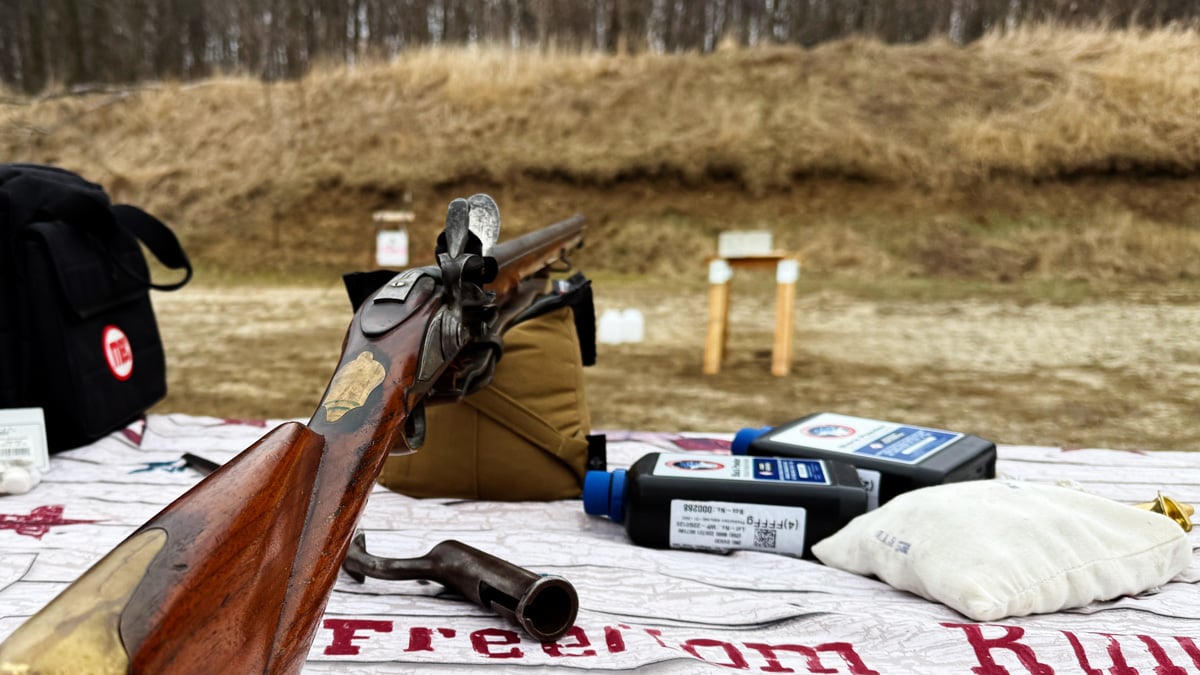
Shooting from 20 feet might not seem far, but my aim was still hardly pinpoint accurate at that distance. It did protect our gel from excess burning powder, at least. (Photo: Paul Peterson/Guns.com)


I’ll start with some quick math. Our test musket ball weighed in at 35 grams. Since one ounce equals 437.5 grains, and 35 grams comes out to 1.23459 ounces, we end up with a hefty final grain weight of 584.578 grains. 

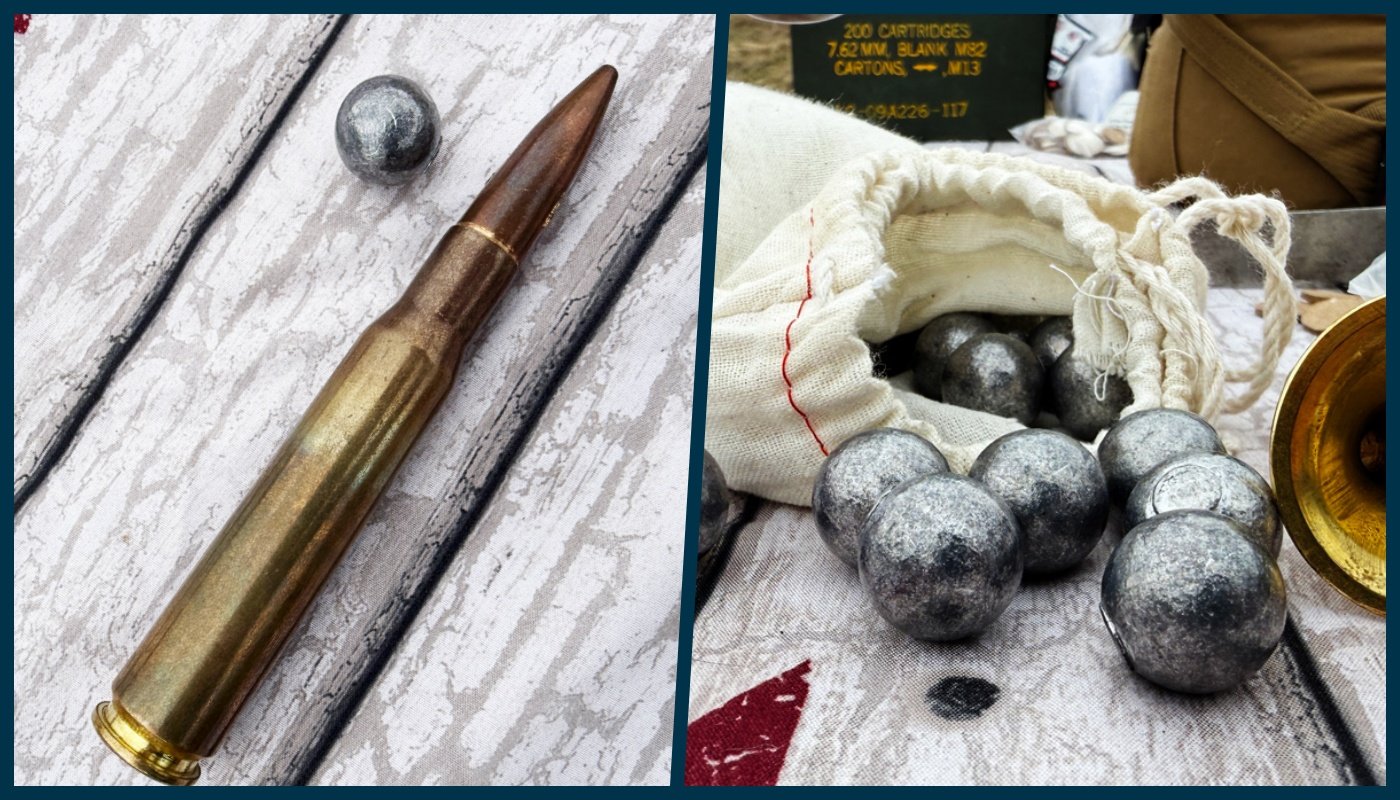
For comparison, a standard M33 ball round of .50 BMG has an even heavier 660 grains, but a large modern 1.125-ounce 12-gauge shotgun slug is a mere 492.2 grains. 


Related: John Browning & .50 BMG History – America’s Heavy Slugger


I charged both of our shots with 110 grains of modern black power, which should have given us a velocity of around only ~1,000 fps from our Brown Bess. That’s an approximation, but then again, we were firing a handloaded musket with an undersized ball that requires a wad.  
 

PPeterson, Brown Bess, Brown Bess Musket, Musket, Revolutionary War, Revolution,
While our .69-caliber ball is wider, the .50 BMG bullet is heavier and longer. The .50 BMG dominates the musket ball for velocity by nearly 2,000 fps. (Photo: Paul Peterson/Guns.com)


Now we can run that all through our handy muzzle energy equation: (“weight in grains” x “velocity² in fps”) / 450,237.  All that gives the old Brown Bess a massive 1,297.8 foot-pounds of energy at the muzzle for a velocity of 1,000 fps. 

It’s an estimate, of course, but you can compare that to a Federal 230-grain .45 ACP bullet traveling at 890 fps, which “only” gives you 404 foot-pounds of energy at the muzzle. 

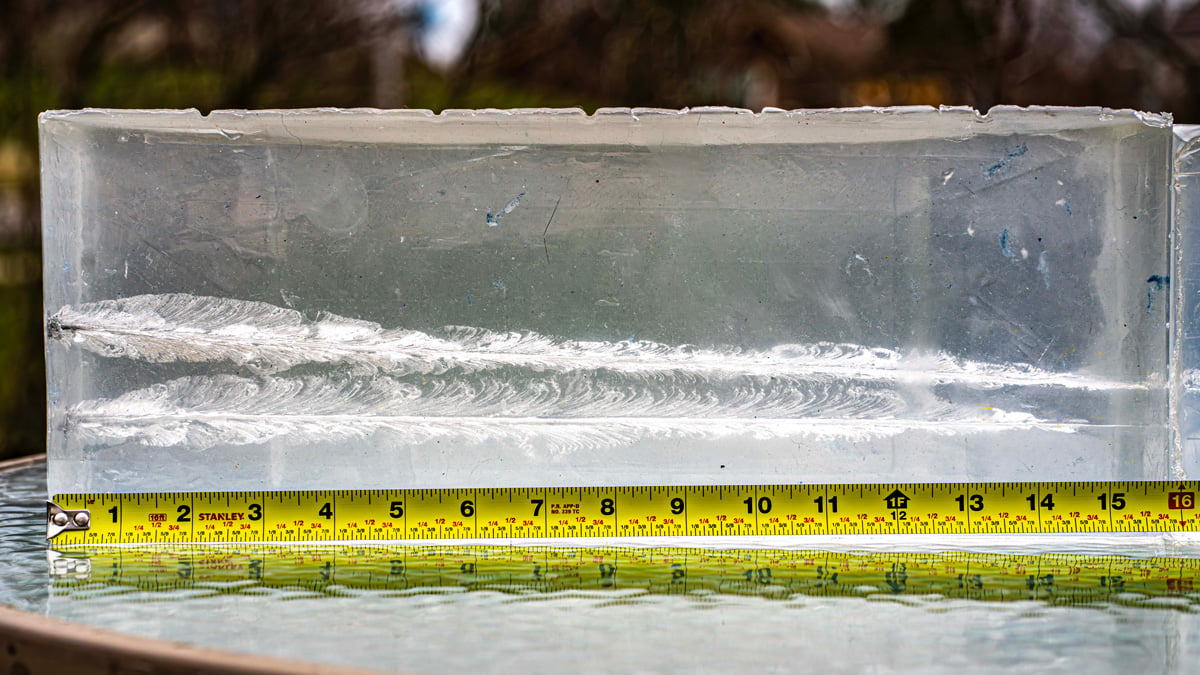
Enough math. Let’s look at the results in our ballistic gel. Keep in mind that the FBI standards for penetration on 10-percent ballistic gel are a minimum of 12 inches and a maximum of 18 inches for optimal stopping power without over penetration.
 

Ballistic Gel
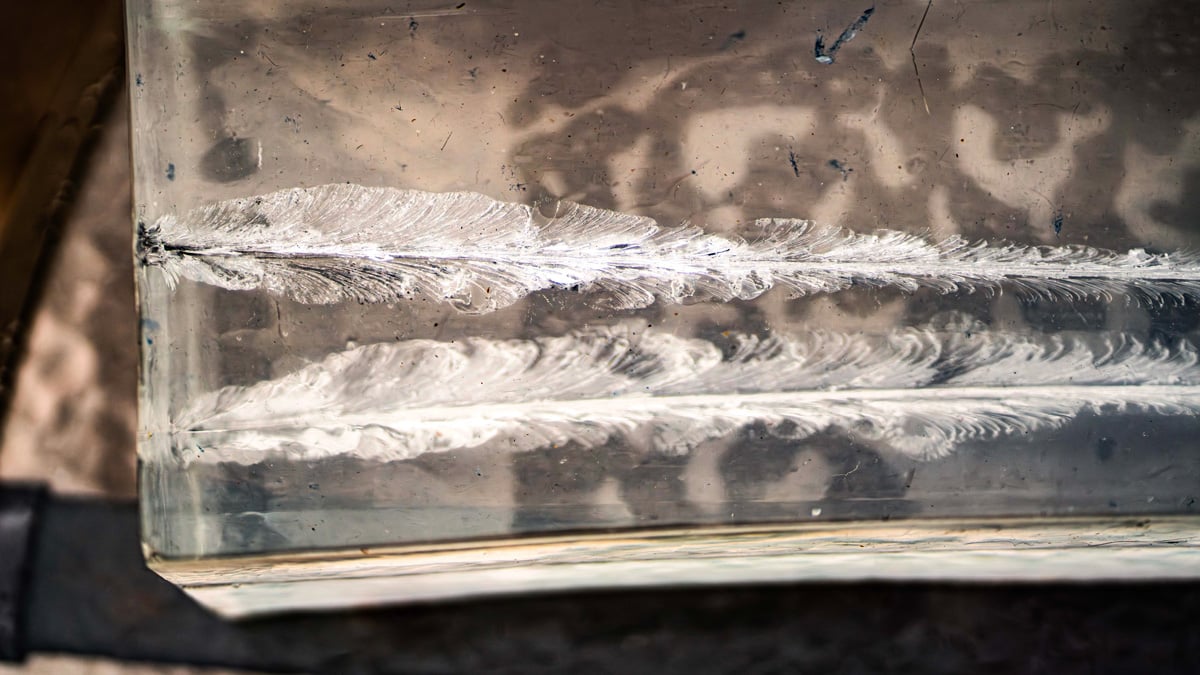
The first block from both our shots shows some expansion, but it's not the far wider pattern I would expect from a modern battle cartridge or hunting load. Our first shot with just one 16-inch gel block included two large water jugs. The musket ball blew through the first jug and split the other all the way down the middle without stopping. (Photo: Paul Peterson/Guns.com)
Ballistic Gel
With two 16-inch blocks of 10-percent Clear Ballistics gel, the musket ball dumped most of its energy into the first block, which is why the wound channel is more chaotic. It passed through the second block, but the ball’s trajectory curled downward. That led it to bounce off our wood table while still blowing through both ends of the bottom of our large water jug before vanishing into the berm. (Photo: Paul Peterson/Guns.com)
Ballistic Gel
The wound channels in the first block of gel show a decent dump of energy into the first 12 inches of gel. (Photo: Paul Peterson/Guns.com)
Ballistic Gel
Burning powder still managed to get to the wound entrance along with the ball. (Photo: Paul Peterson/Guns.com) 


The mass in that .69-caliber ball is where the Brown Bess gets its true power. In fact, higher velocities and lower weights would most likely limit its penetration capabilities. That’s not always a bad thing, because over penetration is really just lost energy that has no effect on your target. Although, over penetration is not necessarily a bad thing when shooting at a packed line of infantry that ran two or three ranks deep.

Here’s an example of what happened in a similar test where we got 16 inches of penetration from a modern 7.62x39mm hunting cartridge.
 

The soft-tipped 125-grain 7.62x38mm Remington Core-Lokt is designed for medium-sized game like deer with a muzzle velocity of 2,365 fps. The bullet achieved 16 inches of penetration before squeezing out the end of the block and stopping against a water jug. That said, you can see the bloom of energy that expanded inside the first half of the wound channel. That is a very efficient dump of energy into the target, which is the whole point of the Core-Lokt ammo line. (Photo: Paul Peterson/Guns.com)


Final Thoughts


Brown Bess Musket
If all the above isn’t enough to get the Brown Bess some respect, how about the fact that it was also common to load additional buckshot (the three little balls) along with the main ball for added downrange damage? This X-ray image of a Brown Bess recovered from a colonial shipwreck is thought to be a 1769 Short Land Pattern. (Image: Lighthouse Archaeological Maritime Program).


Where does all that leave us? Well, at close ranges, the .69-caliber ball fired from a Brown Bess musket is very capable, but it tends to over penetrate instead of efficiently dumping its energy into the target like a modern hunting or self-defense load.

However, it can clearly inflict horrendous and fatal wounds while easily smashing bones. Sure, the velocity is lower, but the potential for 1,300 foot-pounds of energy (more if you up the charge of black powder) proves the musket ball is deadly well beyond 100 yards. 

That is, if you can hit anything with it.

Even slashing its energy in half still puts the Brown Bess’s musket ball at more foot-pounds of energy than your standard 230-grain .45 ACP at the muzzle, and the Lord’s caliber is no slouch either. 

revolver barrel loading graphic

Loading