Video Review
Intro: Meet the Scout V2 Handgun
Coming from Connecticut Valley Arms, in business since 1971, the Scout V2 pistol sprang from the company’s line of similar single-shot rifles. This break-action one-shot is fitted with a 14-inch fluted barrel. Both the box and the firearm indicate the firearms manufacture in Spain. The handguns ship with easy-attach sling studs, whether for a sling or the use of a bipod. The action is opened by drawing rearward on the flared trigger guard. The included hammer extension is handy for those mounting scopes.

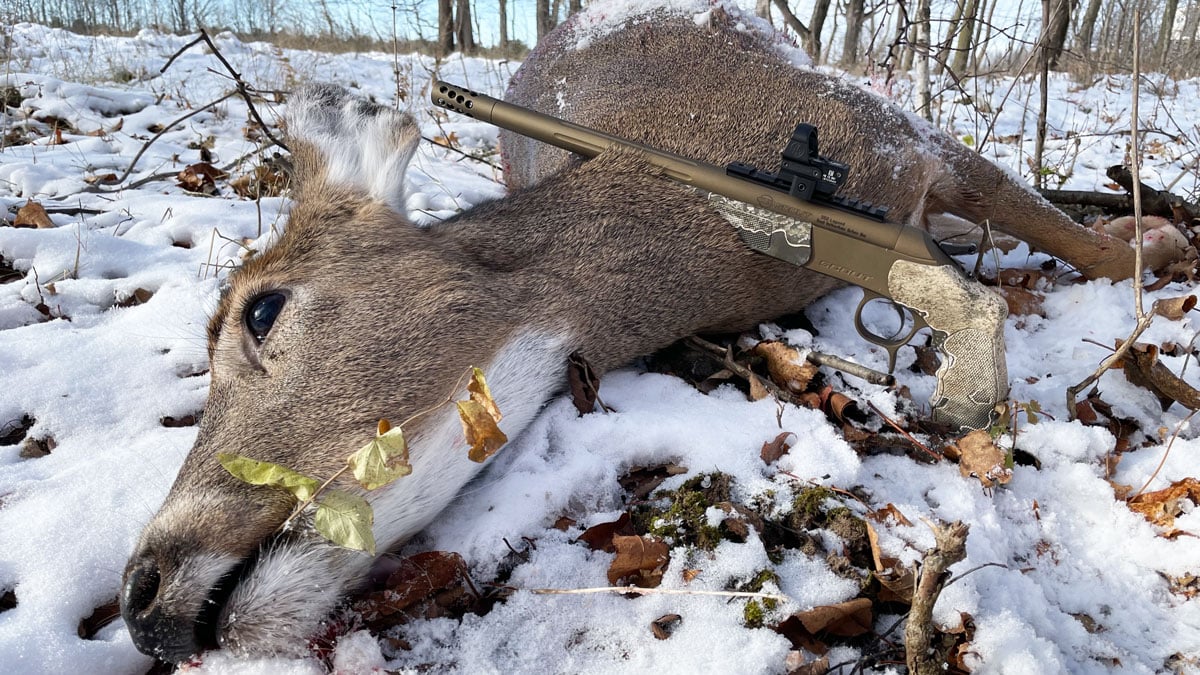
Our particular selection is an upgraded version with Burnt Bronze Cerakote metalwork, Realtree Excape camouflage furniture, and a muzzle brake. The vast majority of models, though, use basic black synthetic stocks along with stainless metalwork. Our test gun weighs in at only 3.8 pounds bare.
The included DuraSight Z2 rail, which is built of an alloy stronger than aluminum, makes optics mounting a breeze. In fact, the rail is long enough to allow real estate for pistol scopes, larger red dots, or even the Leupold Delta Point Pro we used for testing. Lastly, CVA’s Scout lineup is backed by its lifetime warranty. At the time of this writing, base models are selling from $375 to $475, with our upgraded version in Cerakote and camo with included muzzle brake commanding a premium.


Range Time

We headed out to the range on a wildly windy day because we simply had to run some rounds through this one-shooter. We also figured the mix of readily available factory .350 Legend ammunition would prove a good test of its abilities. We used 150-grain Winchester Deer Season, 170-grain Hornady American Whitetail, 180-grain Federal Non-Typical, and even the cheapest 145-grain Winchester USA FMJ to get on target. The gun made work of them all.

We shot our accuracy groups at 50 yards and found several loads cutting holes. None of the factory hunting loads exceeded 1-inch groups. Moving to 100 yards proved several things. First, the handgun is capable not only of 100-yard shooting but even more, especially given a solid rest for this shooter. Second, the .350 Legend round, shooting that well, opens the possibilities for a practiced deer hunter to make clean harvests beyond 100 yards. That extends the ranges and downrange terminal performance with more certainty than what is provided by many traditional handgun rounds.
As for recoil, there really isn’t any of which to speak. Granted, we have a history of shooting big-bore handguns. But realistically, there is more noise than kick, especially with the muzzle brake. Even then, we wouldn’t hesitate to use this one as an introductory handgun for new hunters.
Why Buy a .350 Legend Scout?

The .350 Legend chambering, by its very nature, is not only ideal for whitetail-deer-sized game but also of surprisingly minimal recoil. In a pistol, that makes it an easy round to control and pleasant to shoot, even for those newer to handgunning. That doesn’t mean it’s a slouch by any means. In fact, the .350 Legend has serious knockdown power at ranges out to 200 yards. Only hardcore – and well-practiced handgunners – are shooting past that distance.
We’re still not sure how CVA manages to put such a crisp, light-breaking trigger on what we’d consider a budget platform. The pull on our Scout V2 handgun breaks repeatedly at only 1.5 pounds, sans creep. And that’s no anomaly. Since we snagged this one, our local gun shop has been selling the heck out of these handguns and every one has impressed buyers who test the dry fire.

While the .350 Legend is our preferred chambering choice for a deer hunting handgun on this platform at the moment, shooters have plenty of others from which to shop. The list of chamberings has shifted over the past few years, but we’ve currently found them in .357 Magnum, .44 Magnum, .223 Remington, .243 Winchester, .300 Blackout, 6.5 Grendel, and 6.5 Creedmoor.
All the models we’ve seen use a DuraSight Z2 optics rail, including earlier models with shorter and non-threaded barrels. The included sling studs make it simple for shooters to attach not only a sling for field carry but, more importantly, a bipod.
Pros and Cons

What’s interesting is that the Scout V2 handgun actually seems a bit of an afterthought. It clearly springs from the company’s single-shot Scout line of break-action rifles. The forend even seems to be a trimmed-down version of the larger version, evidenced by its muzzleloading ramrod cut-out carryover.
The pistol grip, which is comfortable enough with its finger grooves, works fine but does leave room for improvement. There’s a sharper raised edge near where the stock meets the base of the receiver. When we asked recent buyers what they thought, only about half had even noticed this, and fewer still were bothered by it.
To be honest, we weren’t expecting to be terribly impressed with an inexpensive single shot. But the opposite came true. In fact, we’re now toying with the idea of performing a few modifications, including adding custom wood furniture. The gun shoots that well.

The other area we take issue with is the safety. In our opinion, a single shot requiring the hammer be cocked does not need a manual safety. We discovered, however, that the safety was not necessarily favored by the designers. Rather, it was a necessity for pistol importation. The actual safety lever is rather flimsy and feels like it has the potential to be a weak point on the firearm. To be clear, however, we would never consider this a reason not to purchase the firearm, as workarounds exist should it ever become an issue.
Here's a quick breakdown of the pros and cons.
Pros:
- Accurate even at longer ranges
- Lots of ammo choices
- Strong optics rail
- Can host bipods and slings
- Inexpensive
- Low felt recoil
- Good even for beginners
- Reliable
Cons:
- Grip could be improved
- Manual safety on a single-shot hammer-fired pistol
-
Safety lever is a bit flimsy but not a big issue
Conclusion: A Good Buy