Roots of the Round
Believe it or not, the 7mm-08 has technically been around in one form or another since the latte 1950s, albeit as a wildcat cartridge. Early on, as just one of dozens of wildcats created around the .308 casing, it put down roots as the 7mm-.308. In the simplest terms, that meant a .308 Win casing necked down for .284- diameter projectiles.

To be fair, .284 actually equates to 7.2mm, but sometimes naming is misleading. The 7mm Rem Mag, after all, uses the same .284 projectile diameter, as does the classic .284 Winchester. Yet how many shooters used a version of the 7mm-308 so many decades ago? Not many.
It wasn’t until Remington, with its marketing prowess at the time, took a shine to the 7mm-308 that it hit everyday success and launched the round we know today.
The ‘Real’ 7mm-08
Wildcatters seldom receive full credit for some innovative creations. The same could be said about the 7mm-308, languishing in the shadows until Remington saw the potential. The 7mm-08 Remington round we see on rifles and ammo shelves of every gun shop and website is due in large part to Remington’s intervention.

Officially released in 1980, the 7mm-08 Remington, bearing the Big Green tag, made a few tweaks to that earliest wildcat, granting it not only more flexibility and performance, but also the legs to stand on its own and carve out a place in the centerfire production market.
The 7mm-08 Remington is now – after some lean years – considered a shooter-friendly, shoulder-friendly round that is yet surprisingly capable on even big game. That’s due in large part to its design.
Related: Hunting Calibers – Does Size Really Matter?
Remington maintained the same 20-degree shoulder angle but expanded the casing length a hair (0.02 inch to be exact) compared to the parent .308 Win casings. Though longer, the 7mm-08 still fits neatly into short-action platforms. With the 7mm-08 round alongside its .308 kin, one must do a double-take to notice the differences, but they’re there.
Wide Projectile Range
There’s good reason that the 7mm and .284-inch chamberings are popular. The broad range of bullet weights allows shooters, whether of factory ammo or handloaders, to tailor the cartridge to everything from larger varmints to deer to bear and even elk or moose.

More common projectile weights for the 7mm-08 Rem reach from 120 grains on the lighter end to over 162 grains. As an example, the Nosler Ballistic Tip 120-grainers are advertised to move at 3,000 FPS at the muzzle.
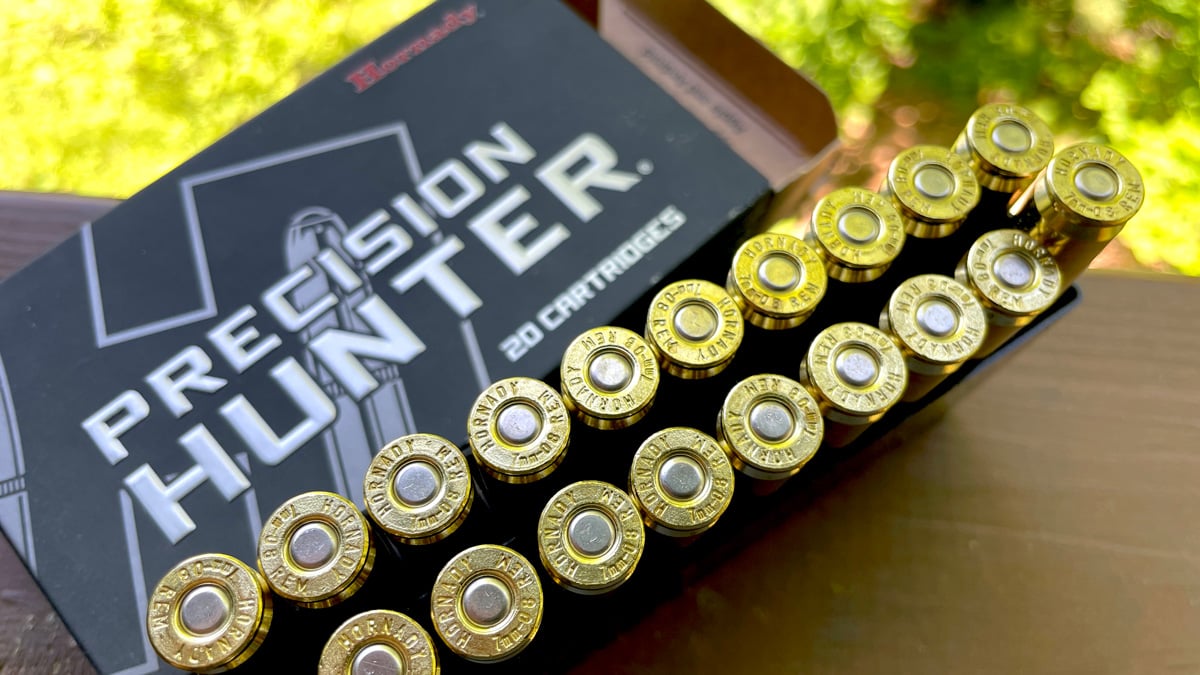
Hornady’s 150-grain Precision Hunter, by contrast, runs around 2,770 FPS muzzle velocity, while HSM’s Tipping Point 162-grainers clock in just over 2,500 FPS. Hunters may grab the 120s for a coyote hunt and quickly switch points of aim to use the 150s for deer or even elk-sized game.
Recoil
The 7mm-08 comes up in most modern discussions of low-recoiling deer rounds. In fact, we sell many such chambered rifles for those seeking an option that is manageable to fire, while yet packing the knockdown power to bridge the gap between deer and larger game.
Related: Low Recoil Ammo for Deer Hunting

Perceived recoil varies according to many factors, including rifle weight, stock design, and load selection. In a broad overview, the 7mm-08 Rem recoils more than the .243 and 350 Legend class, but considerably less than the .270, .30-06, and way less than the 7mm Rem Mag.
In more of an apples-to-apples debate, an average study reveals that the 7mm-08 Rem offers slightly less kick than a comparable .308 but slightly more than a 6.5 Creedmoor. For especially recoil-sensitive shooters, there’s even a Hornady Custom Lite 7mm-08 ammunition load at 120 grains that touts even greater recoil reduction.
The Rifles
In 2024, it’s harder to find a manufacturer that doesn’t chamber a 7mm-08 Rem rifle than one that does. Sadly, the same cannot be said about the 7x57 Mauser, which shares much in common.

Those in the market for a 7mm-08 rifle have open options. A few of our favorites, among many, which all show more than practical accuracy in testing: Browning A-Bolt, Savage 110 High Country, Ruger American Gen II, Mossberg Patriot, Winchester Model 70, CVA Scout, and Weatherby Vanguard.
Those are just a few among many. There are single shots and bolt actions, with prices covering everything from budget to premium. There are compact models with a shorter length of pull, scoped combos, stainless, multiple camouflage coatings, and long-range darlings.
The Ammo