Quick Comparisons
At face value, the EOTech Vudu 3-9x32 scope and holographic EXPS3-DCR are quite different. While the Vudu features an adjustable magnification from 3x to 9x power settings, the EXPS3 offers no magnification. Instead, the EXPS3 opts for a danger-close holographic reticle that has a center dot zeroed for 50 and 200 yards.
For close-range work, the EXPS3 hosts a lower chevron that allows shooters to engage targets without a hold-over at distances under 7 yards. The chevron shape allows for more precise aiming and stands apart from the center dot to improve instinctual aiming. By comparison, the magnified Vudu has hash marks for various engagement distances when zeroed at 100 yards. Adjustments are refined and offer 0.25-MOA tweaks at 100 yards.

The EXPS3 is not magnified, but its large window provides a great field of view and easy shooting, even in low-light conditions. For extra-dark work, it offers 20 brightness settings for the illuminated reticle and has a night-vision setting with 10 additional brightness adjustments.
The ultra-short Vudu offers 10 brightness settings, but it is not night-vision compatible. With the lowest magnification setting at 3x, close engagement distances still require some practice to adjust to the magnification. Either optic would be a great choice for tactical work, but their specs set them up for some specific applications.
Let’s start by looking at the Vudu 3-9x32.
Vudu 3-9x32 SFP Specs

The Vudu 3-9x32 riflescope is built with aircraft-grade aluminum and offers a very small package for a magnified optic. At just 6.8 inches long, it has a minimalist footprint. This model is a second-focal-plane design, but you can opt for a first-focal-plane model.
Since this model has aa SFP reticle, the hash marks will remain the same size no matter what magnification level you use. However, they are only set to be used with the maximum magnification level. FFP models have a reticle that adjusts its size with each magnification level and remain true to scale for adjustments.
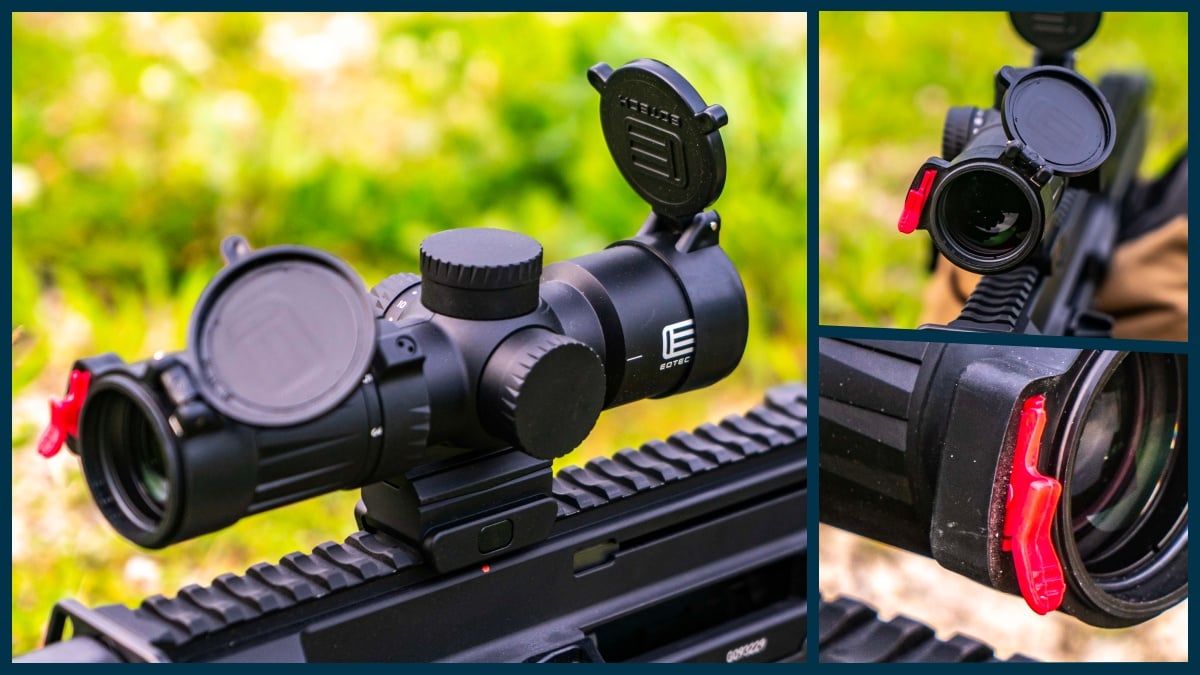
Vudu optics are all fog, water, and shock resistant. This one comes with an integrated base that is compatible with mini-ACOG mounts right out of the box. It had no issues holding zero over 500 rounds during multiple range trips.
Here’s a quick breakdown of the basic specs of this Vudu 3-9x32 scope:
Focal Plane: Second (first focal plane available)
Objective Diameter: 32mm
Eye Relief: 3x (2.5-3.1 inches), 9x (2.3-3.1 inches)
Field of View: 3x (38 feet), 9x (12.7 feet)
Turret Adjustments: 0.25 MOA
Overall Length: 6.8 inches
Height Above Bore: 1.56 inches
Weight: 1 pound
Magnification: 3-9x
Caliber Options: Multiple
Illumination: Yes, 10 brightness settings
Night Vision Compatible: No
Battery Type: CR2032
Battery Life: ~300 hours (lowest setting)
Country of Manufacture: Japan
This Vudu runs on CR2032 batteries, which will give you roughly 300 hours of illumination. There are 10 brightness settings. I’ve tested these under full sun without a cloud in the sky and had no issues picking up the illumination.
The illumination dial has midway stops between each setting, so you do not need to spin the dial all the way to shut off the light. It does not feature an automatic shutoff.

Lenses come with an anti-reflection coating and offer great clarity even at full magnification. I’ve tested around a dozen optics already this year, and this one has the best light transmission and edge-to-edge clarity of any magnified optic so far, except for one true precision and more expensive 3-18x44mm scope.
The magnification ring is oversized and a bit stiff, but it includes a hump for extra leverage. You can toss on a throw lever to speed things along. Personally, I like stiffer adjustments. I’d rather have a stiffer adjustment ring than worry about accidental shifting.
Vudu scopes come with various reticle options. I’ll cover the HC1 reticle on this one in the reticle comparison section below.
Holographic EXPS3-DCR Specs

The EXPS3-DCR is a holographic sight, which means it uses a laser to project a hologram of the reticle onto the lens. Standard red dots use a simple LED to project the dot. The main advantages are superior performance in low-light conditions and easier target acquisition with both eyes open. It also allows for a more complex reticle, such as the danger-close reticle on this model.
That DCR reticle is an adaptation of the old “speed ring” circle-dot layout that now includes a point-of-aim chevron, meant for a more accurate point of impact on targets within 7 yards. The center dot is zeroed to 50 and 200 yards when using .223/5.56mm NATO. I’ll dive more into the DCR reticle in the reticle comparison section below.

Here’s a rundown of the basic specs for the holographic EXPS3:
Optic Type: Holographic Weapon Sight
Weight: 0.7 pounds
Length: 3.8 inches
Width: 2.3 inches
Height: 2.9 inches
Calibers: .223/5.56mm NATO
Adjustments: 0.5 MOA
Brightness Settings: 20
Night Vision Compatible: Yes
Night Vision Brightness Settings: 10
Co-witness: Lower third
Battery: CR123
Battery Life: ~1,000 hours (lowest setting)
Auto Off: Yes, after 4 or 8 hours
Operating Temperatures: -40 to 140 degrees Fahrenheit
Water Resistant: 33 feet
Country of Manufacture: USA
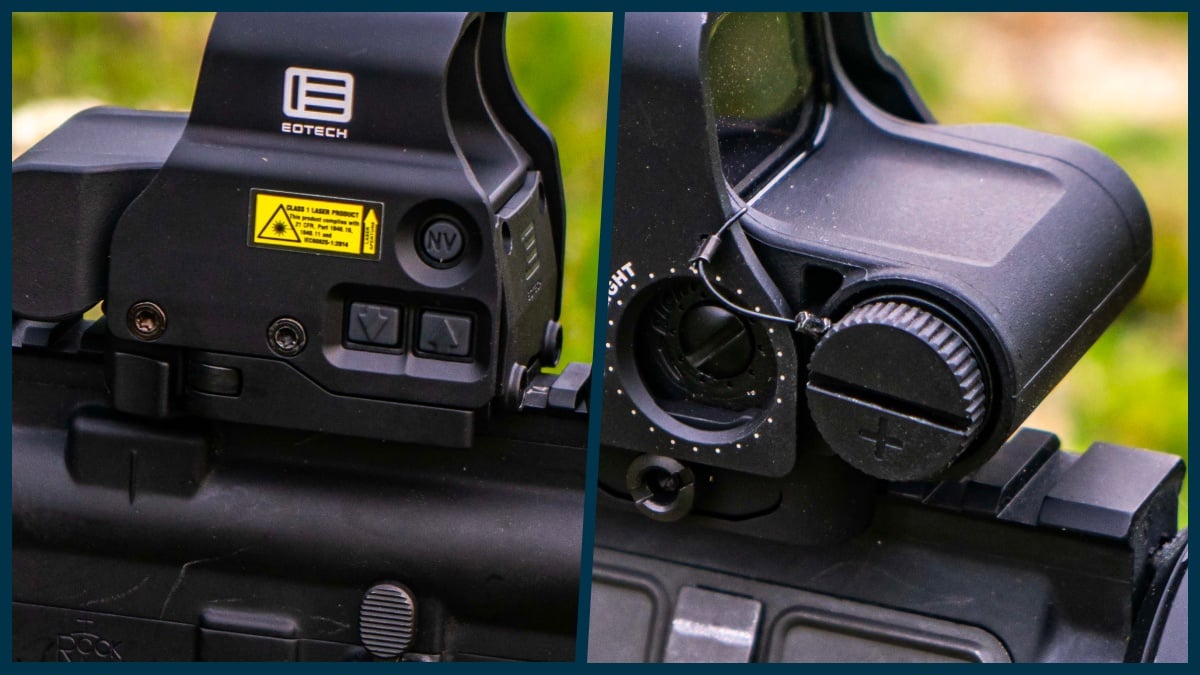

One of my favorite features, aside from the DCR reticle on this EXPS3, is the integrated quick-detach mount. I popped this optic off twice during my accuracy testing without noticing a shift in my zero. The base and optic are set up for a lower-third co-witness and can support night vision attachments.
Even under full sun, I can get this reticle to be “too” bright for my needs. So, if you need to take a shot at the sun or some fool’s 1,000-lumen flashlight, there’s probably a setting that will get that done for you. Beyond the 20 different daylight settings, the EXPS3 has 10 additional night-vision settings.
Reticle Comparisons

These reticles are meant to accomplish two different things. The EXPS3-DCR is all about quick target acquisition, especially in close quarters. The danger-close reticle simplifies the large 68-MOA speed ring to just a left and right bracket. That makes it a lot less busy and more intuitive.
The center dot is a do-all aimpoint that offers a 50/200-yard zero. While the optic is plenty precise, that non-magnified 1-MOA center dot is more about getting fast and relatively accurate shots at mid-range targets. It is not about shooting the wings off a fly at 100 yards. Indeed, the 1-MOA holographic center dot was large enough to cover my groups at that distance anyway. Adjustments are done in 0.5-MOA increments.
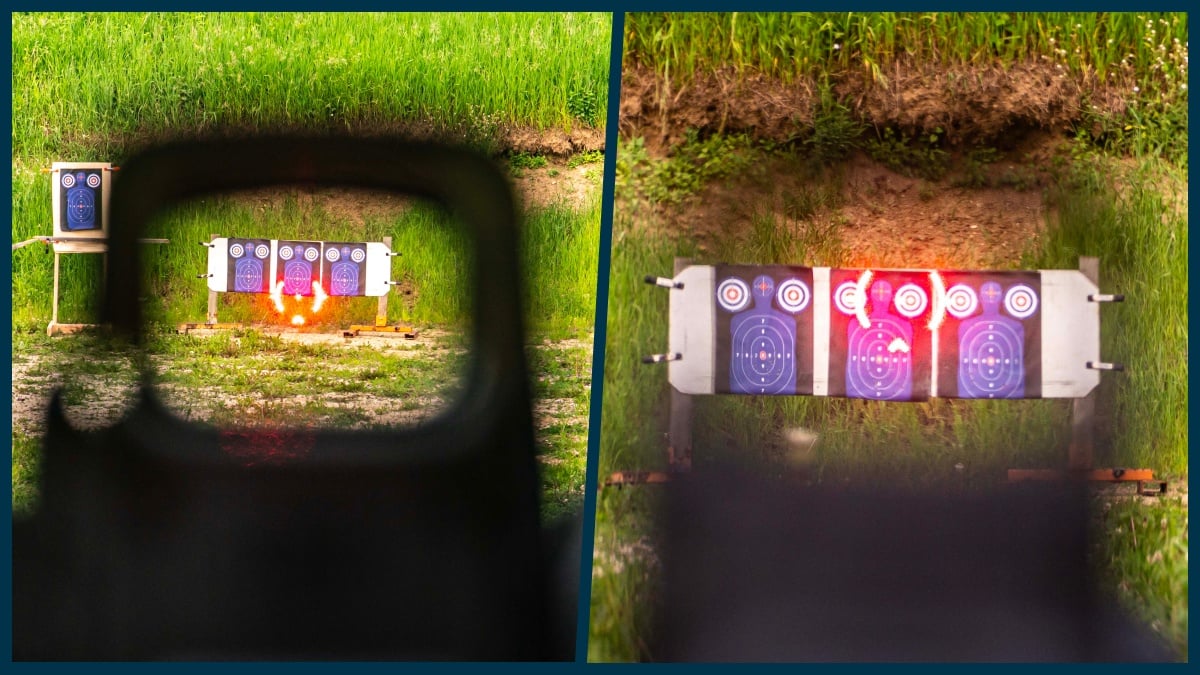
The real money maker for me is the danger-close 7-yard chevron. I’ve spent years training to hold over targets at closer ranges, and it is a skill that can be a blend of instinct and guesswork under pressure. I love the 7-yard chevron because it compensates for the optic’s height over bore, and the result is better shooting at close ranges, plain and simple.
Frankly, this is my favorite reticle for close-to-mid-range shooting ever. It works, and it feels totally natural when I use it. If I had to make a complaint, it would be that the bulk of the EXPS3 optic only allows for a lower-third co-witness when using standard backup iron sights.
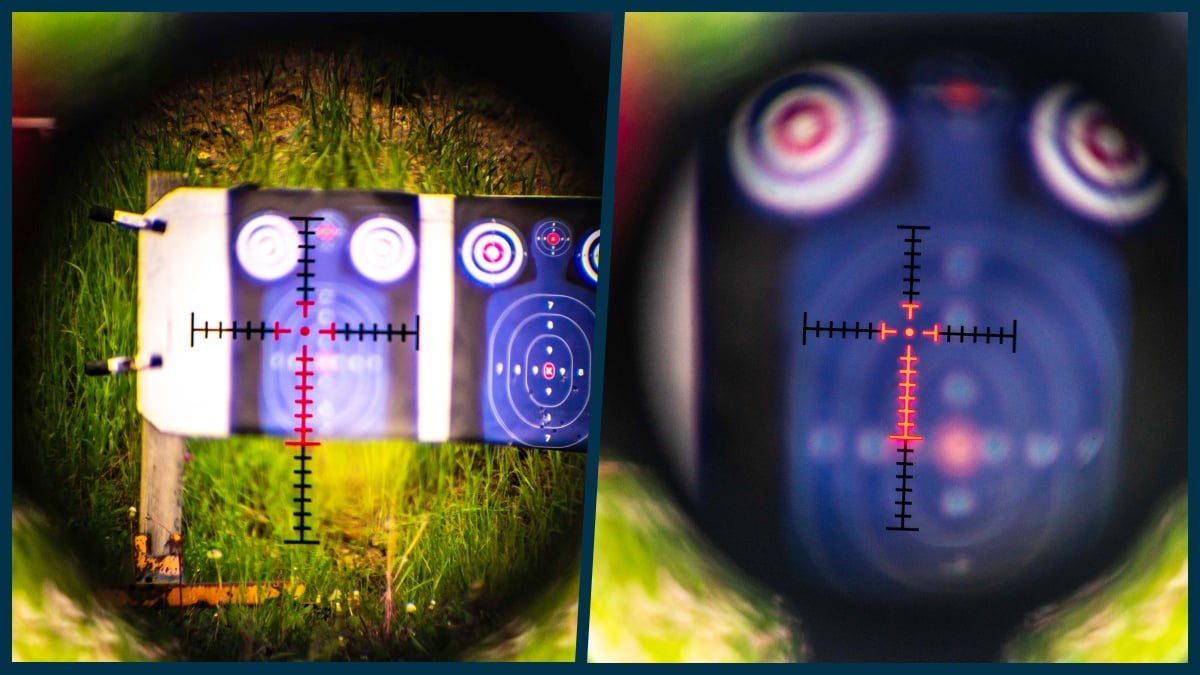
Our test Vudu came with the second-focal-plane HC1 reticle. It’s derived from the hash-mark-type mil-dot reticles you’d expect from long-range optics, but with a bit of a tactical twist. The 10 illumination settings are plenty for low-light and high-sun shooting conditions.
For precision work, the HC1 has a floating ultra-small center dot that is 0.15 MOA at 32x. Given that this particular Vudu optic only goes to 9x, the actual dot diameter at 3x is 3.6 MOA for close-range work and 1.2 MOA at 9x. As an SFP reticle, the sub-tensions (i.e., hash marks) have a thickness of 1.2 MOA at 3x and 0.4 MOA at 9x. The distance between those subtensions is 6 MOA at 3x and 2 MOA at 9x.


All that translates to the fact that you can actually do accurate estimates even when the optic is not at full magnification, but you’ll need to practice. While not a true extreme precision reticle, it is significantly easier to do precision work at and past 100 yards with the HC1 reticle on the Vudu than with the EXPS3-DCR.
Adjustments for the Vudu are done in 0.25-MOA increments, or half those of the EXPS3.
Thankfully, EOTech limited the amount of illumination to just a T-shaped center portion of the reticle. This creates an illuminated center space that draws my point of aim into a man-shaped target nicely at closer ranges.
Accuracy Performance
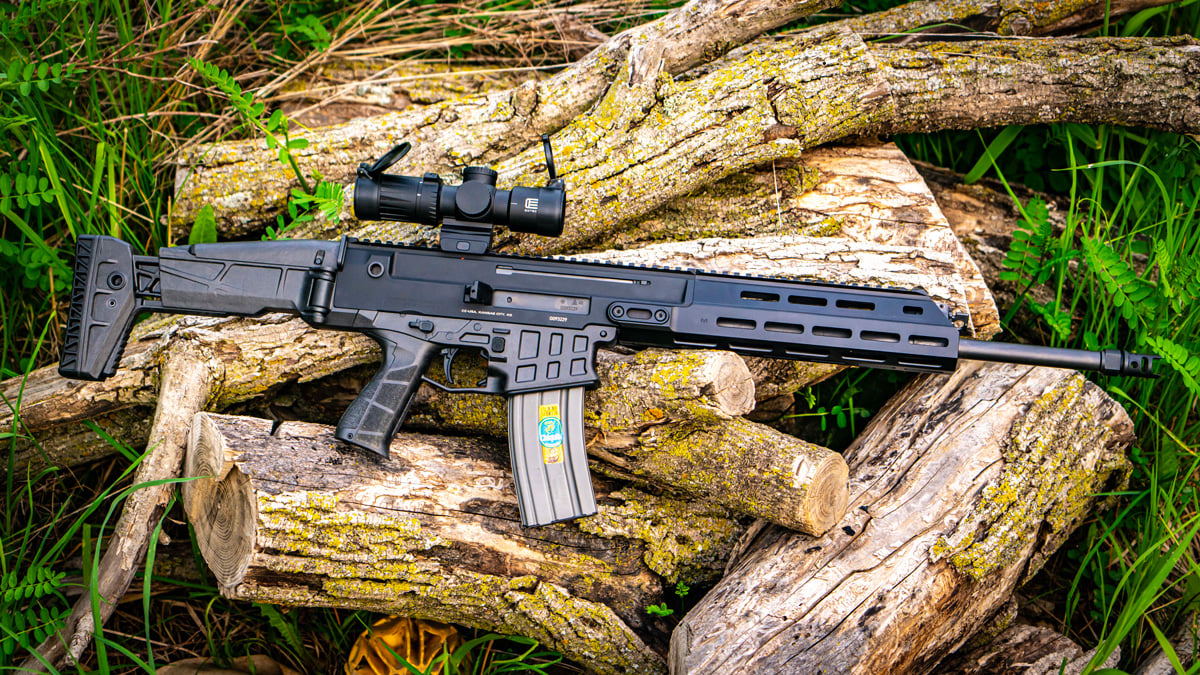
For my final accuracy testing, I attached and zeroed the Vudu 3-9x32 scope to a Bren 2 I’ve been testing, and my personal LEO trade-in Rock River LAR-15 served as the host for the holographic EXPS3-DCR. Both guns held similar-sized groups in past testing.
To confirm this, I first zeroed and tested the EXPS3-DCR on the Bren 2. I then popped that off and attached the Vudu to the Bren 2. I was able to achieve nearly identical groups with both optics on the Bren 2 at 50 yards, which aligns with the intended zero distance of the EXPS3-DCR.
Ammo for this testing was standard 62-grain M855 green-tip 5.56mm NATO. While not precision ammo, the M855 performed most similarly in both guns in my pre-test shooting.
Testing was all done at 50 yards with a shooting bag to keep things even between the EXPS3-DCR and Vudu 3-9x32. First, here is what I got with the Bren 2 and Vudu combo at 50 yards.
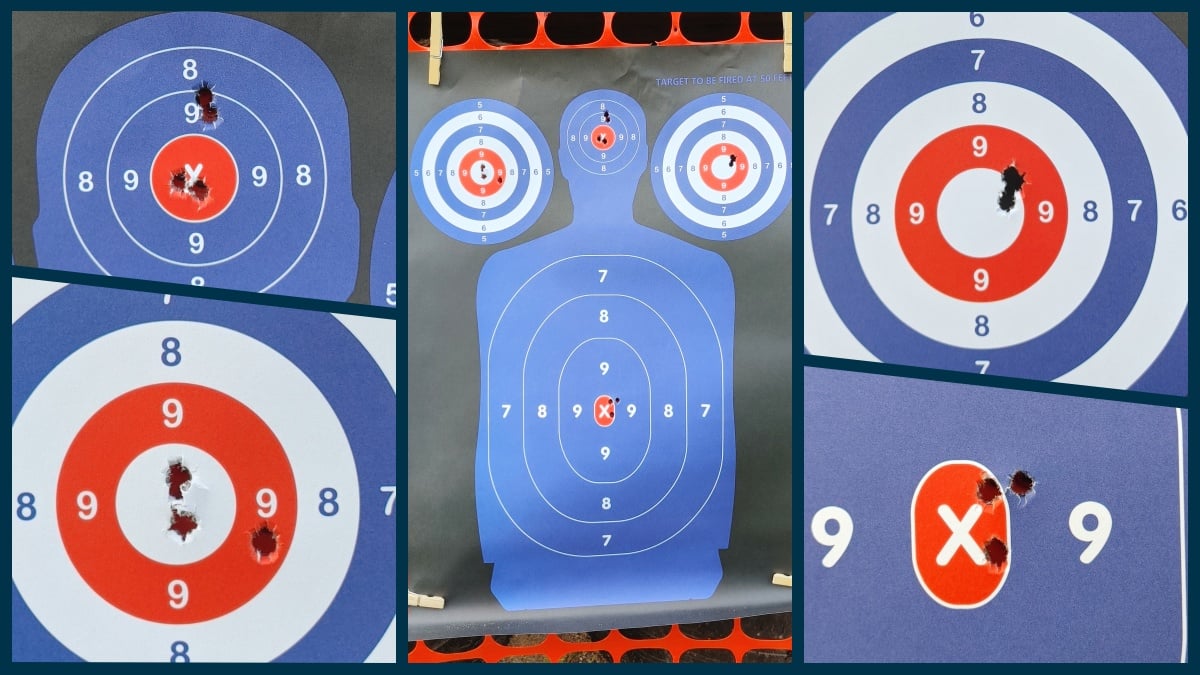
My takeaway from those groups is simple. The optic and rifle are more than capable of consistently shooting 0.5 to 1-inch groups at 50 yards. The variance was essentially my inability to consistently shoot better than the rifle-optic combo and the fact that, even at 50 yards, the center dot is still large enough to partially obscure the precise center of the target.
Now, here’s what I got with the LAR-15 and EXPS3-DCR combo.
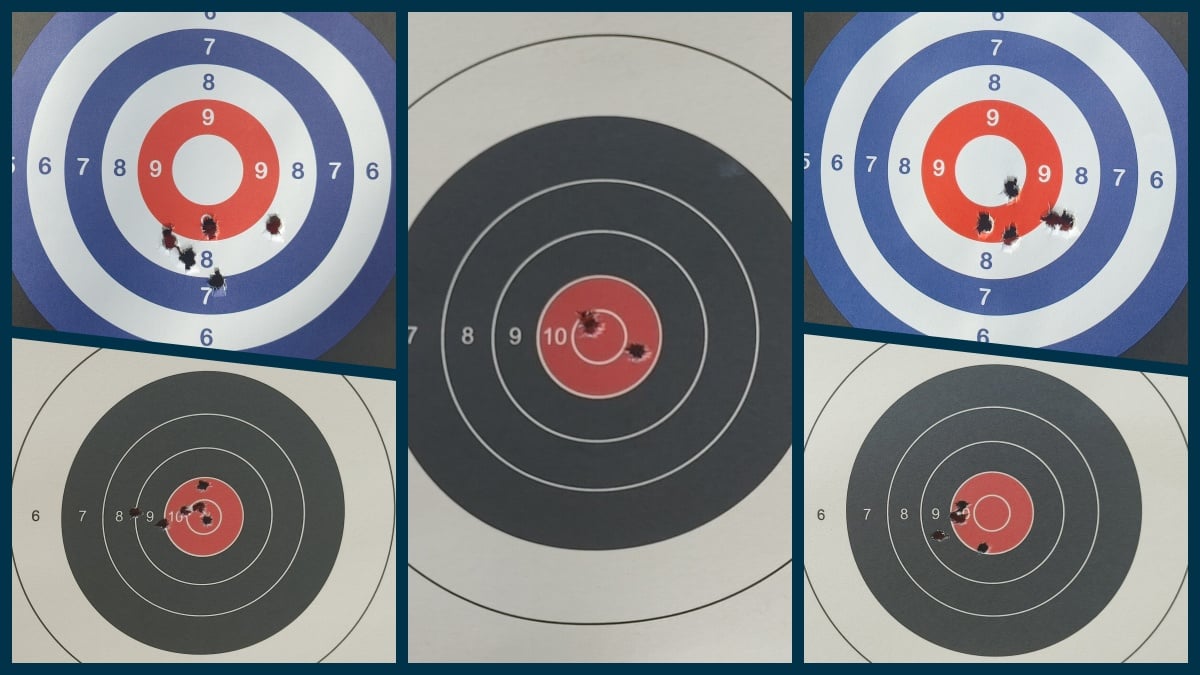
Given the size of the center dot on the EXPS3-DCR and the lack of magnification, the Vudu proved to be much easier for shooting tighter groups, but both optics left me confident that they were more accurate than I am as a flesh-and-blood shooter.
Pros & Cons
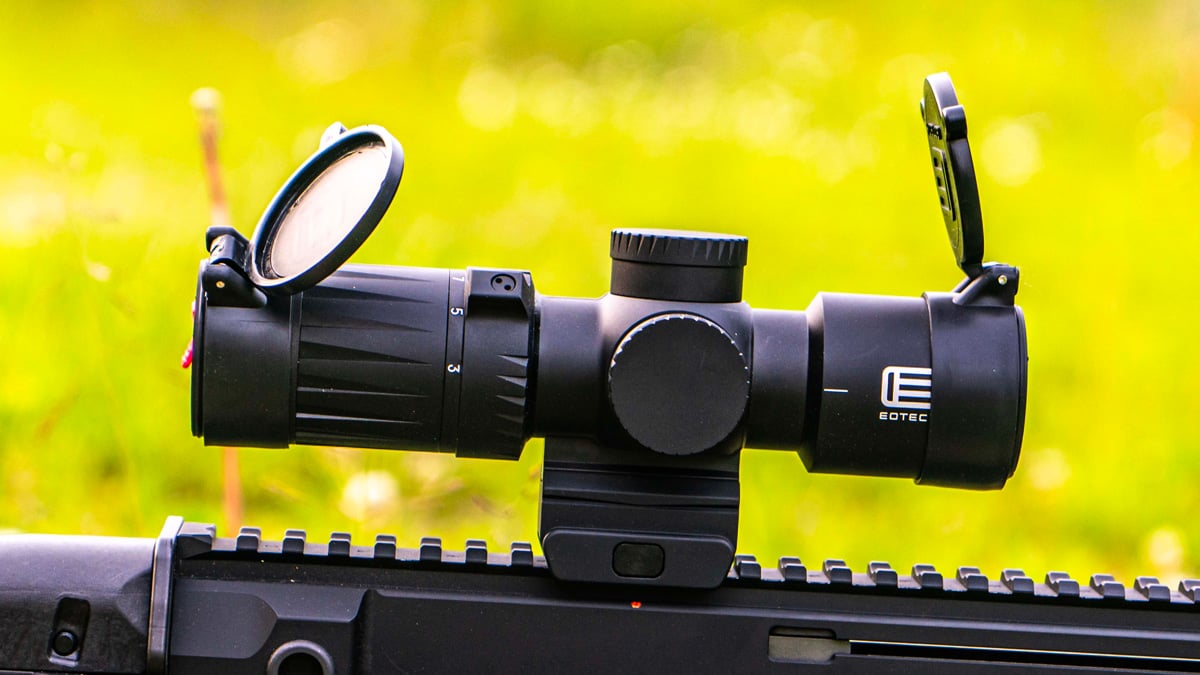
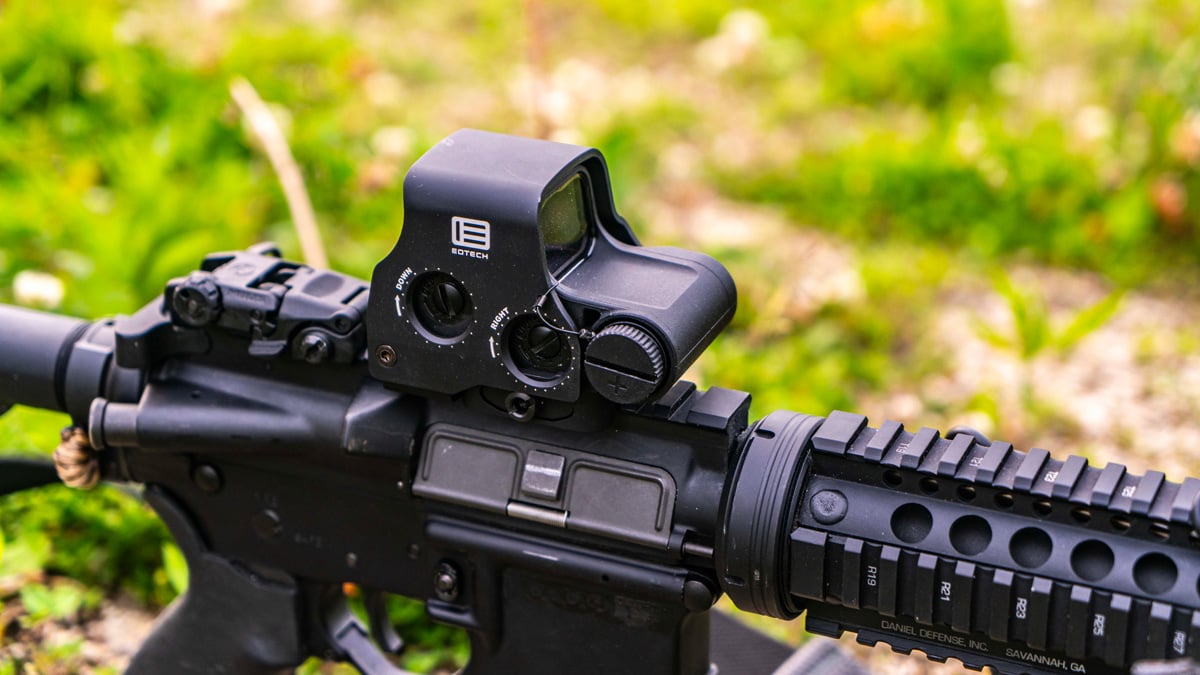
And here are my top pros and cons for the holographic EOTech EXPS3-DCR.
Pros:
- Very accurate
- Highly robust design
- DCR reticle is great for close and mid-range shooting
- Night-vision capable
- ~1,000-hour battery life
- Auto shutoff after 4 or 8 hours
- Made in America
- Integrated quick-detach base also holds zero
- Extra-rugged design
- Fog, water, and shock resistant
- Faster close-range target acquisition
- 20 brightness settings, 10 night-vision settings
- Excellent visibility
- Near-infinite eye relief
Cons:
- No magnification (but does support magnifiers)
- Wide profile
- Caliber-specific reticle for .223/5.56mm NATO
- Hard to do precision work past 100 yards
-
No auto-on feature
Best Pick for You
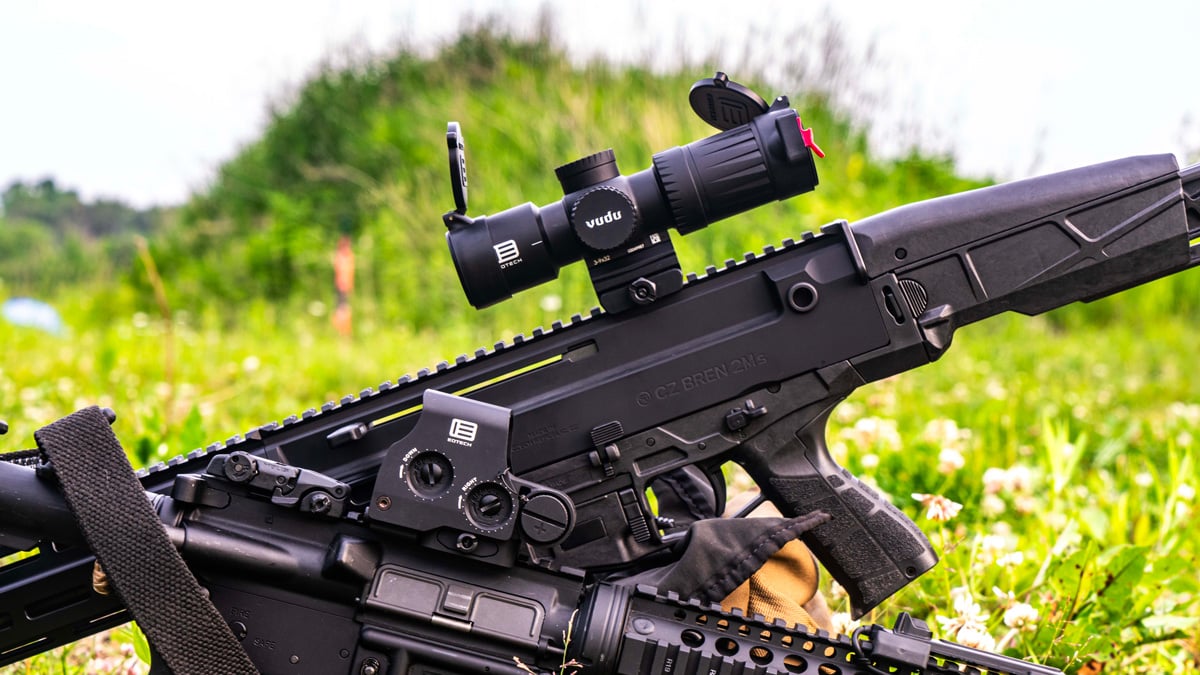
Since both optics have specific strengths, we’ll break down which one we would snag for various shooting needs.
CQB Tactical Pick: Close-range work goes to the EOTech EXPS3-DCR, hands down. The reticle design, lack of magnification, brightness settings, and wide field of view are all superior for fast, accurate shooting in close quarters.
Ranged Precision Pick: The Vudu 3-9x32 scope has it here. It excelled over the EXPS3-DCR due to its variable magnification levels, mil-dot-style reticle with subtensions, small center dot, and range performance testing.
Open Battlefield Pick: Our Vudu takes the cake here, too. While the EXPS3-DCR is better at close-range work, the 3-9x magnification options make this optic plenty nimble for long and close-range work.
Speed & Precision Pick: The EXPS3-DCR is built for speed and precision, with an intuitive design that has us enthusiastically endorsing it for fast yet precise work. Even at mid-range engagement distances, the 50/200-yard zero is fast for quick but relatively accurate shooting.
Home Defense Pick: Once again, the EXPS3-DCR’s CQB chops shine for home defense, too. It is as capable of clearing rooms as it is of defending your home. Our only complaint is that it lacks an auto-on feature, but that feature is also lacking on the Vudu.
Hunting Pick: The Vudu’s compact size and 3-9x magnification, combined with a more precision-based reticle, make it a great hunting option.
Competition Pick: Both optics could excel at competition shooting. The EXPS3-DCR would dominate rapid close-range work, but it would struggle a bit at long ranges. The solution, however, could be as simple as adding a magnifier. Otherwise, the Vudu is a solid all-around performer.
Night Vision Pick: There’s only one real choice here, and that’s the night-vision-capable EXPS3-DCR with its 10 extra brightness settings specifically for night vision.
Value & Versatility Pick: Sure, it costs a bit more, but the Vudu 3-9x32 covers more shooting styles and needs. I would feel at home hunting with this optic, but it can also handle the close tactical work. The 3x magnification setting takes some practice when used in CQB environments, but you can run a 3x optic at close range with great effect. In fact, the U.S. Marines have been doing just that for a decade with their 4x prism RCO/ACOG.
Author’s Pick: I really like the Vudu, and I thought it would be my final pick when I first got my hands on these optics. However, the DCR reticle on the EXPS3 has me sold. If I had to put my money on the table for just one of these optics, it would be the EXPS3-DCR. It’s a great piece of gear, but it’s also a blast to shoot with on the range.