First Impressions
I honestly had no idea of what to expect with a gun called the Tactical Cowboy. I do have some experience with Heritage’s diverse line of .22 LR revolvers, and I have yet to meet one that I did not like for the price.

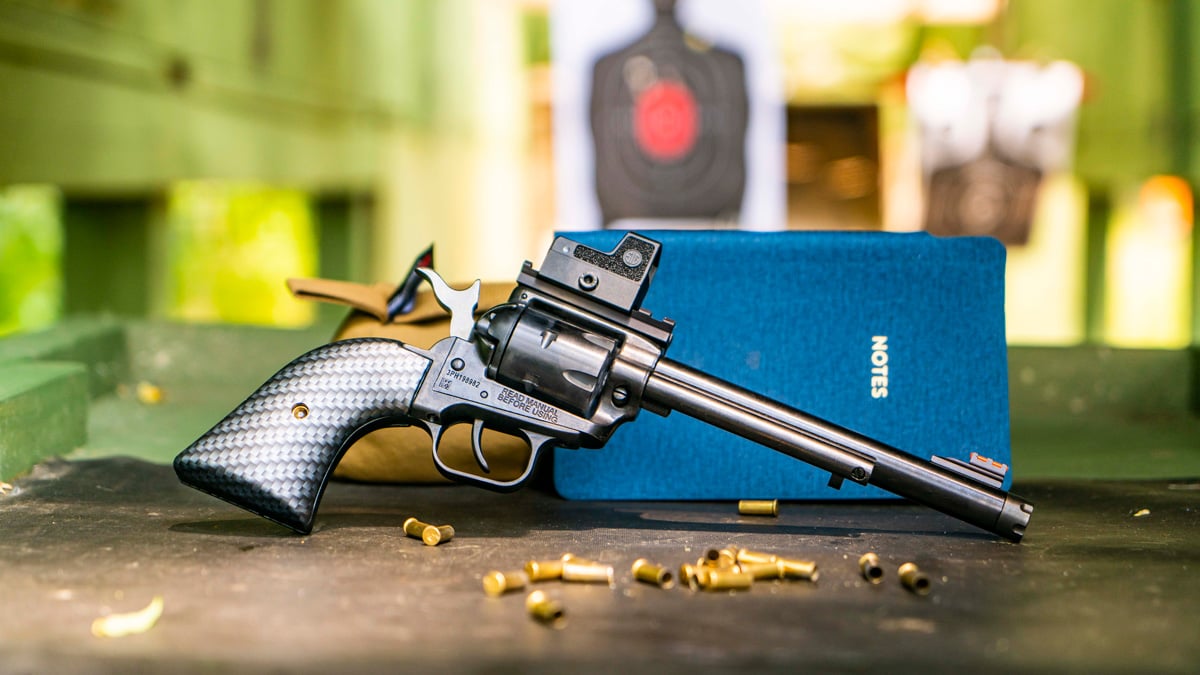
At first, the gun seems awkward with that Picatinny rail on top. It grows on you, especially when you consider this is a budget gun that is still suppressor and optics ready. I even came to like the looks of the gray carbon-fiber grip against the black oxide finish.

Is it truly tactical? Kind of...I guess. As a single-action-only gun that hosts just six rounds of .22 LR, it’s hardly the tactical edge you could get with something like a semi-auto Taurus TX 22. That gun more than doubles your capacity, reloads much faster, and boasts many of the same features for optics and suppressors.
The Tactical Cowboy does have an interesting steampunk Wild West vibe once you get an optic on it. The real test for me was going to be how it performed on the range as a fun-time plinker.
Specs & Features

From a cost-savings perspective, the gun features fairly minimal steel parts. The hammer, cylinder, and internal six-groove barrel are all steel. These are coupled with a frame made of zinc alloy and a handful of plastic parts such as the ejector lever.
Perhaps one of the more notable features are the screws. There are quite a few, though I haven’t noticed any of them walking themselves loose. I would just make a note to inspect them after periods of extensive shooting. A drop of Loctite would solve any issues there.

As for other features, the gun hosts a plowshare-style grip with a flat base and carbon-fiber grip panels. The front sight is a red fiber-optic affair. The Picatinny rail has a deep groove down the middle so you can use the front sight if you decide to run the gun without an optic. It’s also threaded and ready to accept a suppressor or a compensator.


I’ve listed some of the basic specs below:
Length: 11.78 inches
Barrel Length: 6.5 inches
Height: 6 inches
Width: 1.5 inches
Weight: 2 pounds
Capacity: Six rounds
Threading: 1:14 TPI
Chambering: .22 LR or .22 WMR
Trigger Pull: 2.65 pounds
Action: Single-action-only revolver
The Picatinny rail up top is only 2.5 inches long, so you’ll need to shop around a bit if you want to mount a larger scope. I’ve found that it’s plenty of space for most dots ranging from the Romeo Zero and Holosun MRS to a handful of extra-budget-friendly dots.

Given that this gun is somewhat heavy and built for the light-recoiling .22 LR, I wouldn’t say you have to go with anything extremely robust. The cheaper options have worked well enough for plinking, but they do tend to be quite bulky. In any event, the gun isn’t really a competition plinker in my mind.
Accuracy was more than acceptable – which we’ll get to below – and I did take the liberty of attaching a U.S. Optics TS-12X scope that barely squeezed onto the rail. I was pleasantly surprised with the performance.
These Heritage revolvers feature a somewhat unique manual safety that would not be found on the original single-action-only cowboy guns of the Wild West. Even so, the manual advises that you do not carry the gun with six rounds in the cylinder. Instead, you load it with only five rounds and keep an empty chamber under the hammer. I’ve detailed how that works in a previous review.


Shooting & Accuracy
I’ve run 600 rounds of a mix of .22 LR through this tactical cowboy with no major issues. I did have two light primer strikes. That’s to be expected with budget .22 LR ammo. These guns can also support the .22 WMR magnum cylinders from Heritage, which would beef up the power and range at the cost of some added noise.
Related: 2 Revolvers in One – Heritage Rough Rider .22 Mag Cylinder Review
The trigger pull is surprisingly nice for a gun in this price range. It made it easy to break shots accurately. At just 2.65 pounds, it’s hard to blame the trigger for misses inside 25 yards.

We could debate the merits of suppressing a revolver, given that there is the cylinder gap that will release gases. However, the .22 LR chambering is relatively quiet, and I have seen some shooters running these successfully with a suppressor.
For my money, suppressing this gun is the kind of thing you might do if you already had a suppressor on hand and just wanted to expand your options for quieter plinking. Adding a larger optic and shooting of a rest is a different issue. The cylinder gap pushes the gas back into your face off the rest, which I definitely noticed on the range when shooting at longer distances. It was only a minor nuisance. Still, always where that eye protection folks.


Speaking of shooting at greater distances, don’t expect dime-size groups at 50 yards. You can expect to consistently hit in the 2-inch red center at that distance. Larger optics like the TS-12X that I tested also make it harder to manually work the hammer.
If you choose to run a dot, you can achieve similar groupings at 25 yards. Some of that is going to depend on your dot’s accuracy and your ability to shoot a revolver at distance. It was also easy to pick up the included fiber-optic front sight and seemed about spot on right out of the box at 25 yards.


Again, it’s hardly a high-end target gun. But you can certainly have fun with it at a pretty low price point for the handgun, ammo, and a budget-friendly dot.
Pros & Cons
Here’s my short list of the pros and cons.
Pros:
- Affordable
- Suppressor and optics ready
- Fun to shoot
- .22 LR or .22 WMR cylinders are available
- Relatively accurate
- Unique range companion
- Reliable
- Nice trigger
- Picatinny rail with fiber-optic front sight
Cons:
- Slow to load
- Limited capacity
- A bit bulky with an optic
- Not an all-steel design
- Limited rail space
-
Cylinder gap
Final Thoughts

I wouldn’t really say the Tactical Cowboy is tactical in the normal sense of the word. The “tactical” advantages it brings to the table are naturally limited by how the gun functions. So, I struggle to see what real-world tactical advantage it brings over more modern semi-auto handgun options.
It’s a blast to shoot and play around with as a plinker, and it might even do some light lifting as a handgun for small game at closer ranges. It is suppressor and optics ready. I don’t think I would run out to buy a suppressor or expensive optic just for this gun.
Still, there’s nothing wrong with having fun and toying around with an old design that boasts modern features.