History
The APF Strike One Speed finds its roots in Russia. Development of this handgun design began in 2012 under the brand Arsenal Firearms with the model name Strike One. Originally introduced as a replacement for the aged Russian Makarov design for Russian police and military forces, the Strike One was popular with Russian law enforcement but was not officially adopted by the military. However, the design has been frequently seen with Russian Spetsnaz operators.

Unlike most handguns on the market, this design is closely related to the World War I Bergmann-Bayard action, not a tilting Browning action that was so popular around the world. The Strike One uses a Y-shaped speed lock that moves vertically to unlock during firing.
This design allows the slide to be slimmer and sit lower in the hand, creating a lower bore axis and a flatter-shooting recoil impulse. It is also worth noting that the action is extremely strong, as it was rated for Russian military 9mm loads, which have velocities closer to .357 SIG.
The handgun saw development and release overseas but was not introduced to the American market until around 2015. The handgun made a big debut at SHOT Show 2016, being released by Arsenal Firearms along with the Prime Manufacturing Group under Salient Arms International as the Stryk-A and Stryk-B models.

Unfortunately, a trademark dispute forced Arsenal Firearms USA to rebrand as Archon Firearms, and the company eventually settled on the model designation “Archon Type-B” for its compact version of the handgun. The original handgun design manufactured for Russia was produced in Italy. Recently, that design has entered the U.S. market as the Strike One Speed under the brand American Precision Firearms. The APF Strike One Speed is the handgun that we have in front of us today.
Design
On the surface, the Strike One Speed looks like just about any other striker-fired handgun. The one notable difference lies in the deep beavertail cut on the frame, which allows for a deep grip.

Once you break down the handgun, there is a clear difference. Aside from the guide rod, main spring, and barrel, there is a Y-shaped locking joint. This is patented as a speed lock. Unlike the Browning action, where the chamber and breech of the barrel lock the barrel into the slide, this Y-lock moves up and down to lock and unlock the slide during firing.

(Photo: Samantha Mursan/Guns.com)
When the round leaves the barrel, the Y-lock drops and catches a set of slide grooves in the slide, allowing the slide to move to the rear and eject the spent casing as the recoil spring pushes it back into place picking up the next round.

Since the barrel is not tilting up and down, the slide does not need as much space. Therefore, the design is much slimmer than that of a Browning action. The slide sits deep on the frame, allowing the barrel to be very close to in line with the hand, offering a smoother recoil impulse that is easier to keep flat. Ultimately, the idea is that the handgun can achieve accurate follow-up shots faster than other handgun designs.
More Features
Outside of that, this 9mm handgun features a 17-round capacity and feeds from stamped metal magazines. The Strike One Speed is not ambidextrous and only houses a left-mounted slide stop and magazine release.

The sights are a blacked-out rear and a red fiber-optic front. The frame features a long tac rail with plenty of room for mounting lights and lasers. The trigger is flat, with a clear wall and a slightly long reset. While there are options for optics-cut slides, this particular design does not have an optics cut.


The one last feature of note is the stippling on the frame. There are three different styles of stippling on the frame, all at different angles. None are overly aggressive, but they are also not as grippy as I would like to see. If there is one improvement I’d make to the design, it would be a uniform stippling on the frame.
On the Range
Range performance is what really matters when it comes to any firearm. I took the Strike One Speed out to the range on several occasions, and I have well over 1,000 rounds on the platform. I use Winchester white box, Remington, Fiocchi, Sim-X, and some Federal HSTs. At well north of 1,000 rounds, with no cleaning and no oil, just straight out of the box, I have had zero malfunctions. While I have been impressed so far, I would like to push past 2,500 rounds to really test the platform’s performance.

As far as ergonomics, it is one of the most comfortable handguns I have shot. I love a low bore axis, and with a lot of Browning designs, I end up choking down too much and either actuating the slide stop or cutting my hand. The APF has a natural feel, and I never once interfered with the slide stop. The deep grip made recoil control easy.

I love blacked-out rear sights and a highly visible front sight for quick target acquisition. While a red dot would be sweet, it’s nice to see a rear sight that is windage and elevation-adjustable with this color setup. I do wish the front fiber optic was a tad thicker for a wider dot.
I am not God’s gift to handgun shooting by any stretch of the imagination, but I was able to easily hit steel consistently from about 15 feet, all the way out to probably 60 feet.
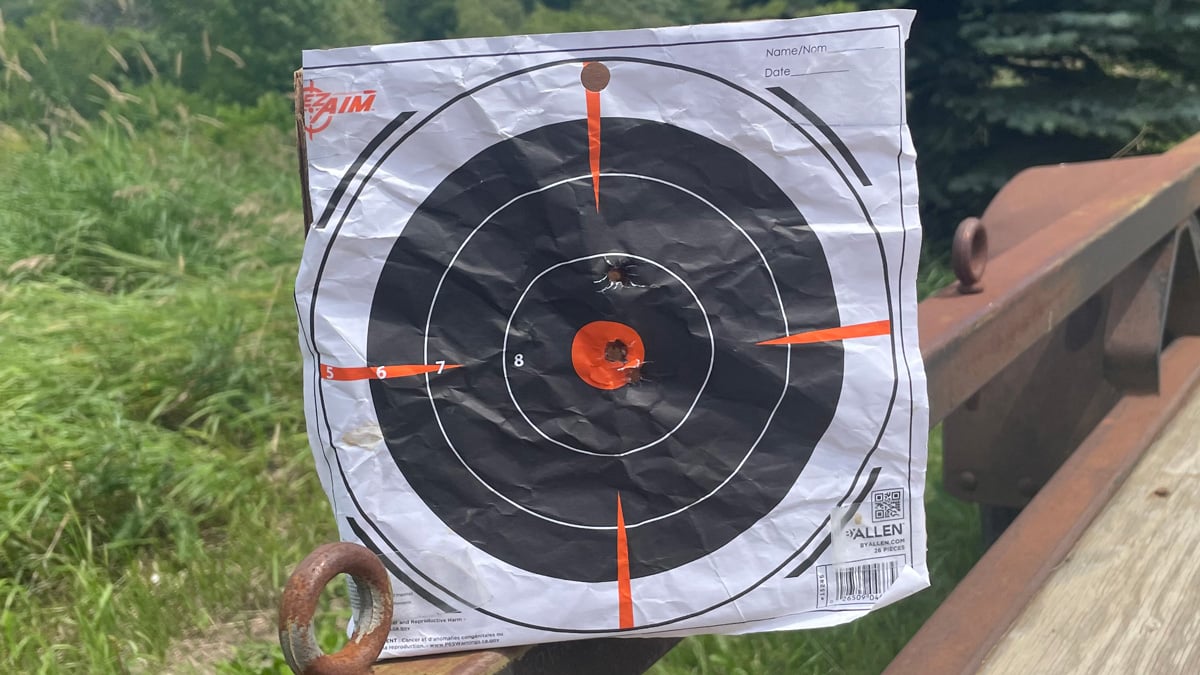
I am convinced that the design is very accurate, and any shortcomings would be with my shooting ability. I did shoot a nice group on paper at about 20 feet, which shows that the gun can perform well.
Overall, it was comfortable, intuitive, accurate, and reliable – all key features in a solid handgun.
Summary
The APF Strike One Speed is a well-built handgun that offers an alternative to all of the Browning options on the market. The only thing that I would change on the design is the stippling on the frame. The only other downside is a relatively limited selection for holsters and accessories.

Outside of those two factors, this has all the makings of an excellent handgun. Anything with a bore axis that low gets me excited to shoot. Overall, I would say that this is a great duty-sized handgun, best suited for the bedside, open carry, or maybe even competition shooting.
As always, the key is not the handgun. You can spend thousands of dollars and buy the most accurate, feature-rich design with the tightest tolerance available, and it doesn’t mean anything if you don’t train. It’s a privilege to have the Second Amendment, so regardless of what firearm you choose, run dry fire drills, grab some ammo, hit the range, and master the craft.