What is a Pistol Caliber Carbine?

Before we can justify spending that hard-earned money on a PCC, we’d best define the term, which is actually easier said than done. Its definition, for all intents and purposes, is right there in the name: a pistol-caliber, carbine-length long gun. Most, but not all, are semi-automatic and magazine fed. Throw me under the bus if you must, but lever-action carbines are darn fast cycling and in comparable – often even more potent – handgun rounds.
Regardless of how broad or narrow your specific idea of PCCs, every one of them is fast-shooting, low-recoiling, high capacity, and readily available. When you ponder PCC chamberings, you should think of rounds like 9mm, .40 S&W, .45 ACP, 10mm, .357 Magnum/.38 Special, .45 Colt, .44 Magnum and a host of others.
Reasons To Buy a PCC
So Many Options
When most think of a PCC, they envision a compact, semi-automatic repeater. While that’s usually the case, PCCs can also be gas guns, lever actions, and even modern sporting AR-pattern short guns. There is a build style for every shooter’s fancy.
Wide Range of Prices
In continuing with the milieu of action options, shooters can enter the PCC market at most any price point. It can be as affordable as snagging a used Hi-Point Carbine for several hundred or as pricey as investing in a premium, competition-ready rig for thousands. Luckily for the average Joe, there are dozens and dozens of choices in the middle ground, both new and used.
Friendly Metrics

As carbines by name, these guns are more compact with shorter barrels. Some have adjustable buttstocks, whether activated by push-button or with spacers. Given the chamberings in traditional handgun rounds, the receivers and actions are also more compressed.
Those metrics make PCCs not only fast-acting but maneuverable in tight quarters like thick terrain and inside structures, not to mention more easily stowed in trucks, UTVs, and the like. Some, like Ruger’s PC Carbine, are available in takedown models, which makes them backpack-friendly as well.
Related: Setting the 9mm Standard – Ruger’s PC Carbine
Handy Home & Ranch Gun
PCCs can be quick and ideal for nuisance animals or sudden defense protection, as they’re likely to be handy and at the ready due to their size. After all, the gun that’s always with you is better than the one that’s not. We know more than a few ranchers who keep a PCC – semi-auto or lever – in their rig along with a sidearm of the same chambering. A Marlin 1894 or Henry Big Boy are loyal companions to a wheel gun, while the list of pistol and semi-auto carbine choices could fill pages.
Shares Handgun Ammo
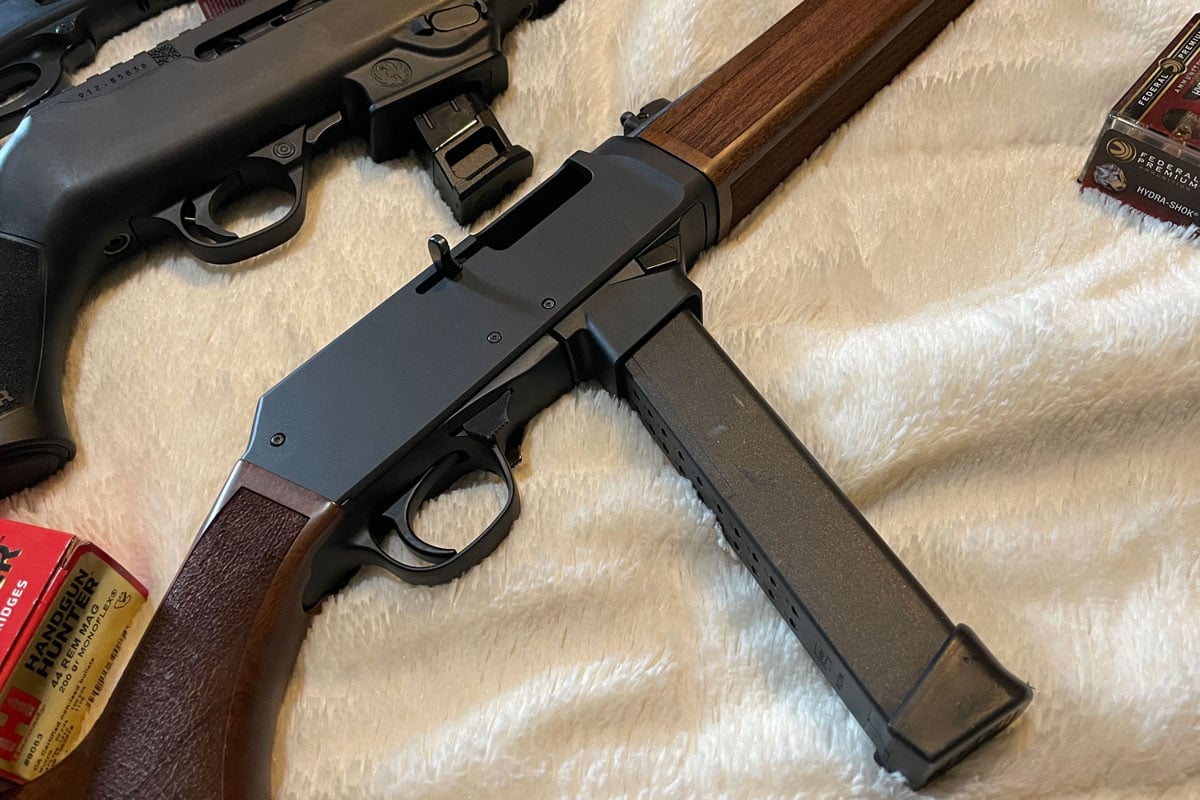
One of the greatest wins for the PCC is its chambering. Every PCC is chambered in a round also found on a handgun, be that a pistol or revolver. That allows shooters to carry the same ammunition for both their sidearm and carbine, not unlike the old West style. In the case of many pistols, the PCC will even use the same magazines. Whether pairing a revolver and lever PCC or a pistol and semi-auto PCC, there’s a winning combination.
Better than the handgun?
Don’t get us wrong – we love handguns. However, most shooters will find far superior accuracy with a shoulder-mounted PCC than they would with a pistol or revolver in that same chambering. In addition, while not all handguns can handle +P ammunition, most every PCC can. By and large, ballistics are also superior with the longer barrels found on PCCs.
Competition Darling
Many shooters take advantage of the challenge and camaraderie of competition shooting. One of the most affordable, lowest recoil match options is that of the PCC. In fact, PCC-specific competitions have been booming in recent years, they’re open to competitors of most any skill level, and getting into the sport does not have to cost thousands in guns, optics, gear, and ammunition.
Hot Features

Though there are exceptions in every class, by and large, the average PCC packs in user-friendly features. They offer a high capacity, whether by detachable magazine or tubular mags. Many show off threaded barrels, so shooters can mount brakes or suppressors. Almost all are optics-ready. A good number of them are designed with easily accessible or even ambidextrous controls.