Gun Ownership Makes You More Likely to Be a Victim
Many anti-gunners claim that if you own a gun, you're more likely to have it used against you than you are to use it in self-defense. They spout ridiculously high percentages that are entirely fabricated. It's impossible to know the accurate number of defensive gun uses (DGU) per year, because many go unreported.
For example, if a criminal comes onto your property and you brandish your firearm, scaring them away, that's considered a DGU. The same goes for drawing a gun and preventing rape, kidnapping, etc. Simply put, there doesn't need to be an exchange of gunfire to be considered a DGU.

It is assumed that this type of thing happens very frequently in the United States because of the high number of gun owners. So, why is it difficult to track? Some will call the police after an incident and file a report, and others will not, making it all but impossible to get an accurate number.
Related: What Should You Do after a Self-Defense Shooting?
The FBI massively underreports this fact, stating that it's only 4.4 percent of mass shootings instead of 34.4 percent. While it's unclear why the agency publishes incorrect information, it's evident that their report continues to perpetuate this myth.
Red Flag Laws Save Lives
Anti-gunners have long touted red flag laws as "common sense" gun control. They allege that individuals who are a danger to themselves or others only become more dangerous in the presence of a firearm. Therefore, if the authorities can disarm them, any attempts at suicide or homicide become more difficult.
In December 2018, John R. Lott, Jr., and Carlisle E. Moody of the Crime Prevention Research Center published a paper titled "Do Red Flag Laws Save Lives or Reduce Crime?" Using the most recent data at the time, the team investigated the effect of red flag laws on murder, suicide, and deaths due to multiple victim public shootings. The findings of the study read, "Red flag laws had no significant effect on murder, suicide, the number of people killed in mass public shootings, robbery, aggravated assault, or burglary. There is some evidence that rape rates rise. These laws apparently do not save lives."

Existing laws already grant emergency orders if someone is a danger to themselves or others. If these laws aren't working, what makes an anti-gunner believe a different law will do better? Not only do red flag laws fail to prevent crime, they are extremely easy to use for malicious intent, ultimately depriving gun owners of legal due process.
Related: Biden Admin Sets up Federal 'Red Flag' Gun Seizure Center
There are many examples of red flag laws failing, including recently in Buffalo, New York, in 2022. Less than a year before 18-year-old Payton Gendron opened fire in a grocery store, he was investigated for making threats at his high school. Police responded, and a mental health evaluation took place at a local hospital.
Despite New York having the strictest red flag laws in the country, nobody requested to remove his firearms. Gendron still legally purchased a rifle and went on to murder 10 people.
Guns Are the Leading Cause of Death Among Children
This disturbing myth seems to pop up every time a tragic incident at a school occurs. The anti-gun politicians speak up immediately and demand more gun control because, they claim, guns are the leading cause of death among children.
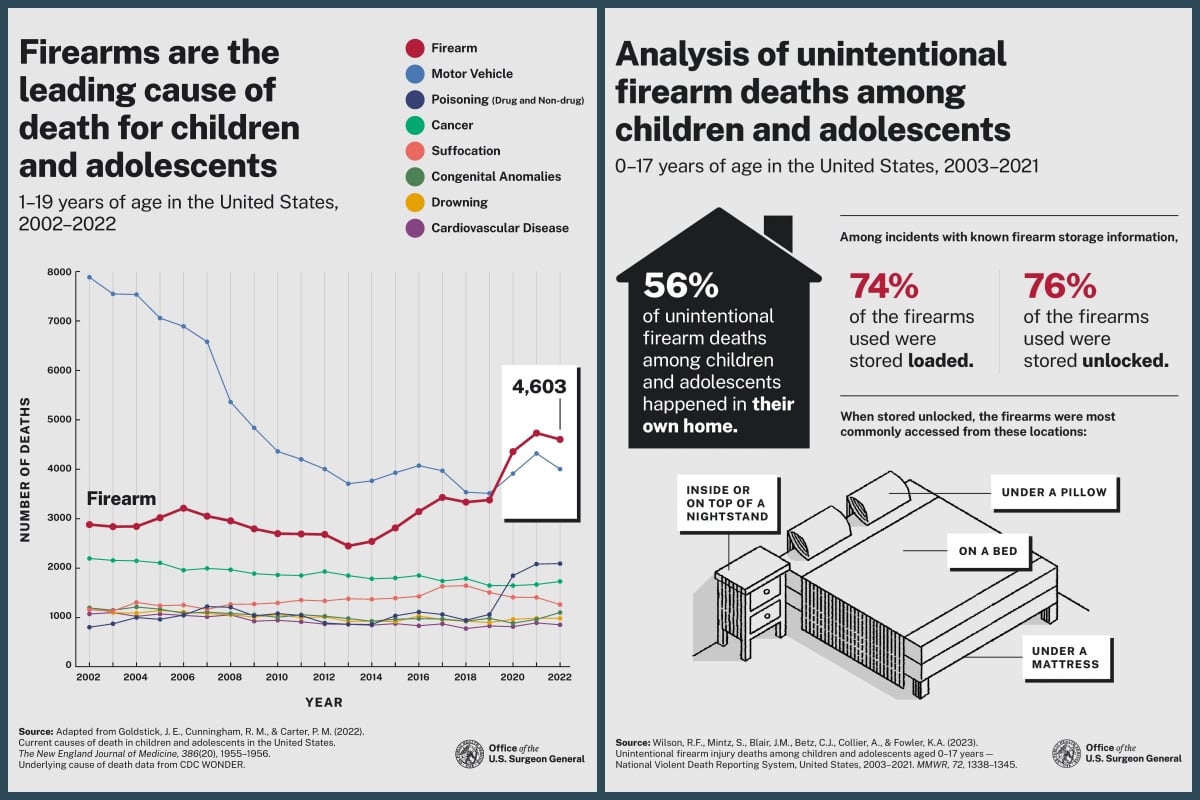
Because this claim is not true, anti-gunners often cite sneaky statistics. Most notoriously, using a misleading data set that includes "children" ages 1-19. In the United States, 18- and 19-year-olds are considered adults by societal standards and laws.
Related: Shots Fired – 2A Community Responds to Surgeon General Advisory on ‘Gun Violence’
When we remove adults from the data, guns are not even in the top three causes of death. If we remove teenagers altogether, and we look at children 12 and under, motor vehicle accidents and drowning cause more deaths than guns. In addition, these data sets always exclude children under the age of 1, because their age-specific causes of death would not allow firearms anywhere near the top.
Ignoring the fact that none of the current gun control laws have managed to prevent these tragedies, they manipulate the data instead of trying to solve the problem.
Permitless Concealed Carry Increases Crime
Anti-gunners claim that constitutional carry will drastically increase the rate of homicides. The problem with this allegation is that criminals don't follow the laws and never have. The only people affected are law-abiding citizens.

In May 2024, independent researchers, Colorado State University professor Youngsung Kim and K. Alexander Adams from the University of Wyoming, examined crime statistics from all 50 states and the District of Columbia between 1980 and 2018. They considered more than 30 variables, including population density, poverty rates, alcohol consumption, and other gun control measures.

They found that, "Constitutional carry does not lead to large-scale changes in homicides or firearm suicides. The doomsday scenarios of constitutional-carry opponents are not supported by social science."
This study and others have noted a decrease in gun-related crime in the states that have adopted constitutional carry. These states did not turn into the Wild West, and some saw as much as 6 percent fewer homicides.
Assault Weapons Bans Reduce Mass Shootings
"Assault weapon" is a made-up term used as a catch-all for semi-automatic modern sporting rifles with magazines that hold more than 10 rounds. For many years, anti-gun politicians have been pushing for and sometimes succeeding in passing an assault weapons ban.

They claim that these firearms equipped with standard capacity magazines can cause too much damage in a short amount of time. If they're banned, mass killing events will cease to exist.
The fatal flaw of this claim? Most mass shootings are carried out with at least one handgun, and many only involve a handgun. Shootings like Virginia Tech in 2007, Fort Hood in 2009, and Virginia Beach in 2019 were all done with handguns.

Banning so-called "high capacity" magazines has proven ineffective, too. It's not uncommon for law-abiding concealed carriers to carry a spare magazine; certainly, someone committing a crime would do the same. In the Parkland, Florida shooting, the killer used 15 10-round magazines to kill 17 people. None of them were considered "high capacity," and yet he still carried out this atrocious attack.
Short of an all-out confiscation, it would be impossible to ban any single type of firearm or magazine completely. These weak laws do nothing to prevent crime and only keep law-abiding citizens from protecting themselves and their families.
Conclusion
When presented with statistics, it can be difficult to separate fact from fiction. It's important to remember that data can be skewed and presented in ways that sound legitimate. Question what you read and do your research. It may take some digging, but the truth always rises to the top.