The Barrett M82A1 .50 BMG
Barrett first produced this rifle more than 30 years ago. After becoming a sensation with various military units, it put Barrett Firearms on the map. The company has since released a variety of other firearms, but the famous M82A1 is still its flagship gun.
Related: First Look – Extreme Long-Range Answers with Barrett MRADELR

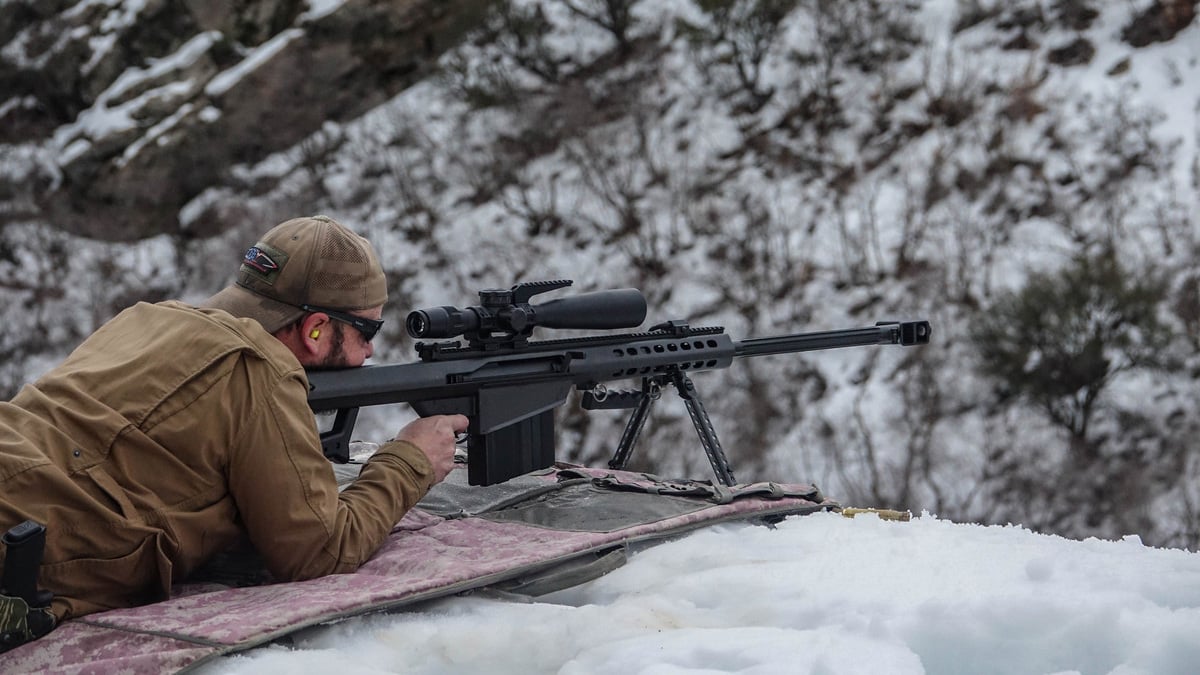
Designing a gun like the M82A1 must have taken some time, as the large .50 BMG cartridge is substantially bigger than most everything else on the civilian market. The operating system is unique and a bit of an engineering marvel. The massive 29-inch barrel features a large, vented brake to help reduce recoil, and the fluted barrel is also mounted in a sliding configuration with a pair of long coil springs yoked around the breech end.


This allows one of the more interesting functions of the rifle: the barrel and bolt both travel rearward when the rifle is fired, only an inch or so until the bolt rotates out of battery and continues its travel rearward. The bolt carrier, while complex, has a familiar-looking buffer spring that pushes it back forward into battery. A three-lug bolt scoops rounds from the 10-round magazine as it comes back forward.

Controls on the M82A1 will be familiar to AR-15 users, as the Barrett basically copies them. The grip and safety will be right where you expect, but that’s where the similarities end.

Machining the structure of the M82A1 would be incredibly expensive, so Barrett instead chose to stamp receiver parts and weld them together. A series of takedown pins like those you’d find on a trailer hitch hold the rifle together, allowing the rifle to be taken down to a slightly smaller size when storing or transporting.
Range Prep
Loading up everything to go with the Barrett would be heavy – just a few boxes of ammo seemed as heavy as some guns I’m used to hauling around. Speaking of ammunition, the M82A1 is an awfully expensive machine to feed. The M107 version probably goes through a lot of ball and specialty ammunition.

For our testing, I got two different brands of match-grade ammunition: one from the big red powerhouse of Hornady and the other from Desert Tech. Both feature the 750-grain Amax bullet and are known for accurate use in .50-caliber sniper rifles.


This rifle was going to need a scope, and I had just taken my US Optics Foundation 25X from another rifle so I dropped it onto the Barrett’s 27-MOA canted Picatinny rail. I mounted the scope using Area 419’s one-piece scope mount, since big guns and big scopes need a robust interface.

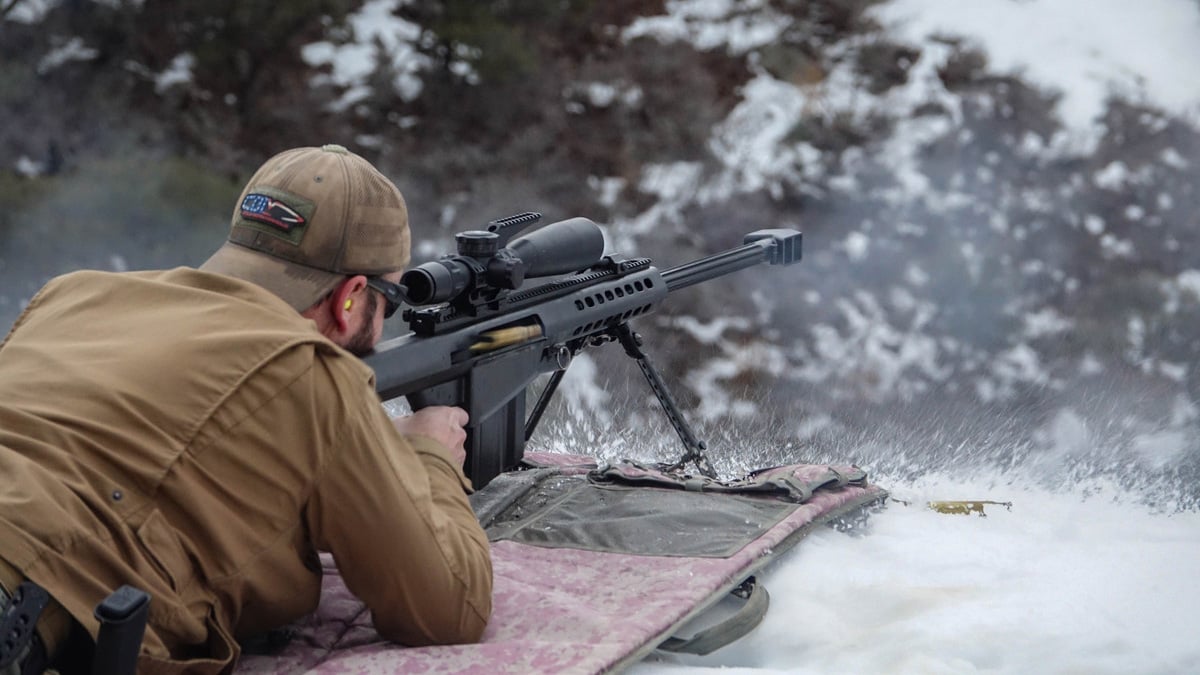
I had no interest in taking this rifle to a public range, as it deserves more room than that. So, I headed into the cold and snowy Rocky Mountains where I could settle into the snow for a solid and comfortable shooting position. I used a patch of dirt and gravel to get the rifle roughly zeroed before moving it to paper to perfect it.
.50-caliber Country
Barrett’s M82A1 is not known particularly for incredible accuracy. I have heard reports from 1 MOA to as many as 7 MOA. I wasn’t sure what to expect, and this was my first experience shooting one. With my target at 150 yards, three-shot groups came out at 1 MOA, which was better than I expected.
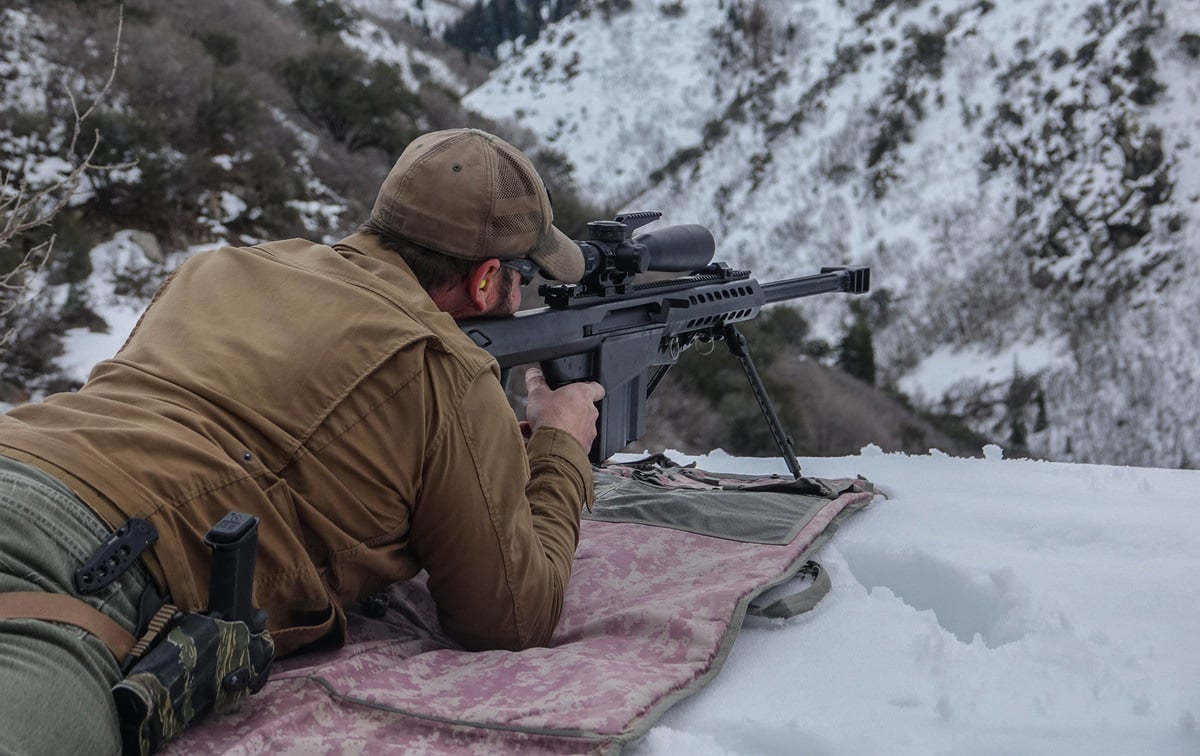
After testing both ammunition types, I decided to stretch out the big Barrett to see how it would do as the heavy sniper rifle it is so frequently shown as. I picked out a small rock outcropping a couple of canyons over, ranging just past 650 yards. With 4 MRAD of elevation dialed, I sent the first shot into the deeply snow-covered hillside.
The report of the rifle was significantly subdued by all the snow, and I watched through the scope as my shot impacted 6 or so inches over my point of aim. I corrected the elevation and fired four more shots at the same point, all of them hit close enough for sniper purposes. In fact, many of the marmots I hunt up here wouldn’t have escaped those shots. An impressive splash of the bullet would spray down into the snow under the rock.

With a gun this heavy, it was incumbent on Barrett to include a suitable bipod. The very strong bipod is pinned to the bottom of the receiver and allows leveling of the rifle. The legs are extendable by pulling them out and secured by a ratcheting button.
Managing Expectations
After a lifetime of pop culture references to this rifle, I am a little surprised at my experience shooting it.
Personally, I have a strong distaste for the idolization of this rifle, particularly due to the hordes of basement-dwelling neckbeards who brave the sunlight now and again to visit the local gun store just so they can utter the phrase “Barrett .50-cal.”
Not to mention the mythical stories and goofy videos on YouTube about .50-cal rifles sucking a deer’s brain out without even touching it… (That myth is easily disproved by shooting a sheet of paper with a .50 BMG and seeing nothing more than a half-inch hole in the paper.)
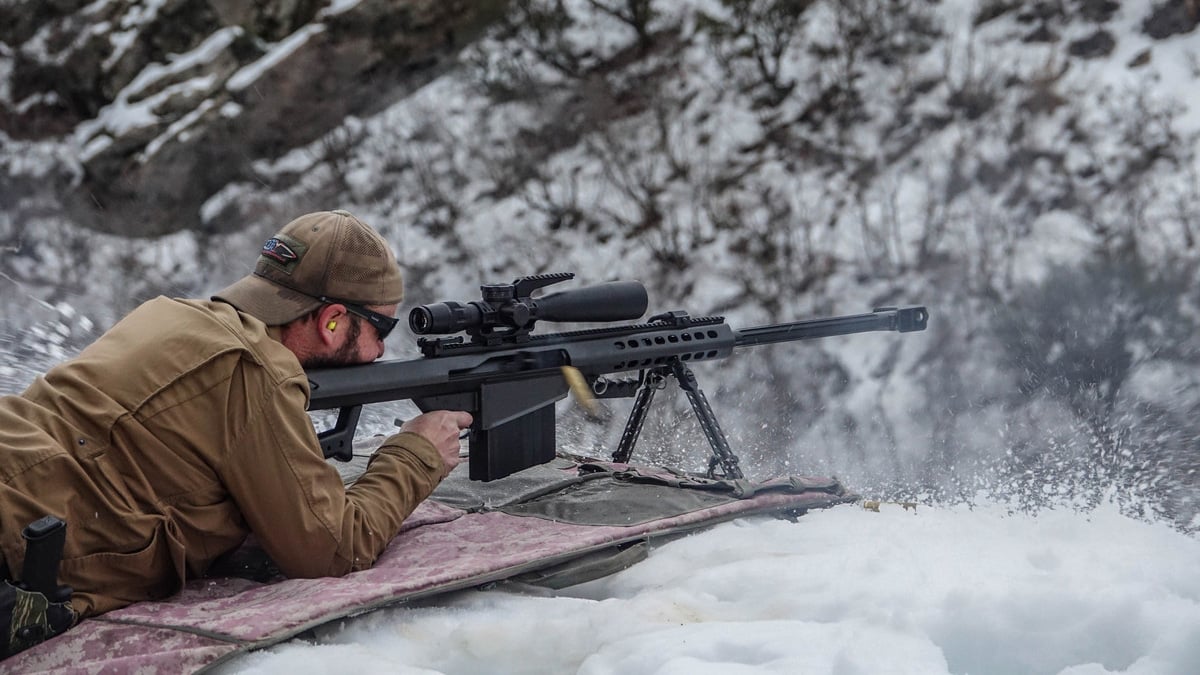
Also, I am only interested in accurate firearms. Based on available information, the M82A1 wasn’t particularly accurate, so when coupled with the golden calf effect this rifle seems to induce, I wasn’t expecting to like it. But like a true gun nut, I couldn’t help but crack a smile every time the thunder came.
You can’t judge a rifle solely on thrills, so let me explain some positive and negative aspects of the Barrett M82A1 .50 BMG.
Pros & Cons
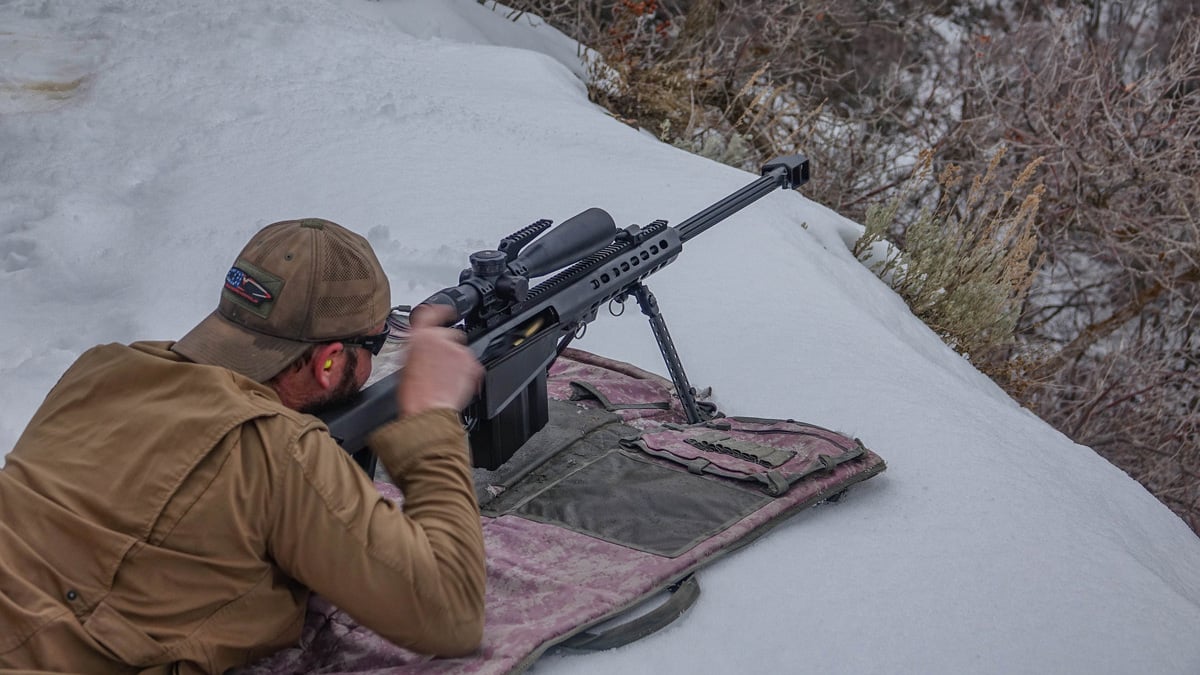
At over 32 pounds, this rifle is certainly not for the weak. But who expected it to be light? Its girthy build also makes it much more pleasant to shoot – just don’t expect to haul it very far. The construction of the rifle is certainly robust, and the long military service alone is a good indicator that its design is durable.

That said, I do feel like it is a very plain firearm. With a street price starting around $8,000, the construction is surprisingly common. Comparably priced firearms generally feature precisely machined alloy parts, not folded sheet metal welded and pinned together. Glancing at individual portions of the rifle, you might think you were looking at a utility trailer or something.

Other features like the rear monopod and recoil pad also seem fairly mediocre for a rifle priced like a 10-year-old Honda. That’s not to say they aren’t serviceable; they just feel like the original decades-old design. Modern comparable rifles have much nicer components.
For all the negatives I just brought up, the M82A1 is still fun to shoot. The trigger feels at least as good as a nice AR trigger, and it allowed me to shoot more accurately than I expected. The long stroke of the bolt seems to soften the recoil to something comparable to a 12 gauge. This coupled with the better-than-anticipated accuracy made rapidly hitting man-sized targets at 600 yards quite easy.

Of course, the M82A1 was made for bigger purposes, and destroying objects from a distance is a more likely duty for it. Breaking vehicles, barriers, and carrying special munition payloads into target is the real-world application for this rifle. That, of course, sounds more like a law enforcement or military application, but since we live in the greatest place on earth, you too can wield this power.

Pros:
- Fun to shoot
- Nice trigger comparable to AR
- Accuracy better than anticipated
- Robust and durable construction
- Proven reliable in military service
- Powerful!
Cons:
- Expensive – starting around $8,000 used
- Lacks precision manufacturing and features
-
Heavy
Final Thoughts
I’ll be honest here: I had to check my own bias with this rifle. Being surrounded by more accurate and precisely manufactured rifles, I have for a long time discounted the M82A1 as a heavy-duty lead pump.
As it turns out, the M82A1 is more than just a lead pump. This particular gun seemed to shoot better than a typical unit, which certainly made it more appealing to me. I can assure you that if it were the typical 3 MOA or more that some folks experience, I probably wouldn’t be as positive.
Despite the various negative aspects of the rifle I’ve brought up, I still wouldn’t mind having one. As far as buying the rifle, I am certainly torn. If spending this kind of money, I think there are other rifles I would probably buy before this one. But that is my preference. If you had an M82A1, what would you do with it?