History
The Colt SP1 dates to 1964, the year the U.S. Army adopted the M16 to replace the M14. In the late 1950s, Marine Corps veteran and machinist Eugene Stoner began work on a new rifle that would set the pace for firearms for decades to come. His design was a lightweight, auto-loading rifle with a detachable box magazine.
Related: Rare Stoner 63 Recalls Military History at Arizona Gun Show

Stoner started with the design of the AR-10, chambered in .308 Winchester. He hit full stride when he scaled down the design, centered on a new .223 Remington intermediate cartridge that Stoner had also been working to develop. Eventually, the AR-15 was born.
This lightweight, intermediate-caliber, auto-loading rifle used detachable box magazines. The smaller caliber was extremely light and allowed the individual to carry more ammunition, while also being extremely controllable.

The AR-15 was submitted to military trials and eventually adopted in 1964. At that time, Stoner’s company Armalite (AR stands for Armalite) had sold the design to Colt, as it was in a better financial place to manufacture the rifle. The military version of the rifle was manufactured by Colt as the M16, while the domestic version was produced under the SP1 designation. While Colt called it the SP1, the receiver still maintained the AR-15 design marking next to Colt’s logo, as a part of the licensing agreement.
The Colt SP1 began production in 1964 and continued until 1982. After 1982, the design would continue to be manufactured; however, post-’82 rifles were mainly made of leftover parts, as the rifle had exited main production. As I alluded to earlier, due to the U.S. 50-year curio and relic law, tens of thousands of Colt SP1s are considered C&R-eligible. Anyone with a C&R license can directly transfer ownership of these old AR designs.
The Colt SP1 Design
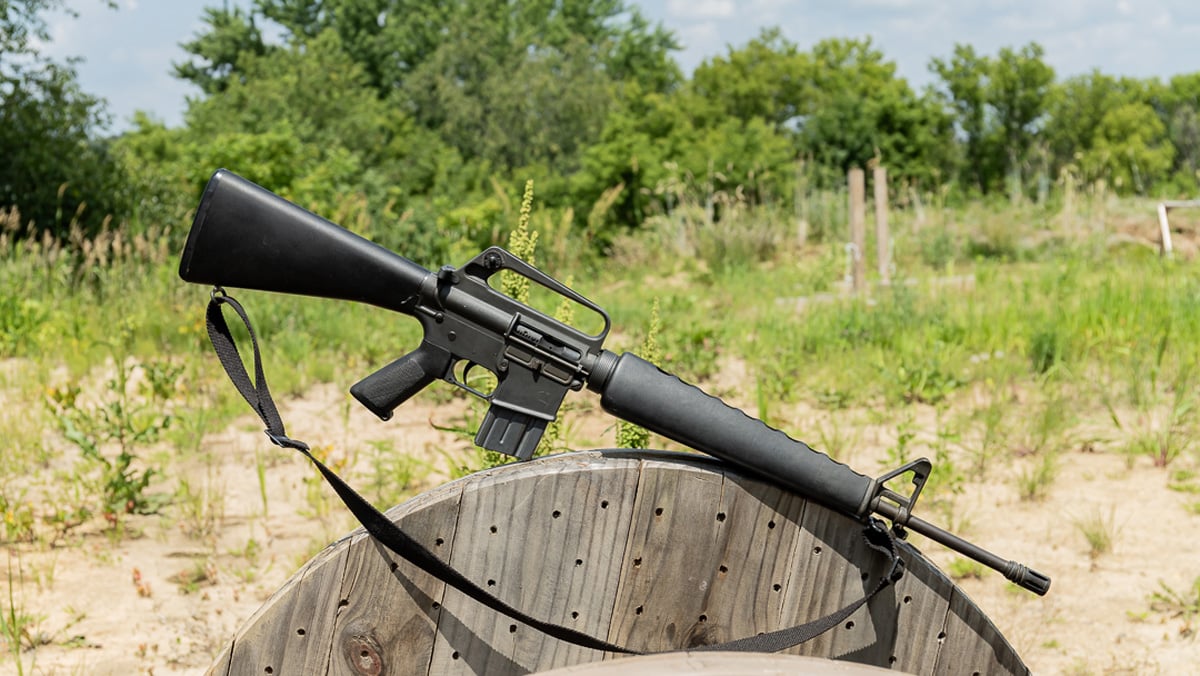
The Colt SP1 is a direct gas impingement, rotating bolt, semi-automatic rifle chambered for .223 Remington. It feeds from the AR-15 STANAG magazine pattern. The design incorporates heavy use of polymer, achieving an incredibly lightweight construction. While most are familiar with the standard AR-15, the Colt SP1 has some unique features.

Starting at the tip, the first notable difference in the SP1 over modern ARs is the A1-style birdcage. This muzzle device is slotted all the way around the design, unlike the modern A2 design, which is closed at the bottom to eliminate upward kick when shooting in the prone. Regardless of A1 or A2, this bird cage design is excellent for eliminating flash.
The next notable design difference is the pencil profile barrel. Modern ARs feature thick and heavy barrels, many with lightening cuts or unique profiles. The principle of Eugene Stoner’s original concept was to have the lightest rifle possible, and the pencil barrel achieved a light and sturdy construction.

Next, the handguard is one of the more prominent features of the early AR-15. While this rifle was put together post-1982, somebody has installed the original triangular polymer handguard. This handguard design is reminiscent of the M16A1, which saw prolific use during the Vietnam War.
While iconic, these triangular handguards are thin and brittle, cracking easily. In the early 1970s, they were replaced by a round handguard with reinforced polymer ribs and a heat shield underneath.
A Simple Receiver
The receiver design is especially unique on the Colt SP1. Anyone who has experience with a modern AR will quickly notice a few features are missing on this SP1. Most notably, the Colt does not feature a forward assist.

The forward assist was an addition made by request of the U.S. Army. Eugene Stoner did not believe in the forward assist. He believed forcing the bolt into battery when there was a malfunction was counterintuitive and would make the problem worse. Subsequently, the Air Force version of the M16 is slick-sided, missing the forward assist.

Another visual feature missing on the lower receiver of the Colt is the fencing buildup around the controls, mainly the magazine release. Modern AR-15s have material built up around the magazine release to protect it from being accidentally actuated.
The lower also has a different retention for the takedown pins in the front of the receiver. In stay of the normal retained push pin, the SP1 features screws on both sides of the receiver, while utilizing the standard captured push pin in the back of the receiver.
More Features
The early Colt design is iconic for its fixed carry handle with a rear sight. Originally this carry handle housed the charging handle, but one of Colt’s modifications was moving the handle to the rear of the receiver, inadvertently making it non-reciprocating as well. The fixed carry handle does have a hole drilled in the middle, allowing for the addition of a Picatinny rail for mounting optics.

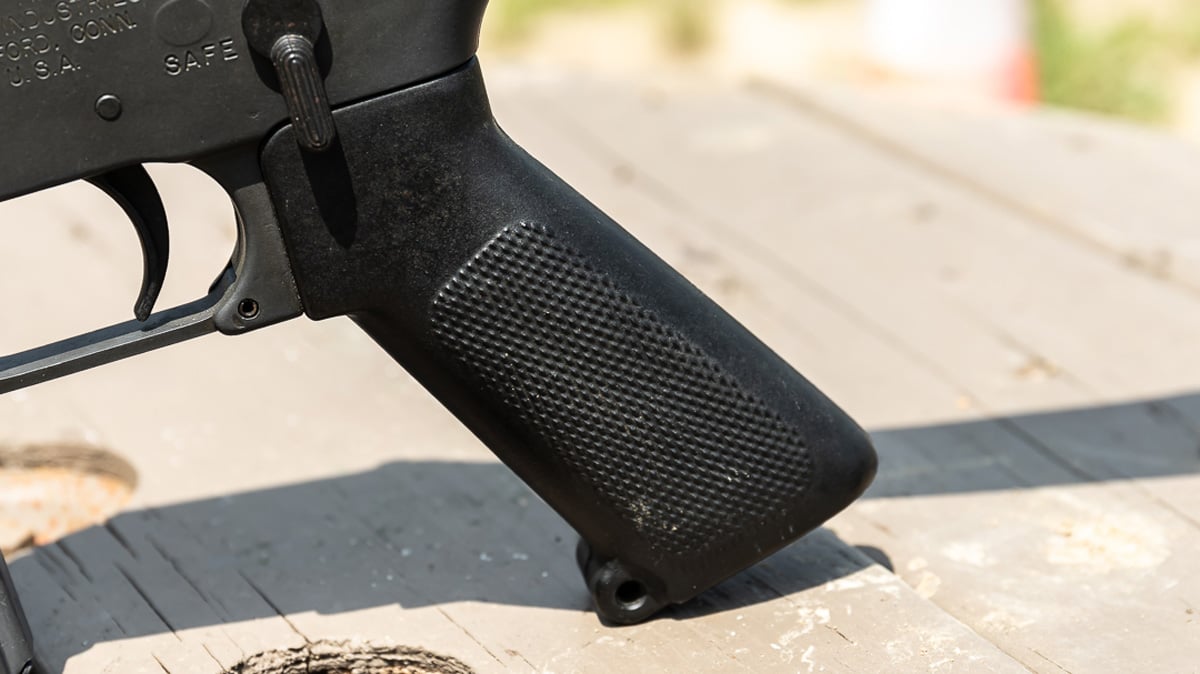
The SP1 includes an A1-style pistol grip as well, missing the finger groove that is present on the more common and modern A2-style pistol grip. The full polymer stock is also a tad shorter than the newer A2-style stock.
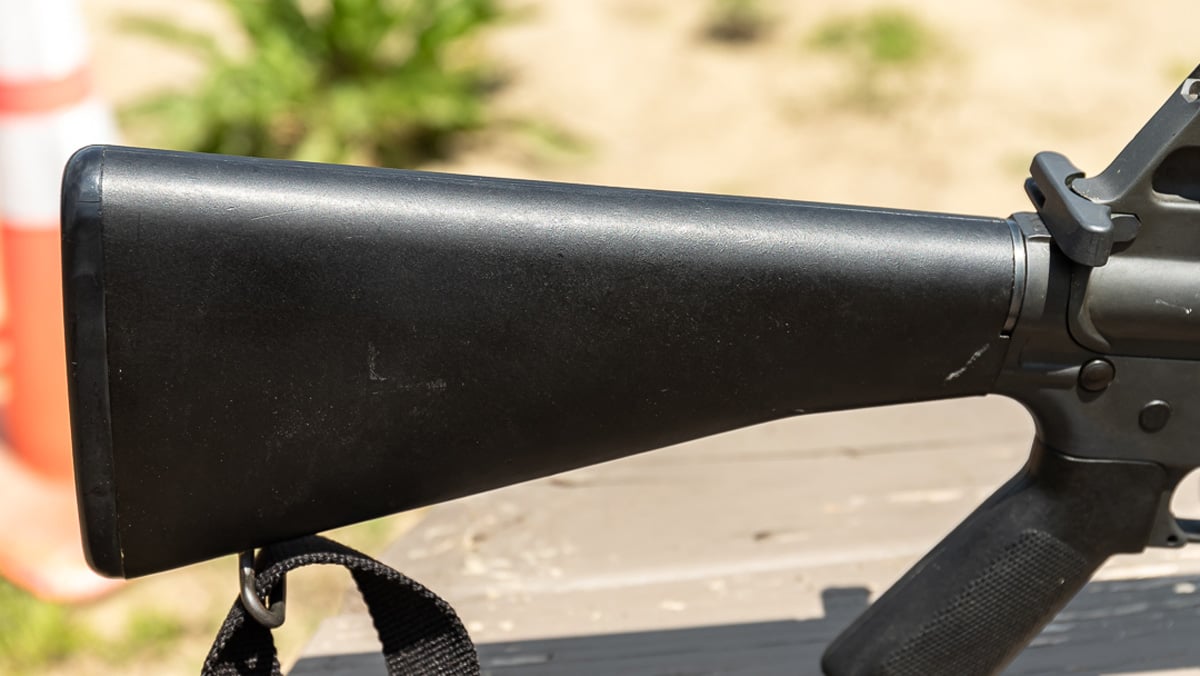
Soldiers in the 1960s typically required a shorter length of pull prior to the addition of body armor as a common practice. The stock includes a buttplate compartment for storing a cleaning kit.
On the Range
Shooting the Colt SP1 is an interesting experience, to say the least. It’s extremely weird to handle an AR-15 design that largely qualifies as a 50-year-old relic. It also feels odd to hold such a light rifle, as the modern AR-15 has become so “feature rich” that the added weight of rails, heavy profile barrels, accessories, optics, and other items have displaced Stoner’s original concept of a light rifle.

While the SP1 is incredibly light, it is also extremely easy to control. The 20-inch barrel combined with the light recoil from the .223 Remington (5.56 NATO) cartridge makes for an easy and pleasant shooting experience. The trigger is very light compared to most other military surplus rifle designs on the market.
The iron sight picture gives an authentic vintage feel to the design. It’s odd, because with the polymer, the modern cartridge, and the familiar controls, it almost feels wrong to be shooting without an optic. But it’s nice to get some trigger time on the basics.

The triangular handguard is one of the best features of the rifle. The support grip is extended comfortably, and as soon as you grab it, you’ll expect Huey helicopters to fly over blasting “Fortunate Sons” loudly over the radio.
This Colt SP1 came out of our Certified Used inventory and included a plethora of straight-wall 20-round magazines. Now, the 30-round magazine was introduced around 1970 and was more prominent for a longer period, but come on – you think I am going to miss out on shooting the aesthetically pleasing 20-rounders?
Summary
It’s hard to believe the SP1 is nearly an old relic, but the design is such a pleasure to shoot. You could spend all day on the range enjoying an iconic piece of history.