First Impressions
When I opened the box for my FNS-9 at the range, nothing in particular stuck out at me about the gun. Its profile was promising, and I immediately started checking off a list of features I like on modern semi-auto pistols.

Compared to many non-Glock semi-autos on the market, the FNS-9 has a low bore access. There’s grip texturing in what seems like all the right places, and the metal sights offer a large front dot with a uniquely notched rear for added accuracy.
Related: Select-Fire FN Factory Tour
It just feels like a working gun. The layout and features are practical, and it gives off an assuring sense that it’s a duty gun fit for hard work. Since this is the long-slide version of the FNS-9, I worried that the length might make the gun feel unwieldy compared to some of my go-to carry guns.
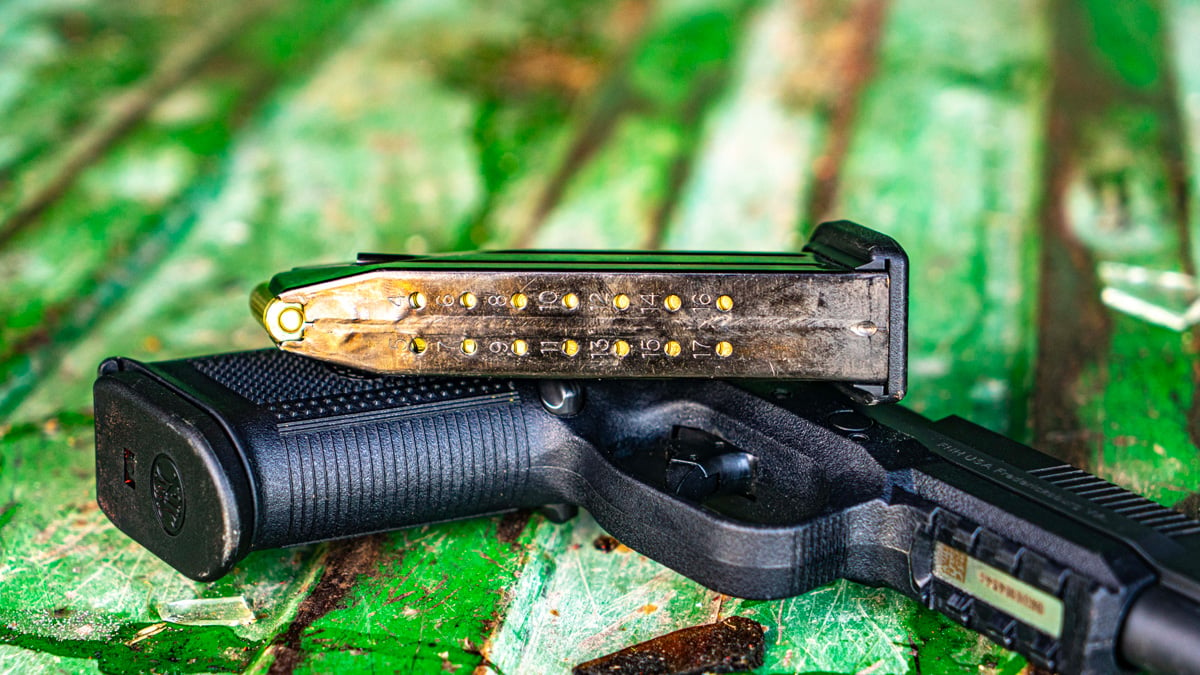
Thankfully, that wasn’t the case. All in all, it looked and felt great, but nothing about it popped out as overly special or notable. It just felt like it was a well-thought-out design, and that made it a very practical tool.
Specs & Features

Outwardly sexy or not, the FNS-9 has all the specs and features you’d want in a modern semi-auto, with one glaring exception. The gun’s short-recoil-operated, tilting-barrel, locked-breach design is built tough and uses the same operating principles as your standard striker-fired Glock 19 or SIG P365.
The gun hosts ambidextrous slide locks/releases, raised ambi magazine ejection buttons, and a simple lever-based takedown system. While the slide boasts effective but not painfully abrasive front and rear serrations, there’s a notable absence of any optics cut or mounting point. Even FN’s website doesn’t show an optics-ready FNS-9 at the moment.

That doesn’t bother me since I haven’t quite jumped on the red-dot bandwagon for my handguns yet. Just know you’ll likely have to get your slide milled if you want to add an optic.
Here’s a quick breakdown of the basic specs for this long-slide FNS-9:
Weight: 1.48 pounds
Length: 8.13 inches
Barrel Length: 4.79 inches
Sight Radius: 7 inches
Height: 5.38 inches
Width: 1.31 inches
Capacity: 17+1
Trigger Pull: 5.7 pounds
I enjoy the trigger on the FNS-9 for its practical simplicity. The trigger is predictable and very easy to stage at the wall. It’s very much a practical working trigger with some stickiness and resistance to the first part of the take-up. It’s not overly sensitive, and it doesn’t fight you as you pull. It simply lets you bring it to the staging point, where it stops with a very noticeable wall.
This makes it easy to break clean shots. Here’s a quick look at that trigger in action:
Total trigger travel comes out to just 0.41 inches with very little creep to the break and no grit. The trigger reset comes to a mere 0.2 inches of travel, which makes follow-up shots fast. I also personally prefer the shoe-like trigger safety over the Glock-style trigger blade safety. It feels more seamless to my trigger finger when shooting from various positions.
Related: Happy 509 Day – Celebrating FN's Exceptional Pistol Series
The grip angle is slightly steeper than the 22-degree slope on a Glock. Instead, it leans more vertically like the 18-degree grip angle on a 1911. This makes the gun feel very natural to point, and the narrow slide combines with the bulkier grip to make the gun feel like a nimble extension of the arm.


Even though it’s longer than my full-size Glock 17, I can feel that the long-slide FNS-9 is faster to maneuver and better balanced overall. I really appreciate the grip texturing, which features various sizes of raised bumps and lines. It’s grippy without feeling like sandpaper.
The metal sights are a basic three-dot combat-style pairing. The rear has an angle to the base of the cut that acts somewhat like an arrow for your front sight post when aligning your sights.


There are four standard safeties on the FNS-9. These include a firing-pin safety, a sear drop safety, and an out-of-battery safety. The trigger-shoe safety flexes back and allows the trigger to move to the rear only with finger pressure. The latter is similar to the Glock blade safety. Additionally, the FNS-9 can be had with a manual safety, but it’s not standard.
The ambidextrous magazine release buttons are textured and angled such that they are hard to bump accidentally but easy to reach without adjusting your grip. I’d say these are my favorite mag release buttons on any gun I’ve tested so far this year. They’re intuitive while being placed and shaped just right.

While the metal magazines don’t eject with much positive force, I’ve never had any issues with them sticking inside the magazine well. That mag well is also beveled for easier loading. Finally, the backstrap is modular, so you can customize your grip with various inserts.
Range Testing
I find the grip angle, size, texturing, and the flare at the base near the magazine well all combine to lock the FNS-9 solidly in my hand when shooting. It’s slightly heavier than a full-size Glock 17, but it feels wieldier in the hand. The grip angle, in particular, helps it point naturally for my hand.

I’ve put 500 rounds through this gun for my testing, with no malfunctions to report so far. Since this gun came to me used, I can’t say how many rounds it’s fired until now, but there’s minimal visible wear on the slide, barrel, and other parts. I also left it dirty for all of my testing.
Related: The Winner Is? My First Handgun as an American
My ammo for this testing was 250 rounds of budget 9mm 124-grain ZSR FMJ, 100 rounds of steel-cased 115-grain Winchester USA Forged FMJ, 100 rounds of 115-grain Remington Range FMJ, and 50 rounds of 124-grain hollow-point SIG Sauer Elite. Reliability was 100 percent, and the recoil was easy to control.
The nice duty-style trigger and long 7-inch sight radius on this long-slide FNS-9 made it easy to get fast but accurate shots. I shot all of these targets on my first range trip, which was rushed due to bad weather.
Here’s what I got out of the FNS-9 at 25, 30, and 45 feet:


Overall, the gun was reliable and performed better than I would normally hope for a first-range visit. More to the point, it was very easy to pick this gun up and run it well without having to learn any strange quirks.
As I said earlier, the FNS-9 is great at being predictably functional in basically every way. It’s hard to complain about that.
Pros & Cons

Here’s a short list of my top pros and cons for the FNS-9:
Pros:
- Reliable and durable
- Accurate with nice metal sights
- Good trigger
- Affordable price
- Nice grip texture
- Natural-feeling grip angle
- Generous Picatinny rail
- Well balanced
- Low bore access
- Easy-to-use ambidextrous controls
Cons:
- No optics cut
- No longer FN’s main semi-auto model
-
Long-slide model is a bit large for concealed carry
Final Thoughts

I think my very short list of cons above basically speaks for itself. I struggle to find things I don’t like about FN Herstal’s underappreciated FNS-9. I rarely hear anyone talk about it at the range, either.
For the cost, there are tons of FNS-9s floating around right now that seem like a hard-to-explain bargain. If anything, I guess you can be grateful that its low-level fame has also kept it reasonably priced.