MP5/SP5 History: ‘Wrinkle-Free Despite Its Age’
Manufactured in Heckler & Koch’s Oberndorf factory in southwest Germany, the HK SP5 hit the American gun market in 2019. Earlier semi-auto variants included the HK94 and SP89 from the ‘80s and ‘90s, but the SP5 returned to the spirit of the original MP5 with more traditional furniture, an 8.9-inch barrel, and a restored paddle magazine release.

Other than the lack of full-auto fire, the SP5 is essentially as close a clone as you can make to the original MP5. Heckler & Koch latched on to the tactical but retro nature of the gun, with its marketing page claiming it’s “wrinkle-free despite its age.”
Related: Two Guys One Gun, Episode 8 – Is the MP5 Still Relevant?
That age is notable. The original MP5 just turned a youthful 59 years old in 2025, and it still commands a respectable place in dozens of military and law enforcement organizations across the globe.

Its Hollywood résumé is even more impressive. I can’t think of any actor with a credit list as long as the MP5. Even decades after its introduction, the MP5 and its many variants were futuristic enough to feature prominently in the long-running sci-fi television series “Stargate SG-1” (1997-2007) and in the hands of Secret Service agents in “Civil War” (2024).
Related: 7 Best MP5 Clones for Any Budget – Buyer’s Guide

The long success of the MP5 owes much to the gun’s ingenious roller-delayed operating system. This light-recoiling design offers great controllability for fast and accurate shooting. It’s also robust and reliable.
Numerous companies offer clones of the MP5, including the popular Zenith ZF-5 and PTR 9. As of 2021, there’s even a plinking HK MP5 chambered in .22 LR that’s manufactured under license by Umarex Sportwaffen in Germany.
Specs & Features
Like the MP5, the German-made SP5 is a roller-delayed, blowback firearm that makes generous use of stamped metal parts. It features a paddle magazine release, right-side button magazine release, fluted chamber, adjustable rear sight apertures, and an 8.9-inch barrel complete with 1/2x28 TPI threading and a tri-lug adapter.


While the bolt doesn’t lock to the rear on the last round, the charging handle can be manually locked by pulling it to the rear and rotating it up. This allows the user to strike or “slap” the charging handle down to send the bolt forward when loading.
Related: HK SP5K-PDW Is the Action Hero We All Need
It’s a peculiar feature, and it has resulted in one of the most satisfying of all gun sounds: the HK slap. In fact, the sound is so satisfying that the act of slapping an HK became a bit of a music, video game, and social media trend.


Here’s a quick breakdown of the basic specs for the SP5:
Weight: 4.49 pounds
Length: 17.75 inches
Barrel Length: 8.9 inches
Sight Radius: 13.38 inches
Height: 8.5 inches
Width: 2 inches
Capacity: 30+1 (10, 15, 20, 40, 50, and 100-round mags available)
Trigger Pull: 6.5 pounds
The trigger has almost no take-up, with 0.05 inches of travel until you hit the start of the trigger wall. That wall is fairly long and stretches the total trigger travel to 0.22 inches. Most of that trigger travel is a springy but smooth pull. Overall, the trigger is pleasant, but it’s hard to stage for a crisp and clean precision break.
Triggers for sub guns like the MP5 – including its clones – are rarely refined. They’re generally clunky because these firearms were designed as close-range select-fire guns. However, I’d easily put the SP5’s trigger in the top tier of MP5-style guns I’ve tested.
Related: Century Arms AP5-M Review – Budget MP5K Clone
All in all, it’s a fast-shooting trigger with a very positive and audible reset that has only 0.3 inches of travel for the trigger reset.


There’s no Picatinny rail for accessories. Instead, the SP5 uses HK’s proprietary claw mounting system. This keeps the SP5 profile true to the original MP5. You can use this to add optics to the top of the receiver or to add a more user-friendly Picatinny rail.


Finally, the SP5 hosts traditional MP5 iron sights, complete with a ringed front post and adjustable rear drum. The rear drum has four different aperture sizes that are zeroed to 25 meters (27 yards). I was pleasantly surprised by how well I shot this pistol variant, so let’s move on to our range testing.
Range Testing
Any 9mm pistol that weighs 4.49 pounds is bound to have a light amount of felt recoil. That weight is easily double that of most handguns. Still, the roller-delayed operating system inside the SP5 makes the recoil feel like the gentle and sluggish rocking of a large boat. It’s borderline pleasing, but you do have to grow accustomed to the rocking motion.

Once you get used to the cadence of the recoil, it’s easy to drum out shot after shot at a fast but predictable pace.
I generally don’t like large handgun platforms like AR and AK pistols because I feel they lose too much accuracy with the removal of the stock. They’re more cumbersome to shoot because they are based on rifle/carbine platforms. Yet, the SP5 provided plenty of accurate performance even on my first range trip.

The gun is a bit awkward to balance in both hands without a stock. It isn’t terrible, and it starts to feel more and more natural with time. That said, I would personally opt for a braced model if I were to add an SP5 to my personal collection of firearms.
Related: PTR 9C Review – Your American-Made MP5 Clone
HK put a nice trigger in the SP5. This isn’t a precision trigger, and the MP5 was never meant to be a precision shooter anyway. The gun is very accurate, but the trigger focuses more on a short pull and rapid reset over the ability to stage the trigger for crisp breaks.
Instead, there’s a fair amount of creep to get through the wall to the break. It’s not gritty or mushy. It simply requires a very deliberate trigger pull, which I think is spot on for a gun like the SP5.

Reliability proved to be exceptional. I experienced no failures over 600 rounds of testing. My test ammo included budget 115-grain steel-cased Winchester USA Forged FMJ, 115-grain Federal American Eagle FMJ, and extra-budget 124-grain brass-cased ZSR FMJ.
Pros & Cons
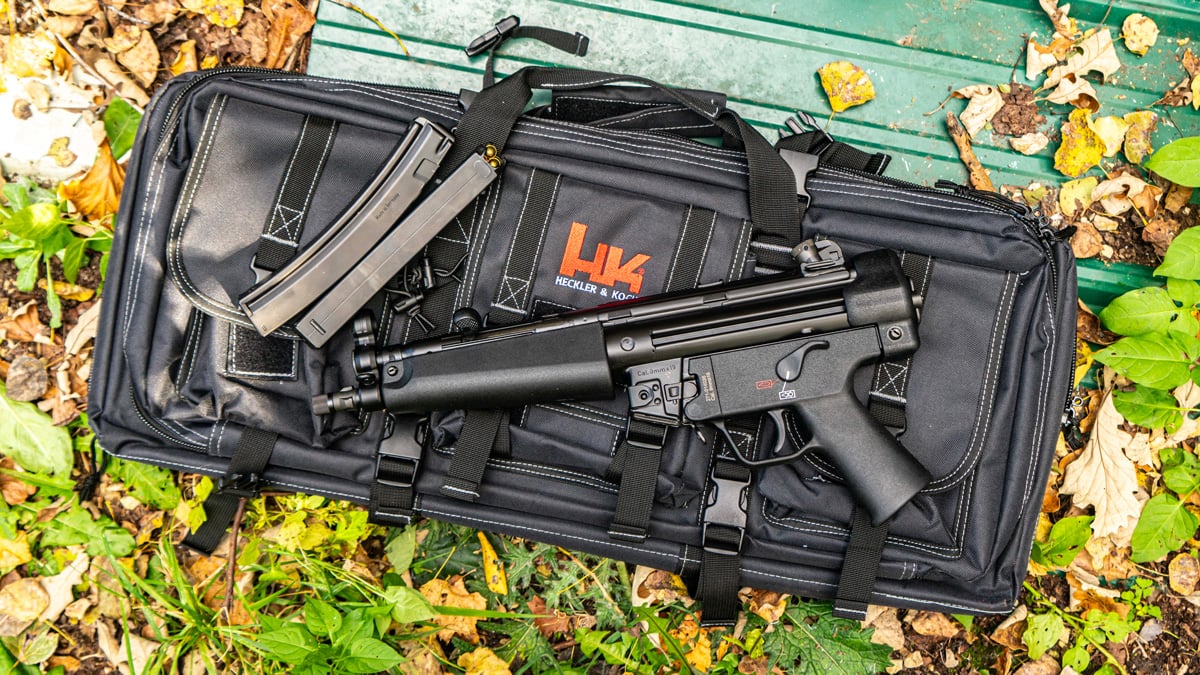
Here’s my short list of the pros and cons for this Heckler & Koch SP5 pistol:
Pros:
- Very well made
- Accurate and reliable
- Easy to disassemble and clean
- Nice trigger for an MP5 clone
- Generous magazine capacity
- Small size
- Genuine German-made HK
- Fun to shoot
- Classic design and feel
- HK claw mount for optics
- Lots of magazine options
- Threaded tri-lug barrel
Cons
- Higher cost than many non-HK MP5 clones
- Accuracy is limited by the lack of a shoulder stock
- No Picatinny rail
- Heavy for a 9mm pistol
-
Old design is a bit bulky by today’s standards
Final Thoughts

The MP5 might seem like a vintage or even outdated design in the age of the CZ Scorpion 3+ and SIG Sauer MPX, but it doesn’t feel dated when you hold the SP5 in your hands.
It’s a solid firearm with quality craftsmanship and parts. More than that, it looks and feels the part of a tactical workhorse. Sure, it was cutting edge way back in the 1970s. I don’t care. It makes me want to grow a bushy mustache, strap on some black combat boots, and rappel off a roof and through a window like a character from a “Rainbow Six” video game.
At the end of the day, there’s just something to be said about owning a German-made HK MP5 clone. If the whole point is to get as close as you can to the original select-fire MP5 – minus the ATF paperwork – there’s no better option than the SP5.