We asked You!
We took a few polls of our social media followers, asking if you should modify the trigger of your carry gun in various ways. We asked a variation of the same question across our three major social networks, and results varied a bit across platforms.

On Facebook, where we asked, “Should you put a competition trigger on an everyday carry gun?” 502 people reacted to the question. Perhaps more telling is that 219 people felt strongly enough to answer.
This question was partially inspired by the recent release of the new SIG Sauer P365 AGX Legion Comp. The AGX Legion series is often seen as a competition gun, and the P365 platform has been a trendsetter in concealed carry since it was announced. Now, you essentially have a competition-style trigger offered on a concealed carry gun right out of the gate.

Answers on Facebook varied, but the majority leaned toward “it depends.”
On Instagram, we phrased the same question to our audience in a poll where you don’t get a chance to leave a comment. Results were almost evenly split, with 49 percent yes, and 51 percent no.
On Twitter (currently known as X, sort of) though, we asked a variation of the question that allowed even more interpretation: “Should you change the trigger on your everyday carry gun?” Perhaps we have a more cautious audience, or perhaps more lawyers follow us, but the answer was definitively negative (70.6 percent no to 29.4 percent yes). We’ll dive into some of the better comments a little later, but first let’s ponder the question.
Why Modify an EDC Trigger?
Before we dive into competing schools of thought on what might be right and what might be wrong, let’s contemplate why. There are numerous reasons to modify the trigger. Typically, a stock trigger will be too heavy, too “gritty” or “mushy,” not have a short enough reset, or have a wall and break that the user just doesn’t love.

Despite the tagline “Perfection,” the trigger is one of the first elements to be swapped on a Glock, and the comments on social reflected that. Yet, the question of whether a Glock trigger is truly good or not has been raging since the Austrians invaded the handgun scene back in the ’80s.
Indeed, an entire market has been made of replacement Glock triggers, speaking not only to the popularity of the brand but of the desire to upgrade it. So, who is actually right in this situation? Let’s look at each perspective first.
Related: Are Glock Triggers Good or Bad?
The Case for Making the Switch
The idea for switching out your OEM trigger to something better is relatively simple. Often, the end user wants a lighter or faster trigger to enable them to shoot better, especially at distance and at speed.
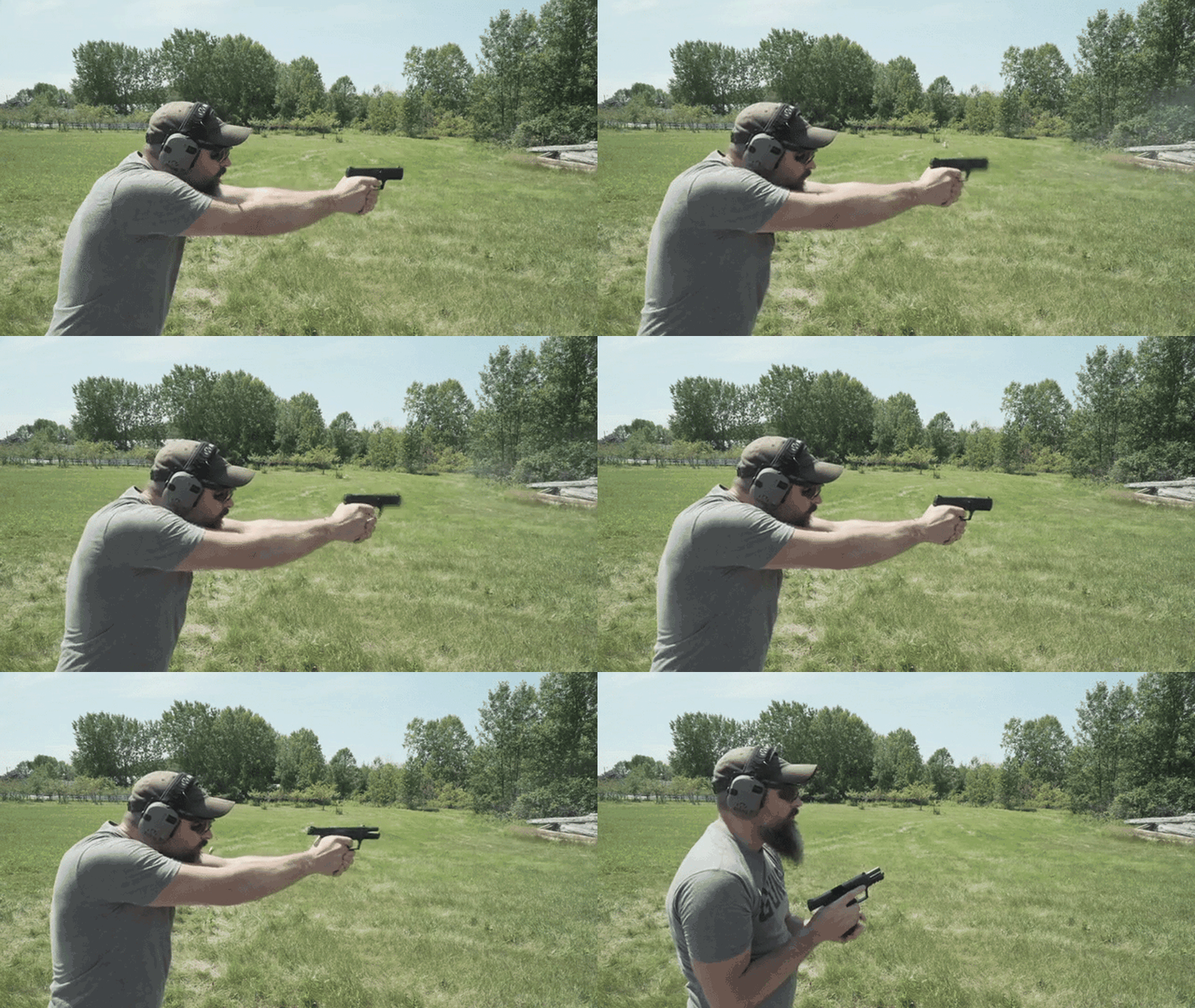
It’s true that if you find yourself in a self-defense situation, you may have to engage a target at a distance or make a rapid target transition, but the data to support that scenario just isn’t there. For some, the idea of carrying the same gun they train and compete with may hold some valor, but again, it really depends on your training and comfort level.
But the argument for a lighter and faster trigger isn’t exactly solid ground for many who carry a gun. Let’s see why.
The Case for Leaving It Alone
Many guys and gals specifically want a long, heavy, double-action pull as their first trigger pull because they don’t want an accidental discharge that could result from the stress of being in a self-defense incident. After all, the best self-defense situation is one that never happens, when you get to walk away clean. The idea that you have to put intentional thought and muscle action into the double-action pull is reassuring to lots of folks.
Then there is the legal side of things. Many people will argue that an unscrupulous and driven district attorney, especially in a “less free” state, will try to use a modified trigger against a defendant after a self-defense incident. Certainly, one needn’t stretch their imagination to understand that a DA driven to make a name for themselves in a notoriously anti-gun jurisdiction could see a modified trigger as a boon to their case.

If you carry every day, you should be abiding by the law, which includes the escalation of force doctrine. If you break the law, you’re going to jail no matter who the DA is and what the trigger situation looks like. That is why training for the legal aftermath and joining an organization like the USCCA can be incredibly helpful, no matter where you live.
The other argument for leaving a trigger alone is that modifying a trigger on an OEM gun will typically break the warranty on the gun. Even if the gun is past warranty, if you don’t do it right, the trigger swap could be detrimental and cause all sorts of issues.
Is there a gun that offers the perfect solution? Some people think they have found just that in the double-action/single-action (DA/SA) trigger.
DA/SA to the Rescue?
Hang around the range and talk concealed carry triggers enough, and you’re bound to run into someone who is going to gush over the perfect solution: the DA/SA trigger. The DA/SA system has also been around for a long time and with good reason, as it really does seem to offer the best of both worlds. You start with a long and heavy double-action trigger pull, and then every subsequent round delivers a short and crisp single-action pull.
The logic behind it makes sense. If you’ve identified and pulled the trigger on a threat, you’ve committed to the act of self-defense, so every follow-up shot should give the greatest chance of engaging the target.

The counter-argument to DA/SA triggers being the magic elixir should also be taken into consideration. It’s often said that you must increase your training time with a DA/SA gun because you must train for two different trigger pulls and weights. There is also the argument that if you don’t train with the double-action pull enough, the heavier pull will be tougher to execute under stress and thus go off-target.
Still, DA/SA guns are incredibly popular among civilians and law enforcement alike because they offer a solution to the problem. One thing that this author has found, though, is that the double-action on DA/SA guns can vary dramatically. Some guns, like the CZ 75, have beautiful double-action pulls and are smooth, while other guns, like certain snub-nosed revolvers, have incredibly heavy and gritty double-action pulls. It’s really all about the gun and manufacturer.
Related: Single-Action Vs. Double-Action Pistols
So Which is Right for You?

We’ve said this many times before, but we’ll say it again as it always bears repeating – the right gun for you is the one you train with. Whether you put a 2.5-lb trigger on your carry gun or carry a DAO gun with a 12-pound trigger, the end result will be the same if you don’t train with the gun. We never rise to the occasion; we sink to our highest level of training.
Whichever gun you decide to carry, be sure to familiarize yourself with it, send some rounds downrange, and take a class if you can. If you can’t afford the sometimes-expensive training classes, may we suggest a service like Make Ready TV. They deliver high-quality instruction from some of the best in the country right to the screen of your choice. You can even get a deal on a membership right now by visiting our deals page.
No matter your stance on modifying triggers, the only way to becoming truly proficient with your gun is training. So, pick up some ammo or do some dry firing, and keep up the great work of being ready to defend yourself and your loved ones.