If you’re not hooked on Steve McQueen’s Josh Randall character of “Wanted: Dead or Alive” fame, you’re likely asking the question in the title. Though the literal answer may best be defined as the appendage of a female horse, to gun owners a Mare’s Leg is lever-driven heaven.
Those ultra-compact, pistol-meets-lever guns might seem an answer to a question nobody asked. Yet, firing one of those saddle-ring shorties from the hip can’t help but make you want to know more. Here’s a look back at the origins of the platform, its legality, and the best specimens on the market today.
America’s allure with the lever-action rifle reaches back over a century and a half, so it should come as no surprise that cowboy actions are in our collective DNA. Those early levers served practical purposes for survival, westward expansion, game-taking, and personal protection. Romanticism with that early era continues to evolve, now into 2024 with more lever-action rifles on the market than ever before.
The Mare’s Leg, meanwhile, fits no practical explanation, yet continues its appeal. But why?
Since McQueen starred in “Wanted: Dead or Alive” in 1958 slinging what seems to have been a highly modified Winchester Model 1892 with most of the stock removed and the barrel chopped to under 10 inches, television viewers have gravitated to his weapon of choice.
There’s some debate whether the piece is so named for its shape not unlike an equine haunch, or McQueen’s alleged claim that the compact firearm kicked like its namesake. No matter the term, the end game is the same. That chop-job lever action, whether worn in the most beastly holster or tucked against the hip, worked its way into reality and remains solidly there to this day.
Legality
The Mare’s Leg is no run-of-the-mill lever gun, and because of that inability to fit definitively into a single category, prospective buyers often wonder if the platform is even legal. The answer is usually yes, but occasionally no. Here’s why.
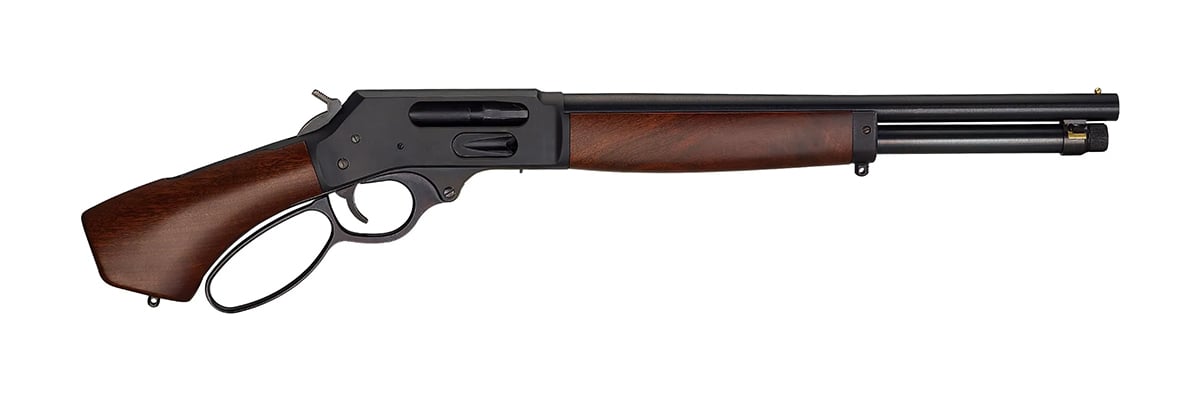
Henry Repeating Arms brings the Mare's Leg platform up to date with its Axe .410 shotgun. (Photo: Kristin Alberts/Guns.com)
Though with a rifled barrel and carbine-like metrics, the Mare’s Leg is not a rifle, but rather, by definition, a handgun. As such, modern production pieces are sold and transferred on ATF Form 4473 and state handgun forms. When we stretch the definition of Mare’s Legs to include shotgun versions, even those fall under Title I GCA (non-NFA) firearm definition, meaning no tax stamp or additional flaming hoops stand in the way of ownership.
When we look back to McQueen’s originals, though, the legal lines blur. Even back in the late ’50s and early ’60s during filming, the very real prop guns found themselves in violation of the ATF (actually ATU/ATTD at the time), and a significant fee had to be paid to appease the regulation.
Not quite a shotgun, the Axe falls into the handgun category with other Mare's Legs. (Photo: Kristin Alberts/Guns.com)
Today, shooters could theoretically acquire a short-barreled rifle permit and do their own customization of an existing long gun, but why not simply snag one of the many existing Mare’s Legs, all of which are perfectly legal?
Mare’s Legs Today
When you want to channel your inner Josh Randall, the good news is the market holds ample options. With short “buttstocks,” large levers, and a variety of chamberings from rimfire to centerfire, and even shotgun, the silver screen has never been more achievable in your own backyard.
Though this is truly a niche platform for which we’ve yet to find a truly practical purpose other than want over need, the production of Mare’s legs firearms continues. Here’s what you can find on the market right now.
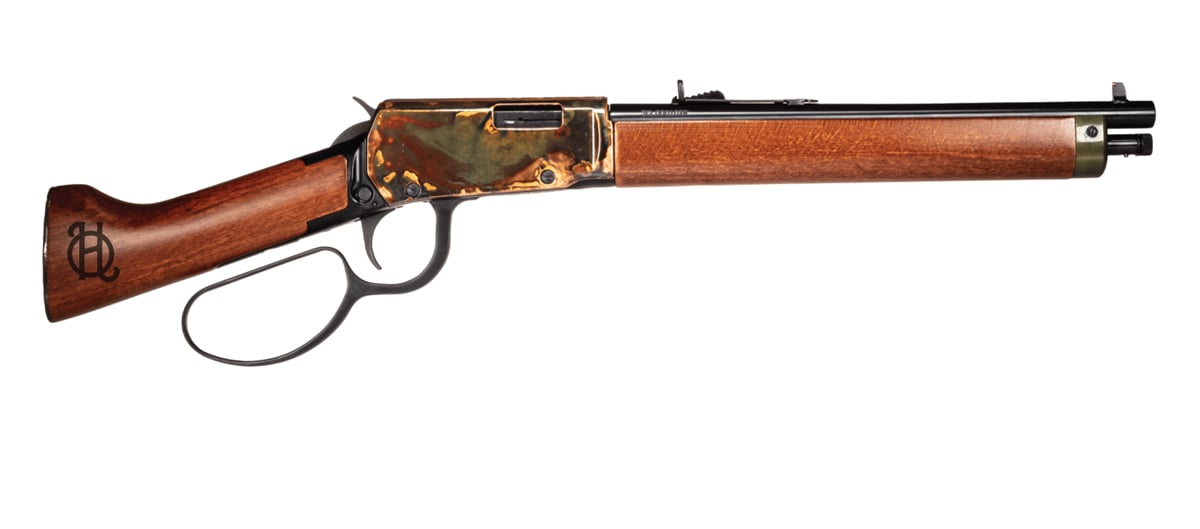
Henry Mare’s Leg
If a Mare’s Leg is on your want list, then Henry Repeating Arms has you covered with by far the largest selection in both chamberings and finishes. For what it’s worth, Henry says the stock is “cut to the exact specification of the gun used on the television series.”
In fact, Henry offers not only the centerfire, but also a pair of rimfire variants in .22 S, L, LR and .22 WMR for legit, low-cost, no-recoil plinking. But it’s the octagon-barreled, polished brass Big Boy Side Gates that most closely replicate the original, albeit with extra aesthetic flair. They can be had in .357/38 Spl., .44 Mag/Spl, and .45 Colt. Each has a 12.9-inch octagonal barrel, 25-inch overall length, American walnut furniture, a saddle ring, and a large loop, and is made in the USA.
Chiappa 1892 Mare’s Leg Takedown
This Italian stallion practically oozes cool factor, while also closely resembling the original – until Winchester itself commences production. Chiappa’s 1892, a centerfire Mare’s Leg clone of Winchester's 1892, is an authentic looker. There’s a 12-inch barrel, large or small loop choices, and carbine-style ladder sight.
What really sets it apart is the takedown feature. We’re not sure why you’d need to break this little guy in half, but it never hurts to have options, though the entire piece measures only 2 feet. The Chiappa 1892 Mare’s Leg Takedown can be had in .357 Mag and .44 Mag, though .45 Colt looks to be the most common chambering, each with a lovely case color receiver and hand-oiled walnut furniture.
The Settler Mare’s Leg is a .22 LR rimfire with a 12.5-inch barrel, measuring an ultra-compact 23.25 inches overall. The shorty is built with an aluminum alloy frame, wood stock, and case color-esque receiver finish. There’s a buckhorn rear sight and drift adjustable front, while the tubular magazine holds 15 rounds.
Though we’ve yet to handle it, the gun is now shipping, and its sub-$500 retail price point will likely become the most affordable Mare’s Leg on the market.
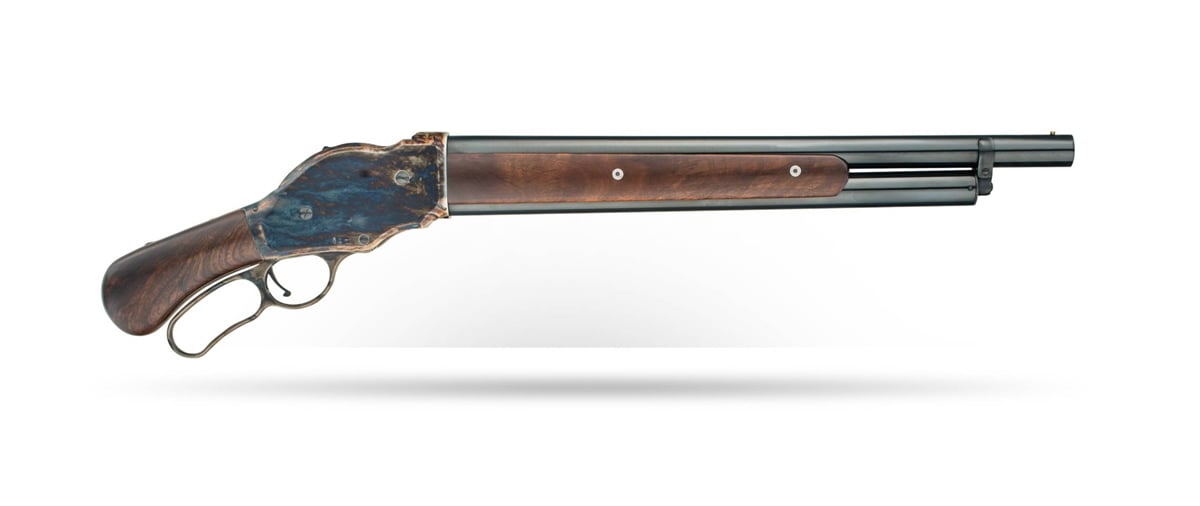
Chiappa 1887 Mare’s Leg Shotgun
Both Chiappa and Henry have expanded the Mare’s Leg concept into scattergun lore, making the hip-fired gun easier than ever to connect with the target by means of shotshells. Chiappa’s 1887 is a spinoff of the historic Winchester 1887 lever-driven scattergun, this time with a serious 12-gauge hat-tip to the “Wanted: Dead or Alive” design. There’s an 18.5-inch round barrel, and classy finishes including case color and hand-oiled European stocks.
The 1887 Mare’s Leg has a twin in Taylor's & Co’s 1887 Bootleg, with its 18.5-inch barrel and 27.5-inch overall length. No matter the name, the end game here is the same with a hefty, nearly 8-pound, 12-gauge handful.
Henry Axe
When a low-recoiling shotgun is needed, and nothing but a Mare’s Leg will scratch that itch, the Henry Axe is waiting. The compact .410 bore Axe, fitted with a barrel barely over 15 inches, is a treat to fire. At just 26.4 inches overall, the piece is surprisingly well balanced for 5.75 pounds.
The 2.5-inch chambered scattergun is threaded for Invector-style choke tubes and holds five rounds. Since its 2019 introduction as a steel and American walnut darling, the Axe has seen the addition of two more variants. There are now a polished Brass Side Gate and a blacked-out X-Model with black synthetic furniture for a more tactical urban cowboy appeal.
An Equally Short Conclusion
For all those listed here, many more Mare’s Legs have come and gone over the years, including the Eagle Squadron Mare’s “Laig,” JB Custom, Legacy Sports’ Puma 92, and even Rossi's. The latter’s Ranch Hand, a centerfire Mare’s Leg with a greatly oversized loop, seemed popular for a handful of years before dropping from production.
Whether you think they’re silly, useless, cool, want one, or hate them, the Mare’s Leg is a unique American firearm design. Born on the television screen and kept in popularity through sheer romanticism and plinking joy, the name Mare’s Leg remains in the vocabulary of every firearms aficionado.