Crowned King: .17 HMR
No matter how much you love any of the other .17s – and believe me, I understand nostalgia and cult followings – there’s just no arguing that on mainstream popularity, the .17 HMR has dominated this category since its introduction by projectile and ammunition powerhouse Hornady in 2002.
Related Review: All About the .17 HMR – A Tiny Round with a Big Footprint

Chalk it up to marketing, availability, performance, or just plain practical acceptance against affordability, the Hornady Magnum Rimfire is built by most every production ammunition company and rimfire rifle brand in actions including bolt, single shot, repeater, lever, semi-auto, and even handguns.
-
Recommended Ammo: CCI TNT 17-grain JHP / 2,550 FPS
The Speedster: .17 WSM
The .17 Winchester Super Magnum – a rimfire – is a mover and a shaker, slinging its projectiles upward of 3,000 FPS. This one was introduced by Winchester in 2012, the result of necking down a .27-caliber nail gun blank. Bullets are usually 20-grain, though 15-25 grainers are out there, and, as far as we can tell, the .17 WSM is still touted as the fastest rimfire round.

Speed aside, the WSM was never wildly embraced, though it remains in production. Higher-volume shooters who prefer to reload may be better served by others on this list, as .17 WSM ammo prices are roughly 20-25 percent higher across the board than the HMR. For those seeking pure rimfires, the WSM may be lesser known and more difficult to find, but those increases in ammo and firearm costs are rewarded with greater performance from the heavier-built casing, higher pressure round.
-
Recommended Ammo: Winchester Varmint HE 20-grain Polymer Tip / 3,000 FPS
Not Quite Mach Speed? .17 HM2
The round of many names and abbreviations is another fairly youthful rimfire. Also known as .17 HM2, or .17 Mach 2, the .17 Hornady Mach 2 was born in 2004. The goal was to build on the raging success of the .17 HMR, but the shorter-cased HM2 never grabbed anywhere near the same amount of fame. While ammunition can still be found, the Mach 2 represents one of the least popular on this list.

It’s not that the round doesn’t perform. Based on the .22 LR Stinger casing and necked down, the HM2 is driving 17-grain projectiles at velocities very near its twice the speed of sound name. In fact, it’s faster and flatter than a .22 LR, but its stumbling point is not doing anything significantly more than the already-adored HMR. To be clear, though, the .17 Mach 2 is not to be confused with the scarcer .17 Mach IV, a wildcat based on the .221 Rem Fireball.
-
Recommended Ammo: Hornady Varmint Express 17-grain V-Max / 2,100 FPS
Centerfire Cruiser: .17 Hornet
Right from the get-go, I will admit my fondness for the .22 Hornet. Thus should follow the same adulation for that wily little round necked down to .17 caliber. The prolific gunsmith and wildcatter P.O. Ackley may have been the first to come up with the round, but it was Hornady a good handful of decades later (2012 by SAAMI approval) that popularized its own version of the .17 Hornet we know today.
Related Review: All About the Underrated, Varmint-Stopping .22 Hornet
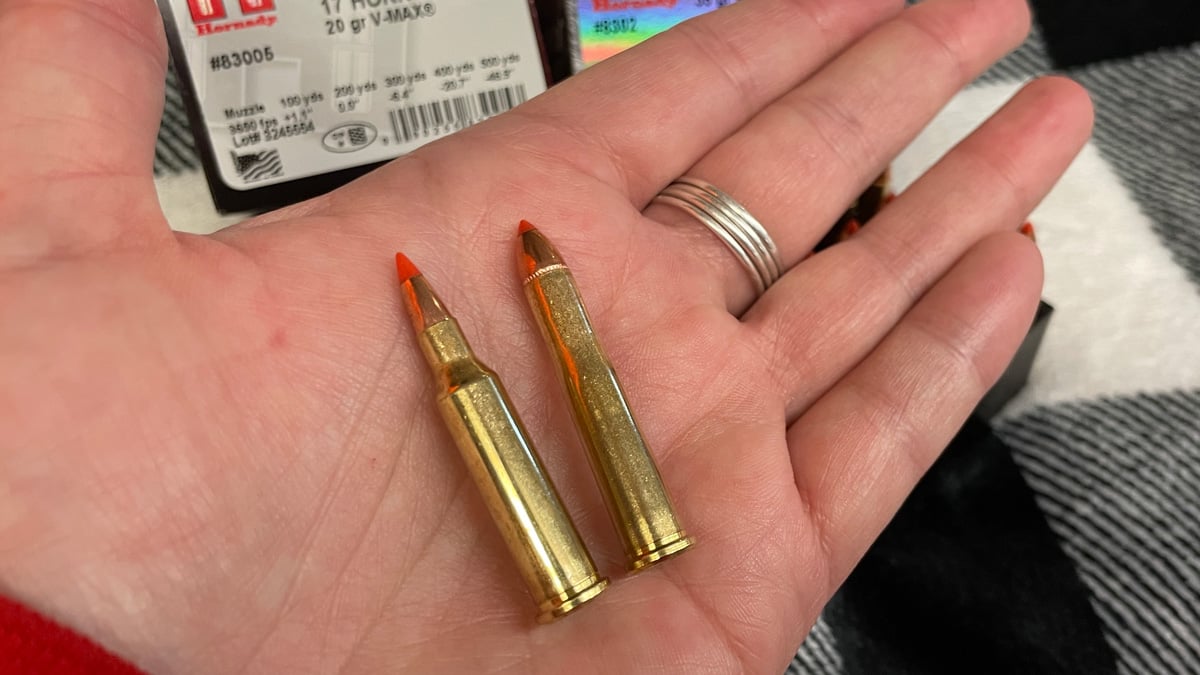
Factory ammunition may not come cheap, but it is still available from Hornady, Winchester, and Federal. Reloaders can make quick work of the little casings, too. As .17 Hornet outperforms many on this list both on paper and in the field, hunters of the bigger furbearers will recognize the Hornets as underrated chamberings.
-
Recommended Ammo: Hornady 20-grain V-Max / 3,650 FPS
Remington’s Teenagers: .17 Remington & .17 Fireball
Though decades apart, this pair of Remington centerfire chamberings share space, among many other commonalities. Admittedly, this is an area in which I have little hands-on experience. Though neither of these cartridges caught fire with buyers, you may be surprised to know that ammunition is available for both, at least from Remington itself.

Based on a .223 Rem casing necked down to hold the smaller diameter bullet, the .17 Remington led the way for most others in this class with its debut in 1971. It has long been regarded as the first commercially marketed .17 caliber, and it’s a screamer with velocities exceeding 4,000 FPS.

The .17 Remington Fireball, better known as just .17 Fireball, wasn’t released until 36 years later in 2007. Fireball performance numbers are similar to the original but considerably more efficient. Plus, it achieves those numbers with less powder, reduced fouling, and ultimately, increased barrel longevity compared to the original. There’s no doubt handloaders will enjoy both of these centerfires, but unfortunately, firearms seem to have fallen out of production.
Recommended Ammo:
- .17 Rem: Remington High Performance 25-grain HP / 4,040 FPS
-
.17 Fireball: Remington Premier AccuTip-V 20-grain / 4,000 FPS
Final Thoughts
If you were already familiar with all these .17s, odds are you’re a serious shooter. The .17-caliber may be tiny, but it’s not one to overlook. The low recoiling .17s are almost always a pleasure to shoot. Some are reloadable, all are interesting, and nobody can fault a fan of .17s, whether popular or more obscure.