A Brief 1911 History
I want to touch on a few important aspects of how this pistol came about. The late 1890s and beginning of the 1900s saw an industrial boom and the birth of semi-automatic firearms that used the energy from the spent cartridge to chamber the next round. Having realized the standard .38 Long Colt was less than effective in the jungles of the Philippines, the U.S. Army was intrigued by the self-loading pistol invention and began formal trials for its next sidearm, a semi-automatic pistol of at least .45 caliber.
Related: 1911 Patent's 111th Anniversary
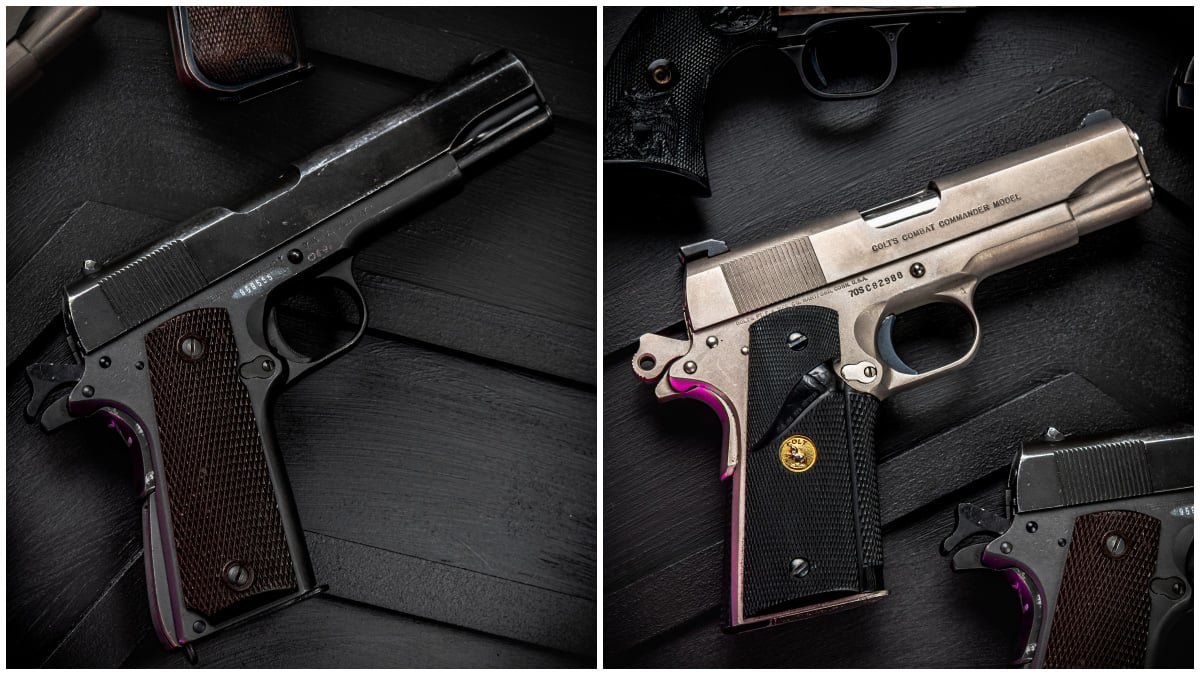
DWM (of Luger fame), Savage, and Colt were all finalists in the trials, which lasted from 1907 through 1911. The pistols were put through a 6,000-round test over the course of a couple days, and the 1911 passed with zero malfunctions. The Army officially adopted the pistol on March 29, 1911, followed by the Navy and Marines a few years later.
While Colt was the initial maker of the gun, several other manufacturers helped with production during wartime. The United States enlisted traditional firearms companies, including Winchester, Ithaca, Remington Rand, and Savage, as well as unconventional manufacturers like Union Switch and Signal and Singer. Of the nearly 2 million units produced during WWII, about 500 were made by the famous sewing machine company. Singer models in great shape can fetch around $250,000 today.
Related: Classic WWII 1911s – Remington Rand & Union Switch

The 1911 entered legendary status due to it single-handedly winning World War II (joking, but have you seen “Saving Private Ryan?”). While no article, post, or photo of a 1911 is complete without some form of a “Two World Wars!” comment, the gun was first used in the Punitive Expedition against Mexico, then World War I, World War II, Korea, Vietnam, Desert Storm, and in some cases through the GWOT – and to the present by certain military units that prefer it.
Related: How to Speak 1911 – Holding Class on the Evolutionary Differences
There have been some cosmetic changes, as well as a few internal tweaks, but by and large, it is the same design from over 114 years ago. It was officially replaced by the Beretta M9 in 1985 after the next round of military trials, but the 1911 was just catching on with law enforcement at the time. They, too, saw the need for a semi-automatic handgun to replace revolvers for duty use.
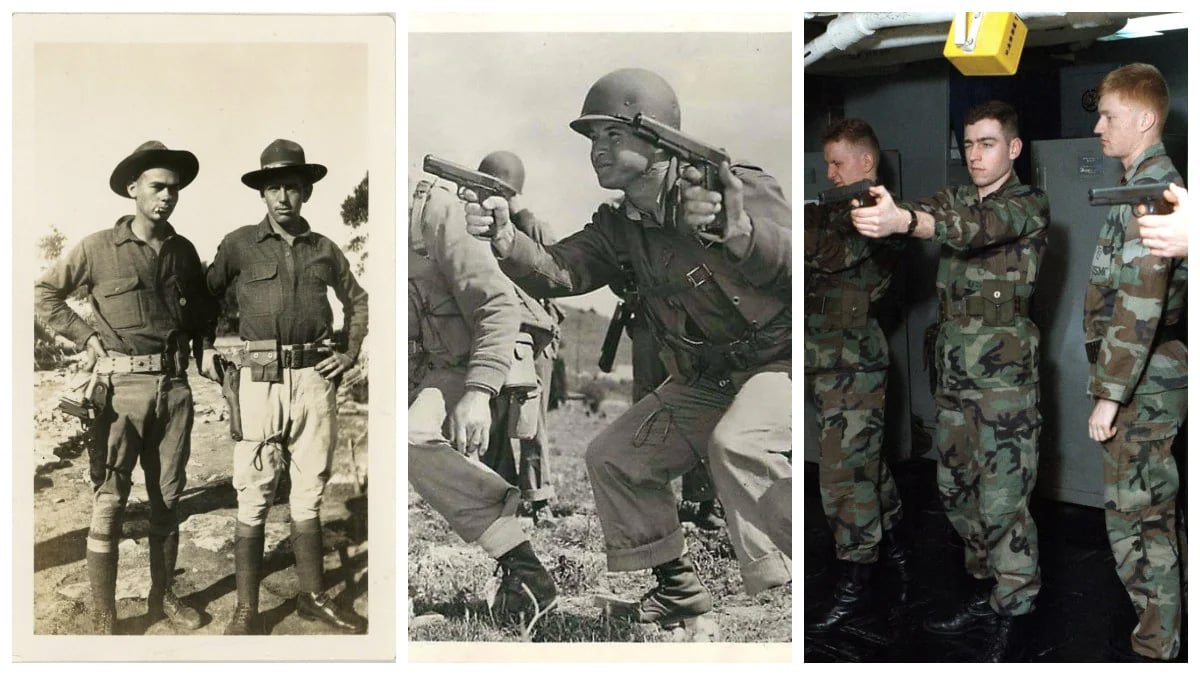
The FBI Hostage Rescue Unit, SWAT teams, Delta Force, and civilians alike have relied on the 1911 for decades. The pistol enjoys an enthusiastic following, and nearly every company that produces pistols has its own take on the design. Demand really has not wavered, despite a contingent that prefers double-stack polymer guns.
WWII Tribute Model
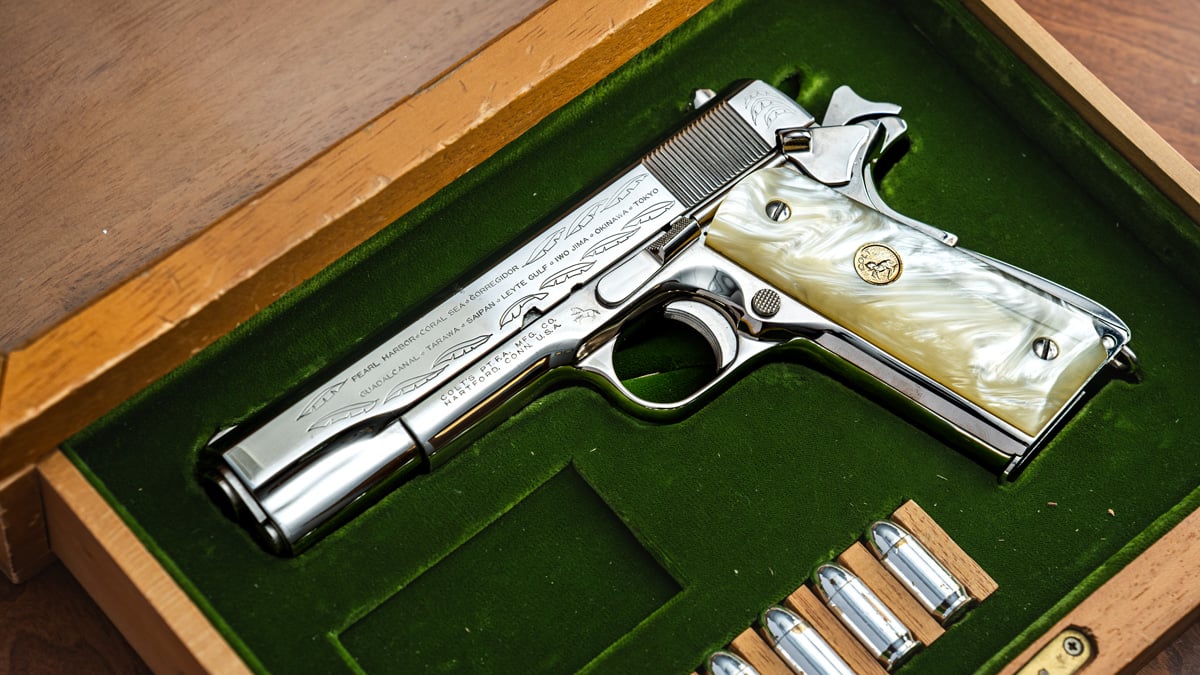
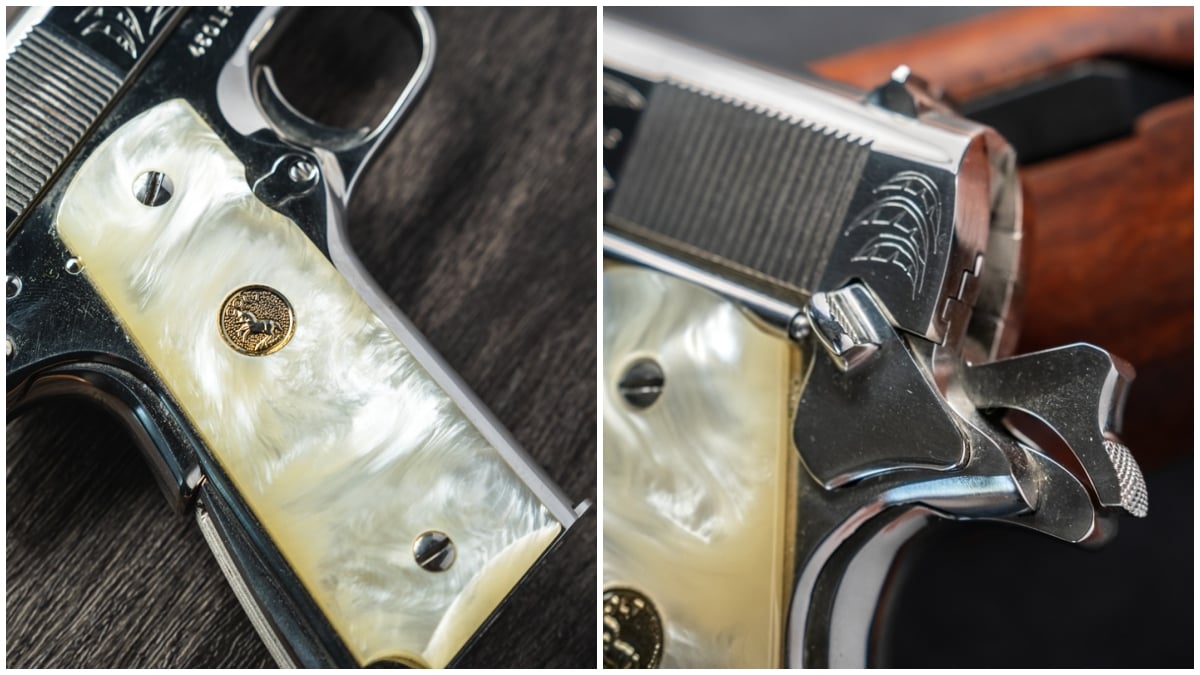
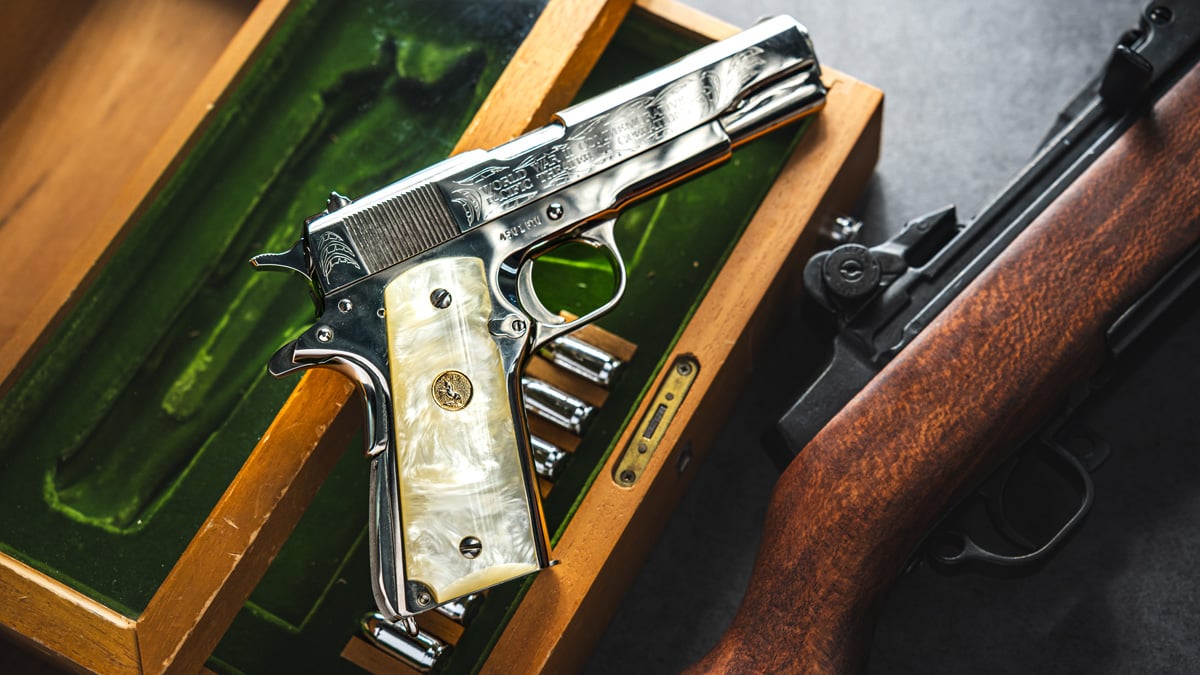
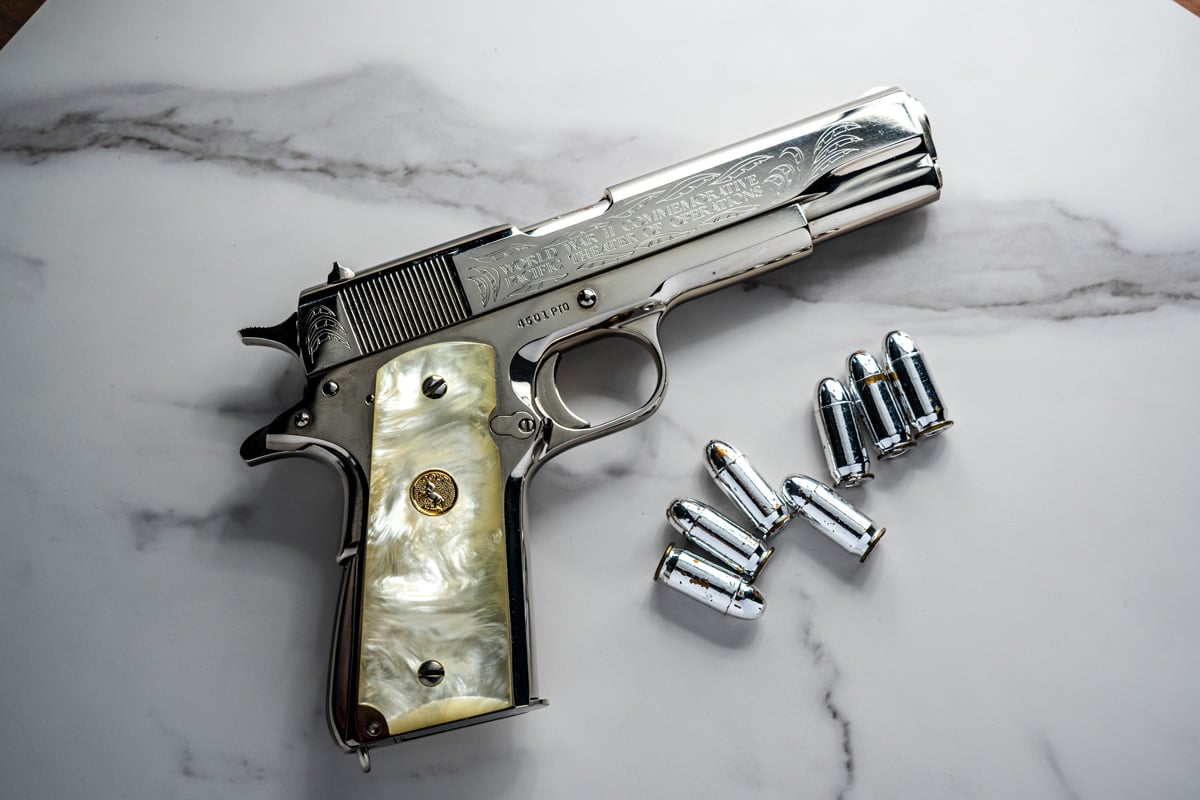
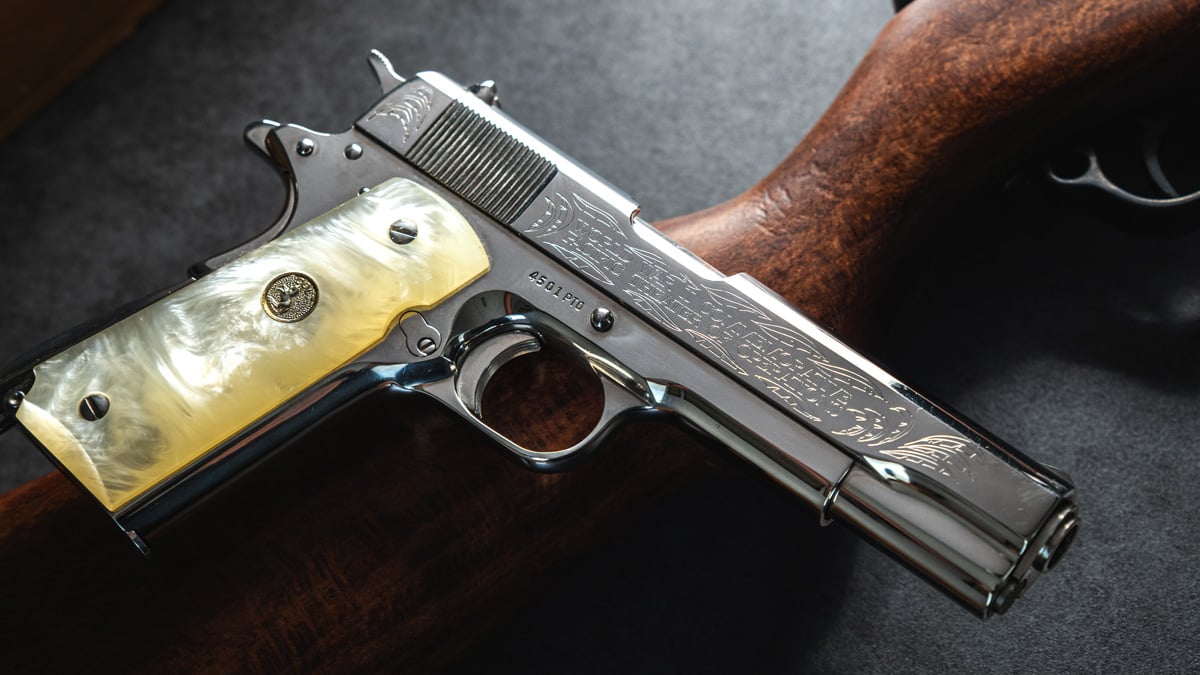
This unique 1911 features tasteful, detailed engravings on both sides of the slide commemorating the Pacific Theater of the Second World War. The chamber side reads, “World War II Commemorative Pacific Theater of Operations,” while the slab side lists key battle locations in the Far East, most notably Pearl Harbor. Both sides feature a feather/leaf background motif.

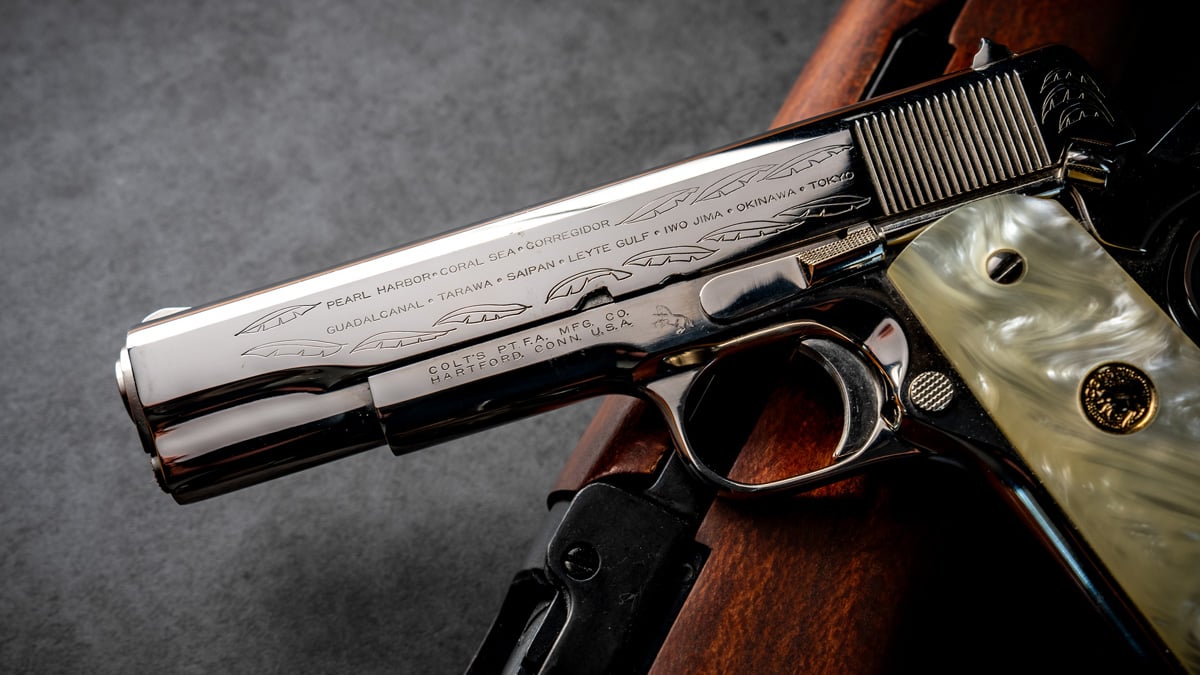
The gun is based on a classic M1911-A1 model and has the shortened trigger, arched mainspring housing, and GI sights. It is finished in a polished nickel plating complemented by faux ivory grips with Colt medallions. It comes in a green velvet-lined showcase with seven dummy rounds in nickel to match, but this package is missing the top that normally includes a photo of Japan’s official surrender on Sept. 2, 1945. Still, it’s a truly stunning piece worthy of display.
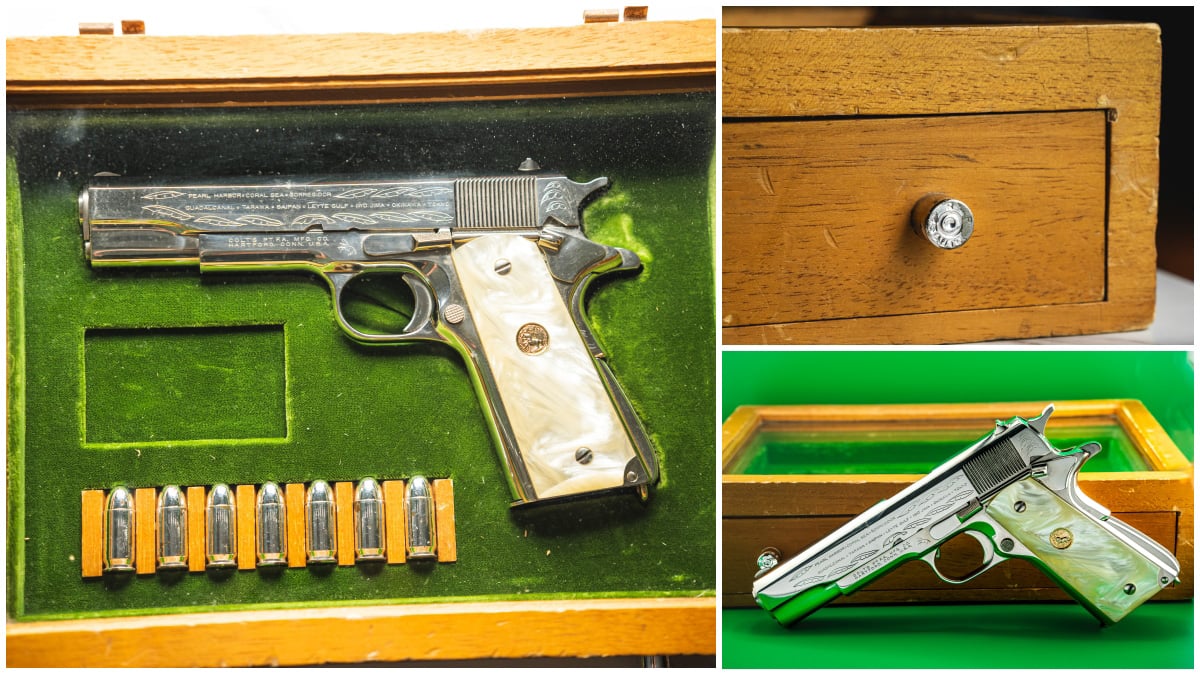
The case has a glass partition, and the gun is accessed through a drawer. Normally, this model includes a metal card engraved with “Asiatic-Pacific Theater December 7, 1941 – September 2, 1945.” The total presentation does a great job of highlighting the battles and sacrifices of WWII, while tying in a faithful reproduction of the iconic sidearm.
Overall, this is a classy bundle best enjoyed with your eyes and handled with gloves. While I’m sure this model would cook on the range, I did not fire it.
My Feelings on the 1911
The 1911 is one of the first guns I remember seeing. I had an all-black squirt gun that was about 1:1 size, back when that sort of thing didn’t require an orange paint job. I recognized the gun in movies and shows, and my airsoft collection included both a Colt Mark IV Series 70 silver Commander and an Infiniti Double Stack.
When I think about purchasing or building an heirloom gun, my brain instantly pictures a decked-out classic 1911. Over the years, I’ve had nine. I currently own six, three of which are custom builds I intend to use and pass on to my kids. When it comes to my own preferences, the 1911 is a close second to my Beretta 92s.
Related: Back in Action – Why the Beretta 92 is Making a Big Comeback
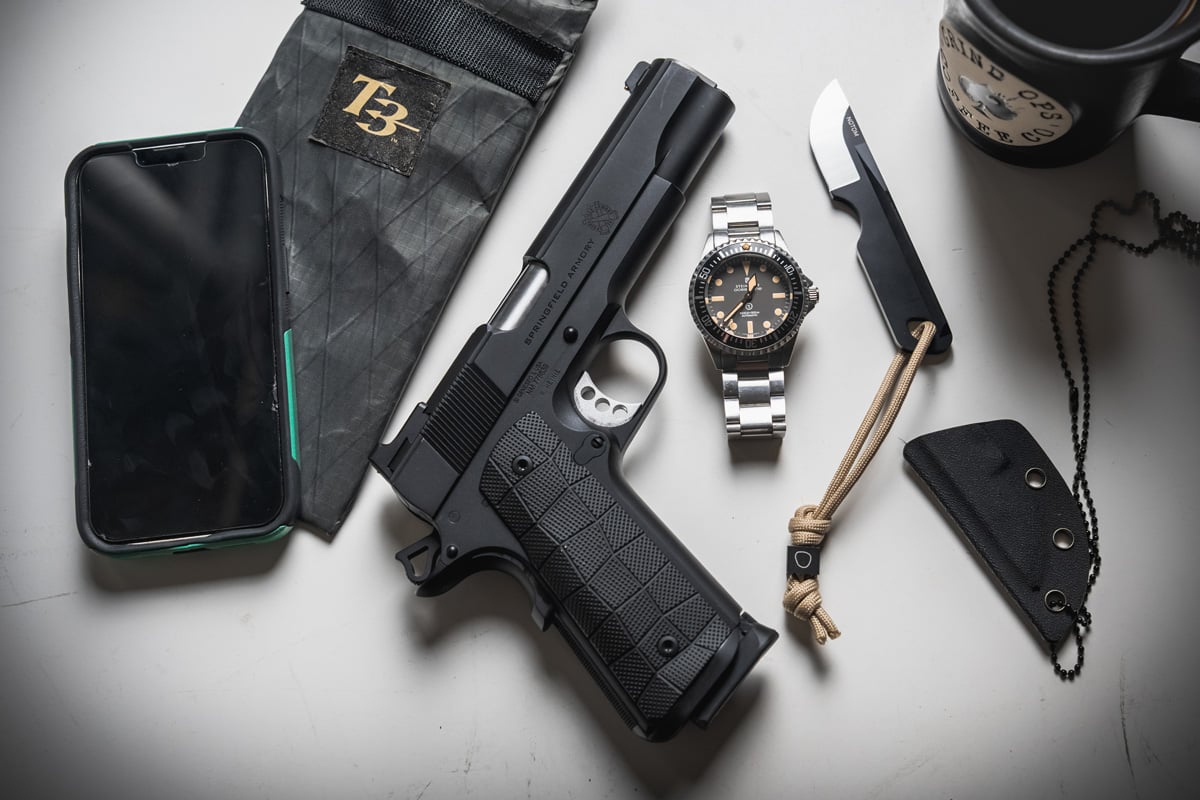
There’s a reason many new handguns and even rifles feature grips with 1911 angles. It seems this pistol was done right the first time. While it’s been challenged and changed over the years, the ergonomics just feel right. Some people will disagree, arguing that the safeties are cumbersome or that the reliability and perceived break-in period are just too much for them to handle.
I understand those things. Parts of those complaints are real, and some are myths. A 1911 built correctly with good tolerances and forged steel will simply run and be reliable. It takes time and training to really get into the maintenance and cleaning protocols, but most models are good to go. Nothing compares to a well-built, tuned 1911, and the triggers still set the standard for handguns.
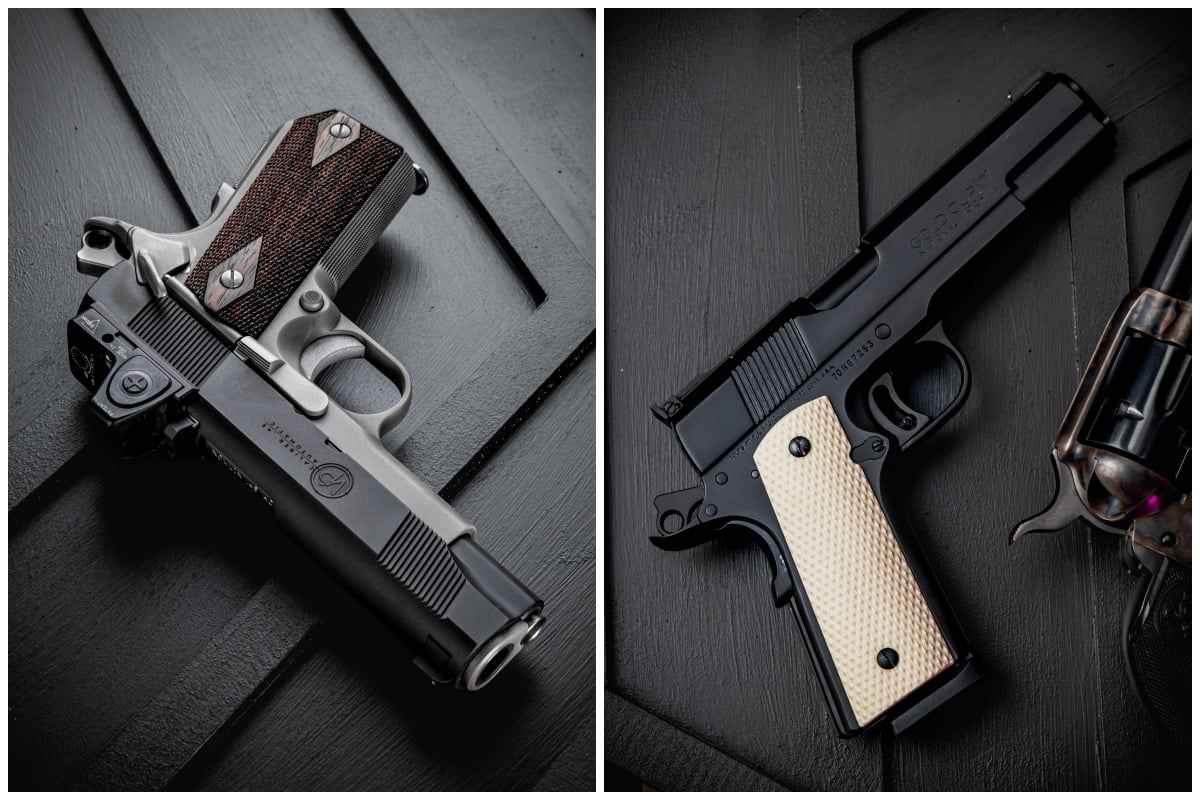
The 1911 is an enthusiasts’ gun. With training, it can absolutely be effective for combat, everyday carry, and duty, as proven over the last 100 years. I carry my most expensive gun, which is a full build by Valor Precision. It is an all-steel .45, with RMR, ring hammer, and bobtail, in two-tone PVD.
Still Relevant
It’s a testament to Browning’s genius that so many modern handguns still operate on his tilting-barrel design and mechanism. Yet the 1911 is still alive and well, and some may say it is even experiencing a renaissance of sorts, with new versions of the classic that include rails, optics, and enhanced grips, along with the rise of the double-stack 1911.
Related: 1911 Popularity – How Browning’s Iconic Design Has Stayed the Course
Over the last 10 years, the trend of ultra-flat, ultra-fast-shooting handguns has taken over. At the top of the list are 1911-style guns: the Staccato 2011s, Wilson EDC/SFX, Springfield Prodigy, Alchemy Hi-Cap, and other Turkish clones from SDS imports. Other brands like Atlas, Watchtower, Jacob Grey, and more are dedicated to making tricked-out, custom double-stack 1911s. In 2025, the fastest and flattest guns are based on a design from the year 1911.
The trend includes building these guns around the 9mm round. We now have full lineups of 1911s in 9mm, double stacks packing triple the capacity of the original design with less felt recoil. I laugh when people mention the platform being outdated and surpassed, as we see video after video and post after post with 1911-like guns doing things no other class of handgun can touch. Still, some companies are adjusting the configuration to accept Glock magazines and attract the polymer fans to a more timeless model.
I would consider the last five years a rebirth of the 1911. People seem to be flocking to wood and steel as the tide shifts on plastic. You can now get 1911s milled for nearly any optic, with rails, checkering, serrations, and different sights. There are tons of ways to personalize these, even though it’s harder to do a lot of the work yourself.
We can debate finishes and what is classic, but 1911s – even the high-end models – have never been more accessible. There are options at all price points, with many being semi-custom or great base guns for a full build. Most don’t require years-long wait times, either.
Final Thoughts
Admittedly, my firearms passion was built through polymer. I was lured in by the ability to buy reliable, practical, affordable guns that I could customize. It was fun, and I still like and admire those options. They work but are, in a word, boring. My tastes have evolved, and ultimately, I prefer classic design cues in timeless looks and finishes. Despite my collection of custom Berettas, I would have the hardest time parting with my 1911s. These guns just have the most soul. They have a rich history, and in the case of my twice-rebuilt Colt/Rand from 1943, scars and stories.
The 1911 is synonymous with America. In many ways, a 1911 is the pinnacle of gun-making and one of the only designs worthy of commemorating special occasions. It’s hard to explain what it means to have a gun that was put together – born, really – by hand. I can’t think of another thing that has remained relevant in basically its original design for this long. The 1911 is simply iconic.