BRIEF HISTORY
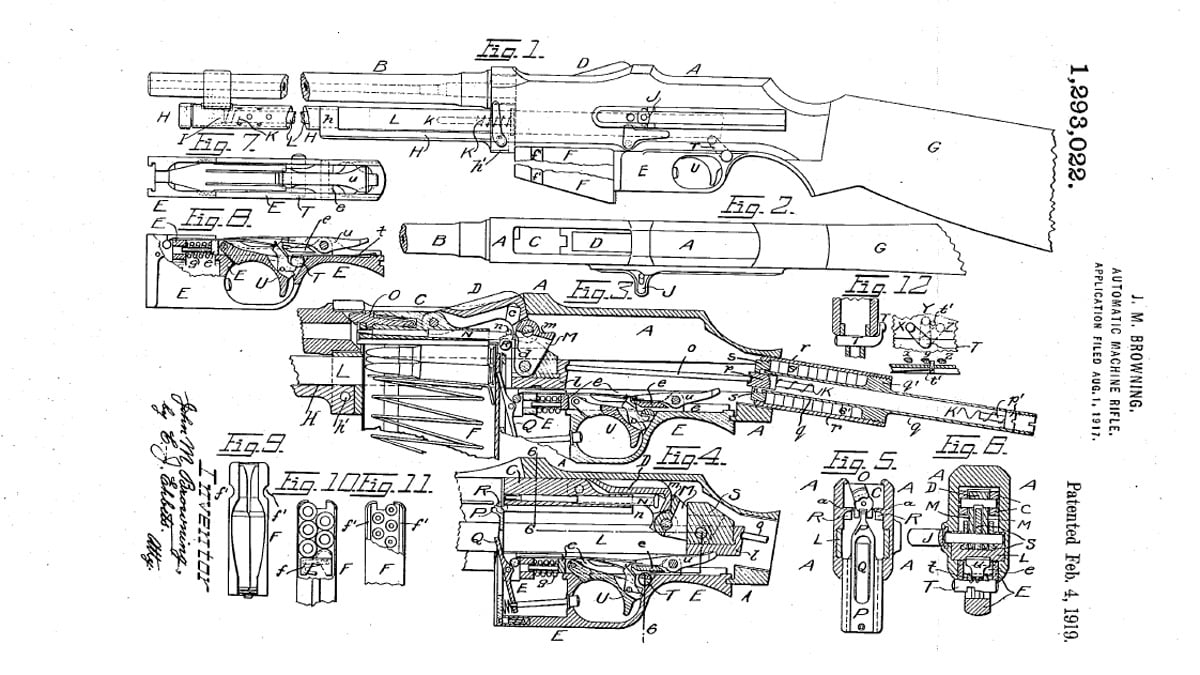
The great John Moses Browning (1855-1926) already owned a patent for a box-fed, semi-auto rifle as early as 1900 with the Remington Autoloading Rifle/Remington Model 8. Even his patent for the infamous but unrelated Browning BAR machine gun (U.S. patent number 1,293,022) dated back to 1917.

However, those earlier designs were a far cry from the modernized Browning BAR sporting rifle we’re looking at today. Released in 1967, I find it fitting the company’s new flagship semi-auto was still one of “Browning’s” brain children, technically.
John Browning’s grandson Bruce Warren Browning (1928-2019) led the charge to develop the sporting BAR.

Bruce Browning’s January 1967 patent filing (U.S. patent number 3,380,182) detailed a sleek hunter with a removable box magazine that closely resembles the BAR we know today. Other designers at Browning Arms Company/FN’s factory in Belgium furthered work on the sporting BAR under a project code-named “Carbine 66.”
Related: Browning’s Other BAR – Baron of Hunting Rifles
The sporting BAR changed over the years. The earliest Type 1 and post-1976 Type 2s remained largely the same. Browning introduced its Mark II version with an updated trigger and bolt-locking system in 1993, and they’re still in production today alongside the BAR MK 3.
The original sporting BAR also inspired a less popular pump-action BPR. These were meant to appeal to hunters in states with increasingly restrictive laws on semi-auto rifles.

The Browning company is still very proud of the family lineage in this gun. Given that it’s coming up on 60 years of production, the company should be proud. Its legacy is also on full display in the modernized tactical/competition-focused FNAR.
Design Specs
Our gun here is an early Belgian-made Type 1, and it’s hiding a bunch of interesting internal parts under its forend. Here’s a peek.

There’s a gas piston at the front where the gas port is located. Siphoned gas from the barrel drives this piston to the rear, where it operates a left and right slide bar via a guide rod. This drives the rotating bolt back while unlocking it from the breach. A recoil spring reverses the process to load the next round.
Related: 3 Browning Rifles Perfect for Deer Hunting This Fall

Total weight comes in at 8.93 pounds with this optic and sling. That’s a hefty but not unreasonable weight for an all-metal semi-auto gun, especially if it’s from circa 1970. Here’s a quick breakdown of the basic specs for this particular BAR:
Weight: 7.8 pounds
Length: 43 inches
Barrel Length: 22.75 inches
Sight Radius: 17.25 inches
Length of Pull: 13.45 inches
Capacity: 4+1 (.30-06 Springfield)
Trigger Pull: 3.4 pounds
The gun hosts many parts across its entire operating system. That’s normally a complaint point for me, but this isn’t a tactical gun destined to shoot thousands of rounds a year. It’s also quite pleasant to feel that action working as your shoot.
I love the trigger on this old BAR. There’s a very short take-up to the wall that’s barely noticeable. The break is crisp without feeling like you hit a stiff wall. It snaps off predictable shots with a light pull of just 3.4 pounds.


The removable four-shot magazine is hooked into a levered floor plate. The bolt locks back on the magazine after your last round. Therefore, reloading requires the shooter to pull back slightly on the operating handle while hitting the magazine latch. This drops the floor plate and magazine for reloading.
It’s an awkward system that I found unnecessarily involved.

My last gripe is the safety. It’s fine. It’s just a traditional cross-bolt button safety behind the trigger. I dislike this common style because it forces the shooter to move their shooting-hand fingers awkwardly before actually taking the shot.
Range Testing & Accuracy
I was pleasantly surprised with how smooth the action on this old BAR ran. The felt recoil of this .30-06 Springfield gun was nearly enjoyable. The somewhat complicated action inside the rifle clearly eats up a lot of that reward violence.

You can feel the mechanics of this gun working while you shoot. I love that. It also came with a vintage 3-9x Redfield Widefield scope, which I’ve only gotten to read about until now. Between the wide-view lens, light trigger, and soft-recoiling action, it was a joy to shoot.
Related: This Gun Fits Me Perfect – Browning BAR Safari
Just as importantly, it was accurate. I’m hardly a long-range precision shooter, so I don’t normally judge a rifle for anything that is likely me at long ranges. That said, here’s what I did after a quick zero at 50 yards:

And here’s what we got at 100 and 200 yards:

The accuracy at 50 yards showed this gun can do better than I shot it at 100 yards. I put 100 rounds of 150-grain soft-point Federal Power-Shok .30-06 Springfield ammo through the gun with no malfunctions. Since I wasn’t shooting precision ammo and only shooting off a sandbag, I’d say the gun could do MOA or better at 100 yards with a better shooter.
For a rifle that’s more than five decades old, I would call all of the above huge wins. I’d have no issues taking this classic gun back into the hunting fields.
Pros & Cons

Here’s my short list of this gun’s pros and cons:
Pros:
- Very accurate and reliable
- Old and new models available
- Pleasant to shoot
- Cool mechanical design
- Great trigger
- Solid construction
- Attractive looks
- Classic feel
Cons:
- Relatively heavy
- Limited four-shot magazine
- Awkward reloading system
- Rear button safety
-
More complex design
Final Thoughts

It’s hard not to love a classic rifle like Browning’s BAR rifle. I can see why it stuck around for so long. Personally, for my money, this is the kind of classy gun that’s worth digging around for a nice used one. Though, the new BARs are very fine-looking guns beloved by many hunters.
This one was well worn and used but still shot like it was a rifle that came off Browning’s assembly line today. That’s a testament to the design and quality that went into these firearms.