AP5-M Background

What a glorious Hollywood life the MP5 has lived, and the MP5K this Century Arms clone is modeled on has had a particularly colorful showing on the big screen. Yet, the gun’s origins go way back to well before the modern action flicks that made it famous.
Developed by Heckler & Koch as the Maschinenpistole 5 in the mid 1960s, the MP5 and its kin were meant to serve as affordable yet modernized submachine guns for the post-WWII era. Yet, these compact, stamped, roller-delayed guns actually emerged from a series of World War II arms developments.

The German firearms industry became quite skilled at stamping parts for firearms during World War II. That was largely out of necessity, but the trend carried into post-war arms development. While several designers experimented with roller-delayed and similar operating systems, it was Nazi Germany’s Gerät 06(H) – commonly referred to today as the StG 45 – that first saw it put into a prototype destined to grow into several modern firearms. It would eventually evolve into what became the Spanish CETME and German G3 rifles after the war.


Heckler & Koch had grander ideas for the roller-delayed system. What started as a full battle rifle that became the very successful G3 rifle – essentially a modified CETME – H&K then branched out and modified to fit a host of needs. The smallest of these developments was the 9mm MP5 we know today.
Related: Two Guys One Gun – Is the MP5 Still Relevant?

H&K further diversified the MP5 with a host of variants that included an extremely compact, stockless MP5K option introduced in 1976 for confined tactical operations. The line of select-fire firearms has dominated the submachine gun market for more than half a century now as some of the most popular military, security, and police firearms of all time.
Specs & Features

It took a team of German engineers, mathematicians, and other scientists to finally crack the roller-delayed operating system. But in a nutshell, there are rollers inside the bolt head that semi-lock the bolt in place until firing. Once the gun is fired, these rollers are forced into recesses inside the bolt head, and the action both unlocks the bolt and slows the bolt head’s rearward movement relative to the bolt carrier.

The process creates a mechanical feel to shooting the gun, almost like a delayed rolling recoil that is more controllable. The design also did away with the gas piston in favor of a simpler system that reduced the total number of parts and machine time needed for manufacturing.
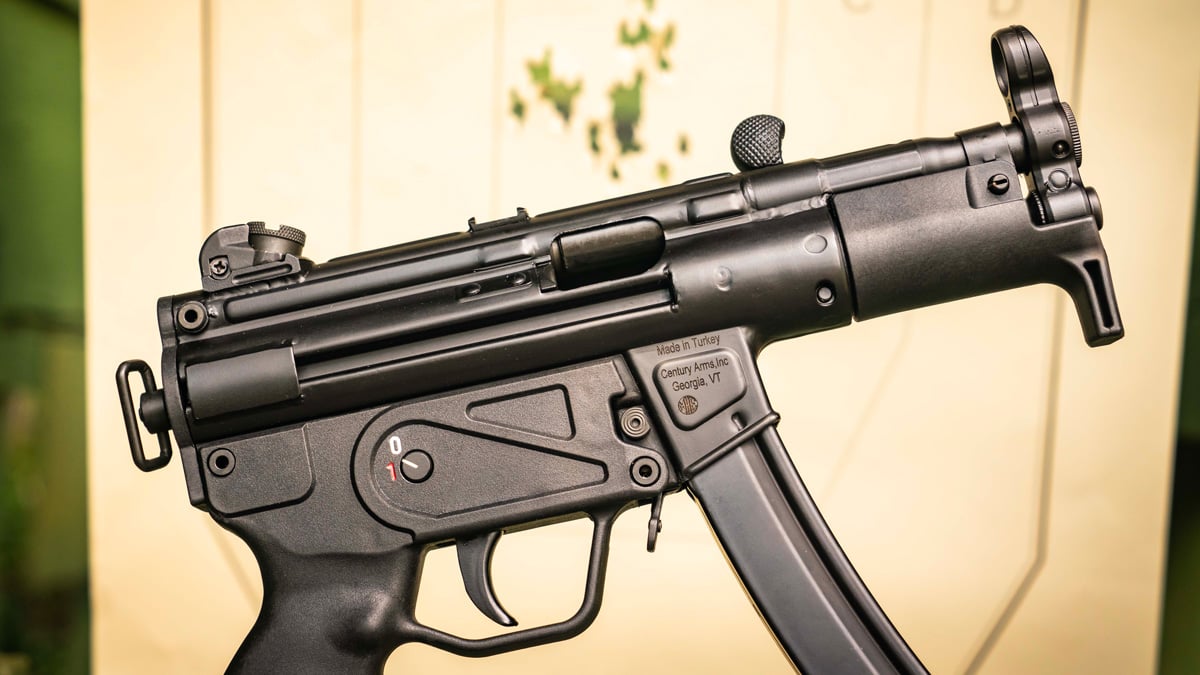
This AP5-M uses a stamped receiver like you would find on a MP5K. The cocking handle does not recoil with the bolt and therefore spares any risk of striking your support hand. It does not lock open on the last round. Instead, you must pull the cocking handle to the rear and rotate it up to lock it open manually.


The pistol grip and handguard are polymer. Sights are your classic adjustable rear MP5-style circle with varying notches and a fixed front post inside a circle shroud. Larger MP5 variants often feature several aperture rear sights instead of notches. There’s a non-Picatinny attachment point if you want to add an optic on this model. Other variants do offer a modernized Pic option on the upper receiver.
Related: Century Arms AP5 Review – Compact 9mm Firepower
Here’s a quick rundown of the basic specs for this AP5-M:
- Weight: 4.37 pounds unloaded
- Length: 12.79 inches
- Barrel Length: 4.6 inches
- Sight Radius: 10.25 inches
- Height: 8.63 inches
- Width: 2.1 inches
- Capacity: 30+1
- Trigger Pull: 6.9 pounds
The trigger is at once unrefined and surprisingly pleasant. It has 0.1 inches of travel to what we can call the wall, and that wall has a long creep to the actual break, with a total trigger travel of 0.25 inches. It’s blocky and mushy, but it was meant for a select-fire gun that would be easy to control during full-auto fire.
I found it performed far better than the above description implies on the range. The reset is short at just 0.15 inches. It’s audible, tactile, and very positive. That makes this a gun that is easy to fire relatively fast.
Here's a closer look at how that trigger works:
The pistol grip has a thumb shelf on the left side and an aggressive hand stop up front. That stop is worth pointing out. There is very, very little distance between your hand and the front of the barrel, so never wrap your thumb forward of the front sight and hand stop. Personally, I keep it wrapped behind the cocking handle or simply hold it closer to the magazine well.

The safety is not ambidextrous, and it’s actually quite large and stiff. You have to extend your shooting-hand thumb quite a bit to swipe the safety down for firing, and it’s also stiff on the return to the safe position. With a bit of practice, it got easy to manipulate the safety, and I can do it with fluid motions now. Just don’t expect it to be like your traditional AR-style safety.

Disassembly entails popping out three retaining pins. Two are located at the rear of the gun and the other is in front of the trigger guard. From there, you can pull off the rear plate with its polymer recoil buffer and pull out the bolt and recoil spring.


All in all, cleaning turned out to be very easy, and no tools were needed for field-stripping the gun. Some final features include front and rear sling attachment points, paddle-style magazine release, and additional button-style magazine release on the right side of the gun.
Range Testing

I expected this gun to look cool and shoot terrible. The 4.6-inch barrel is nothing to brag about, but the 10.25-inch sight radius is relatively generous compared to a traditional handgun. However, without a stock, I didn’t figure I would have much luck beyond an enjoyable mag dump at the range.
I was wrong. Here’s what I got with my first target on a full magazine at 25 yards:

I didn’t work particularly hard or shoot slow to get that grouping. Without any adjustments, it was just a matter of loading the gun and pulling the trigger whenever I had a relatively clear sight picture. Overall, the accuracy impressed me.
One-handed shooting was a blast, and the gun pointed surprisingly well. Since this is a pistol, one-handed shooting highlighted that the gun has a very comfortable recoil. At 4.37 pounds unloaded with a roller-delayed bolt, that shouldn’t be surprising. It’s more of a sluggish roll in your hand than a snap or kick.

I shared some trigger time with various friends on the range over several visits, and all shooters agreed it’s a pleasant and fun gun to shoot. It’s nimble and light when you wield it with two hands, and it’s light enough to control while shooting with just one hand.

I’m sitting at 750 rounds through this AP5-M, and it has been solidly reliable with just a few notes. While this was a used gun, it came in to me looking almost unused. The barrel was spotless, and the action had only a hint of powder schmutz.
On my first range trip with a mix of 100 rounds of 9mm brass-cased 115-grain Federal range FMJ and 100 rounds of 9mm steel-cased 115-grain Winchester range FMJ ammo, I had two failures to fully extract the steel-cased Winchester ammo early in the testing.
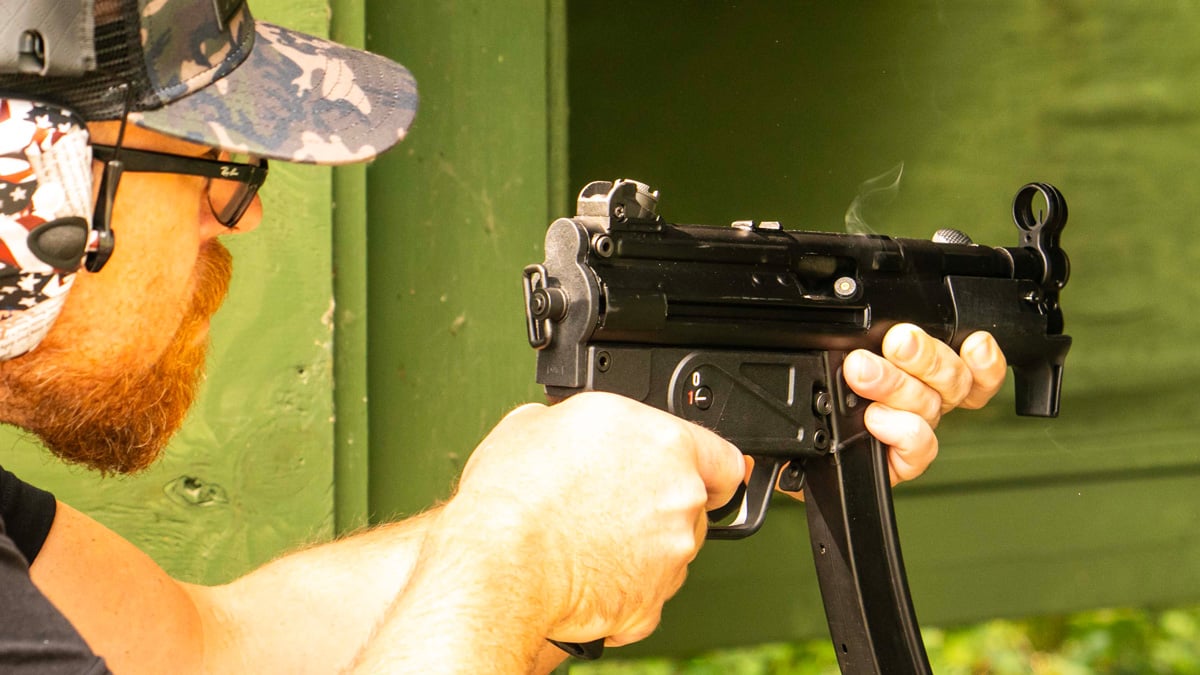
I toted the gun on several more range trips without any cleaning over the last several months. Over the next 550 rounds of a mix of ammo that excluded steel-cased rounds, I haven’t had any similar issues. My takeaway is that the gun may have a bit of a break-in period, and it unsurprisingly likes brass-cased ammo.
As far as reliability goes, it certainly has the ability to be very dependable. I would just test a few budget ammo types before locking in a pallet of 9mm plinking rounds for this – or generally any – gun.
Pros & Cons
Here’s my short list of pros and cons for the Century Arms AP5-M:
Pros:
- More affordable than most MP5 clones
- Very, very fun to shoot
- Feels great in the hand
- Reliable
- Surprisingly accurate and controllable
- 30+1 capacity
- Compact design
- Great classic looks
- Adjustable sights
- Interesting and historical design
Cons:
- Heavy at 4.37 pounds
- Trigger is a bit mushy but predictable
- Stiffer safety design than an AR-15
- No non-NFA stock option for the short barrel
- No Picatinny-style optics rail
-
Very short handguard and barrel
Final Thoughts

I’ve never been an MP5 fanboy, but I loved seeing it come on the big screen as a kid in classic action flicks like “Terminator 2: Judgment Day,” the ultimate Christmas movie that is “Die Hard,” and a highly underrated personal favorite in the “Last Action Hero.” The gun always had a cool factor to it, but I never really thought I’d get to spend much time with one in real life.
The AP5 line from Century Arms is a bit of a break with the trend of more expensive MP5-style guns. I personally find the AP5-M to be one of the most appealing options in the AP5 family for its extra-compact feel. Sadly, this particular gun is on its way back to the Guns.com Certified Used Vault, and it will be missed on my future range trips.
If you are a fan of the MP5, action flicks, or generally just want to prepare in style for a zombie/machine apocalypse, Century Arms cuts the cost with its AP5 guns while still offering performance on the range.