What was the L9A1?
The British Army and its Commonwealth allies in Canada and Australia were some of the first to unofficially adopt the Inglis-made Browning Hi-Power during World War II to supplement the handguns already in use. An "official unofficial" copy of the BHP, Inglis made over 100,000 of these pistols in Toronto during the war, with exiled Belgian personnel from FN helping with the effort.


While the Inglis-marked guns served as the No. 2 Mk1 and No. 2 Mk1* in the Canadian Army until very recently, the British continued to keep the Enfield No. 2 .380/200 caliber top-break revolver as their official sidearm until 1969. What replaced the old Enfield was the L9A1.
The British SOE and elite units such as the Paras loved the Inglis Hi-Power in WWII, but it wasn't until deep into the Cold War that the British Army made the full pivot from top-break revolvers to the double-stack 9mm. Rather than the Canadian-made BHP clones, which ended production in 1946, the Brits turned to FN proper in Belgium and began ordering more or less commercial T-series guns directly from the factory starting in 1964, dubbing them the L9A1. By that time, FN had evolved the design, deleting the old "thumbprint" frame and internal extractor for a more elegant slab-side frame with an external extractor that upped the reliability. Also gone were the checkered wooden grips, replaced with plastic panels. In addition to the standard FN Herstal rollmarks, they carried a British Broad Arrow acceptance mark and a NATO stock number (NSN-1005-13-010-313).

The L9A1 became an instant hit with the British, who kept it in service in combat from Northern Ireland to Aden, the Falklands, Desert Storm, and Afghanistan. The pistol also went overseas as military aid, with many former British colonies around the world keeping it in inventory. The commandos of Australia’s Special Air Service Regiment prized the handgun. When it comes to the British SAS, the unit famously paired the L9A1 with the HK MP5 for close-quarter use, as highlighted in ending the Iranian Embassy siege in 1980 (Operation Nimrod) and in the Gambia in 1981. The Gambian operation involved just three plain-clothed SAS operators, one of them retired, who took on 400 rebel troops and successfully restored the overthrown local government armed with only their MP5s and L9A1s – the hardware smuggled over the border in diplomatic pouches.
The L9A1 was only replaced in British service by 25,000 Glock 17s (designated the L131A1) in 2013, a pistol later augmented by the G19 (L137A1).
The New Inglis L9A1
Tennessee-based SDS Arms, whose umbrella of brands includes Military Armament Corporation (MAC), Tisas, Tokarev, and Spandau, is bringing back the Inglis name to the American market.
At SHOT Show '24, the company announced the L9A1 clone to include a black Chromate finish and plastic grips as well as three more commercial models: a black Inglis P-35B with walnut grips, the satin nickel Inglis P-35N with black G10 grips, and a color-case hardened Inglis GP-35.
We caught up with Jahred Gamez at the time to check out these new guns, which were "coming soon."
Now, the Inglis guns are shipping, and we made sure to get a production model to review. For disclosure, Inglis sent Guns.com an L9A1 for review purposes. All testing was done on this one gun, which has been under evaluation since December.


The L9A1 feels like a well-built BHP from the 1980s and mimics what would be marketed at around that time by Browning/FN as the Mk. II series gun. It is close to the T-series guns used by the British Army from 1964 to 2013 but with the benefits of more understated markings and an ambidextrous manual safety lever.


Specs
- Caliber: 9mm Luger/Para
- Barrel Length: 4.65 inches
- Overall Length: 7.8 inches
- Sight Radius: 6.25 inches
- Height: 5.1 inches over the top of rear sights
- Width: 1.4 inches at widest over grips, 0.91 inches across slide at ejector
- Capacity: 15+1 flush fitting Mec-Gar steel mag (ships with two)
- Trigger Pull: 5.75 pounds (10-pull average), SAO.
- Weight: 32.1 ounces with an empty 15-round mag, 43.4 ounces loaded with 16 rounds of 124-grain Federal Punch JHPs
Features


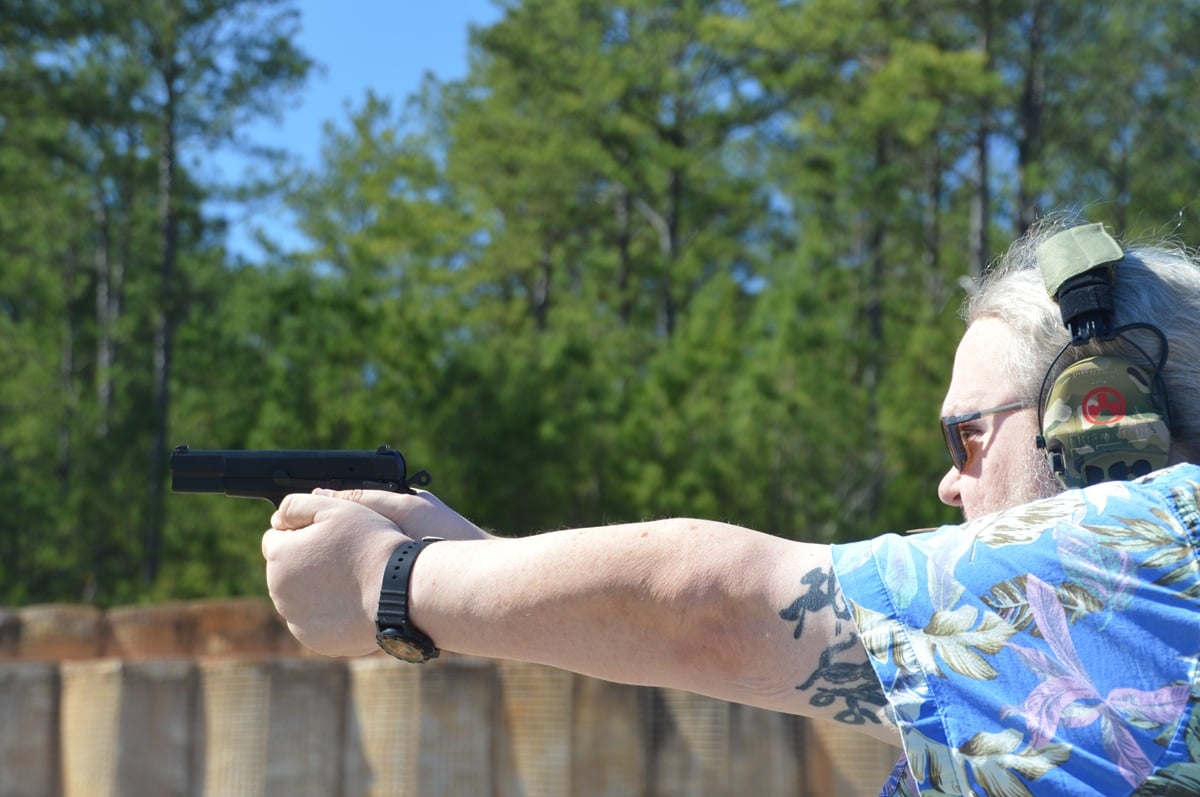


Trigger
The trigger on the Inglis L9A1 feels a bit better than those on most standard BHPs. This is because the pistol does not have the magazine disconnect, which added mush and creep – as well as kept the magazine from dropping free when the release button was pressed. Inglis advertises the pull as being about 7 pounds, and we found that to be a little of an overstatement. It broke at an average of about 5.75 pounds after a short take-up and pull through the wall.
Check out that pull, break, and reset on the range.
Reliability
We fired the Inglis L9A1 right out of the box with no additional lube or preparation, running 500 rounds of factory ammunition through the pistol in assorted bullet weights and load types. We also used several BHP-pattern mags in addition to the two provided with the gun, including FN and Browning-marked magazines. When it comes to reliability, the gun worked well, suffering two easily cleared failures to feed on 150-grain Federal Action Match rounds – likely due to geometry. It also showed a tendency to occasionally fail to lock back on an empty magazine.

Accuracy
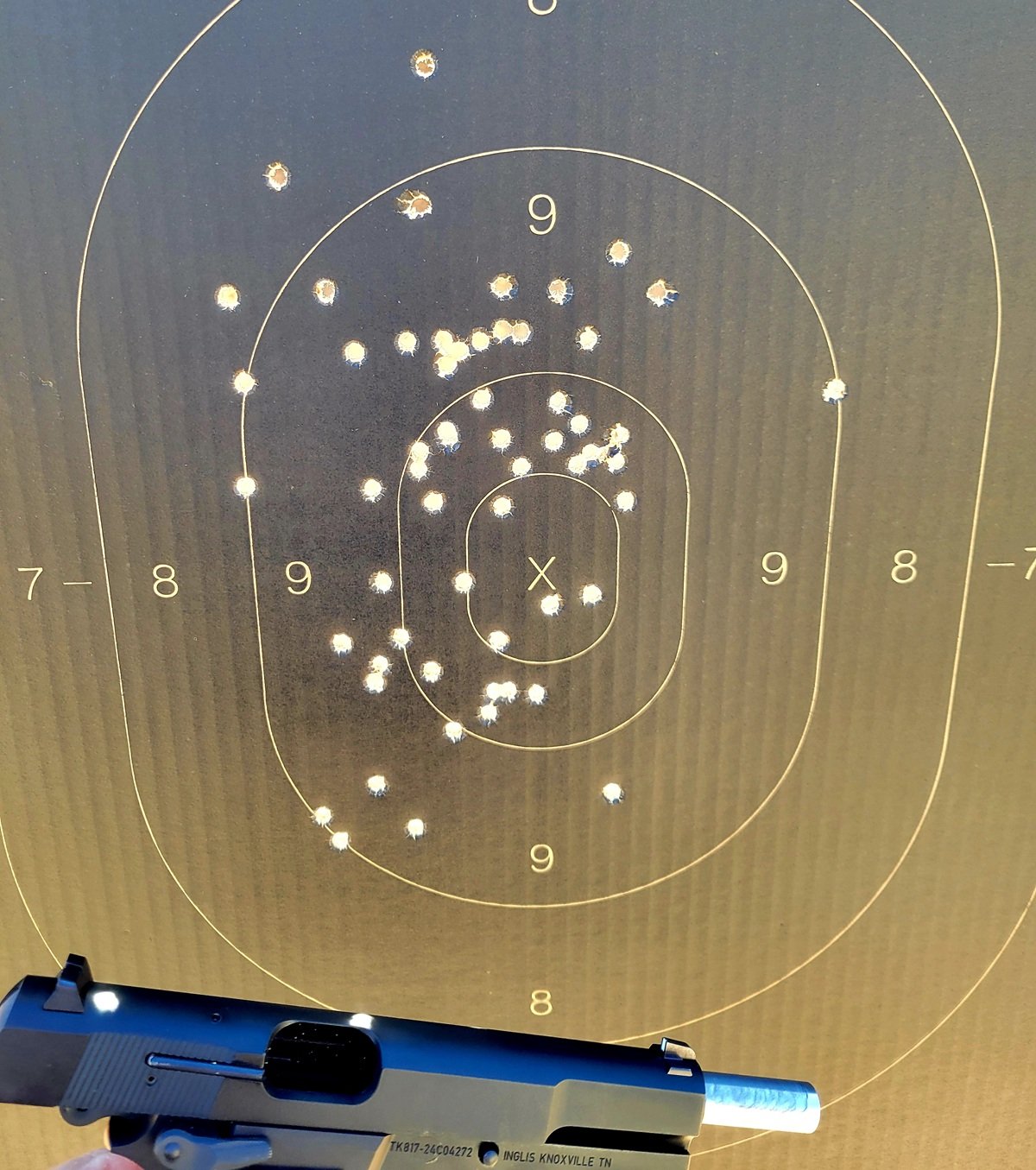
Despite the fixed sights, the Inglis L9A1 proved itself in practical accuracy. We had no problem ringing steel IPSC silhouettes at 25 yards in a standing position, and moving up to 15 yards, could easily keep it well inside the 8-9-10 "5" zone of a B-27 silhouette. It is not a target gun, but the average user should still be able to pull off a Mozambique drill – the staple for BHP lore – at 7 yards.
Pros & Cons
Pros
- Classic design, especially for British Army buffs
- No-frills "combat-style" Mark II/III BHP military contract clone
- Accurate
- Reliable
- Tons of parts, accessories, triggers, and holsters available
- Sub-$500 cost
- No magazine safety (better trigger)
Cons
- A mash-up of designs that may turn off purists
-
No magazine safety (will fire without a magazine inserted)
Conclusion
The Inglis L9A1 is a great entry to the market that nobody else was going after. Sure, there are tons of clones of commercial-style BHPs from folks like EAA (Girsan MCP35) and Springfield (SA35), as well as upgraded and more tricked-out modernized variants with things like flat-faced triggers, accessory rails, and extended beavertails. However, the BHP was primarily designed for use by military/LE customers, and for about 40 years, it was the staple sidearm for most Central/Western European armies and many overseas. With the new Inglis L9A1, SDS/MAC has something very appropriate to this old combat handgun for collectors.
Sure, a purist may point out that the Canadian Inglis firm never made this design, which itself is something of a smorgasbord of features found on BHPs made in the 1960s-'80s, but how much can you nitpick for $500?
I say toss some beans on toast, grow your mustache out over your top lip, and cue up "God Save the Queen." The only true Dr. Who was Tom Baker, and I'm not apologizing for it.