“The eyes of the world are upon you. 
The hopes and prayers of liberty-loving people 
everywhere march with you.”

-Gen. Dwight D. Eisenhower
To all Allied Expeditionary Forces before the D-Day landings.
 

D-Day: June 6, 1944 – Objective: Secure a foothold in France to begin the liberation of Western Europe from the tyranny of Nazi Germany and end World War II where it started. 

Even generations later, the legacy of the Allied service members who stormed the beaches at Normandy, France, or landed behind enemy lines from the sky and drove inland some 82 years ago remains. It remains in the awe-inspiring 9,389 American grave markers still maintained at the Saint Laurent Cemetery in Colleville-sur-Mer, France. It remains in the wreckage of war still littered in places along the Normandy coast. 

It remains in personal family histories, days of remembrance, and in the gift of liberty that still defines Europe today. It also remains in the firearms carried by millions of Americans throughout WWII that are respected collectibles today.

Here are some of the guns of D-Day still readily available for the collectors, the curious, the patriots, and the historically inclined.


Table of Contents

Quick D-Day History
M1 Garand Rifle
M1 Carbine
M1911 Pistol
Thompson Submachine Gun

Quick D-Day History


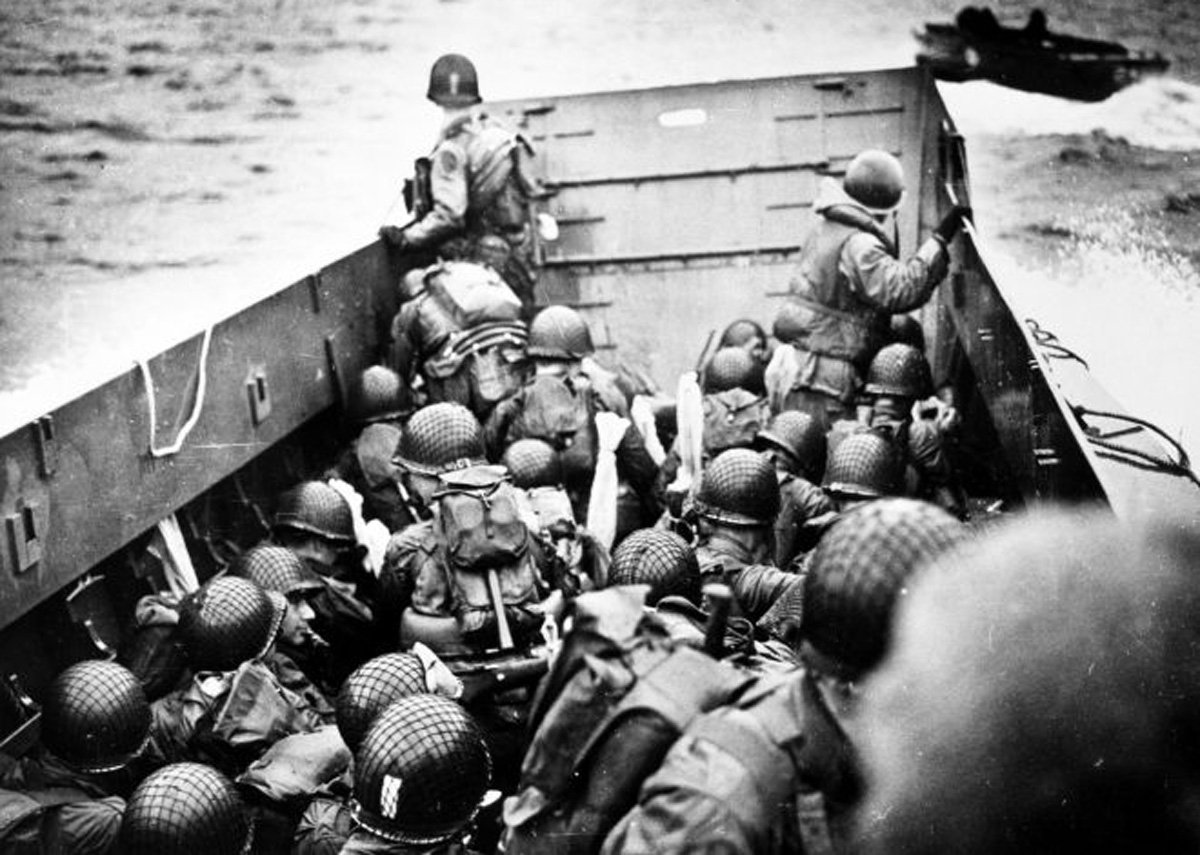
American troops headed to the Normandy beach
Troops crouch inside a landing craft, just before landing on Omaha Beach on D-Day, 6 June 1944. Note many of the rifles are wrapped in bags made of Pilofilm, a rubber-based product developed by Goodyear in the 1930s, which predated modern plastics. (Photo: National Archives)


WWII saw the German military storm the European continent, ejecting the Allies into the sea in the summer of 1940. Then, the Nazi war machine turned on its former ally, the Soviet Union, in a struggle of annihilation. By the summer of 1944, the tide had turned in the East at the cost of tens of millions of lives, but the Nazis still held Europe in an iron grip behind the Atlantic Wall. 

Since the Battle of France in 1940, the only obvious way for the Allies to claw out a victory was to reopen the Western Front. After four years and a few botched attempts, the last chance was D-Day. Five thousand Allied vessels and 1,200 aircraft landed over 160,000 American and Commonwealth troops on the beaches of Normandy. Over 10,000 were lost on the first day, but their sacrifice started a nine-month countdown to the end of the Nazi regime.

More than eighty years later, the waves and salt of the Normandy beaches break down the shrapnel and concrete that symbolized the struggle. Black-and-white memory replaces those who saw it in living color. But the guns they carried are very much with us, still serving a purpose and giving us a crucial living link to a past growing more distant every day. Here are four great guns of the Greatest Generation and a few honorable mentions.
 

M1 Garand Rifle
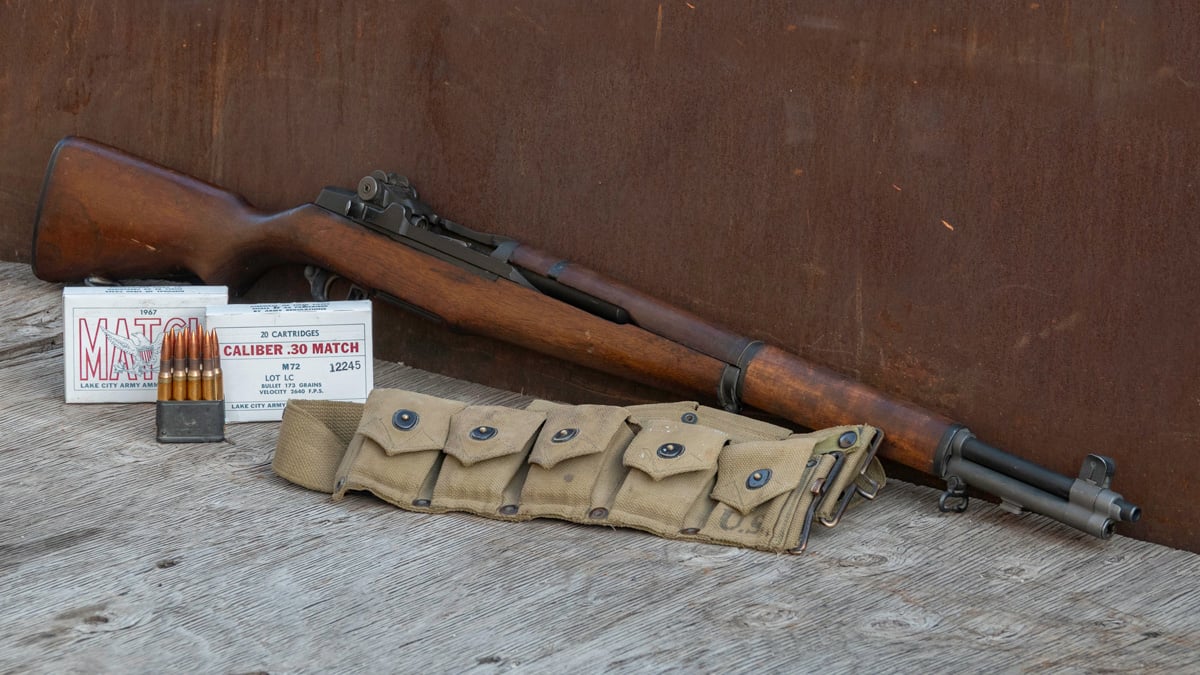
The M1 Garand was the standard-issue service rifle for the U.S. Armed Forces from 1936 until 1957. As such, it was the primary arm of the American infantryman storming the Normandy beaches. Unique among infantry rifles of the time, it was the first self-loading rifle to serve as the standard service weapon for a major military on the battlefield. 

This eight-shot semi-auto .30-06 rifle would go on to see service throughout World War II, Korea, and even the early stages of the Vietnam War, with a total production run of over 5.4 million. Demand for the M1 remains strong thanks to its wartime association and its use in service-rifle matches like those held at Camp Perry.

M1 rifles can be built up from parts kits or bought complete as different rack grades of wartime and post-war production models.
 

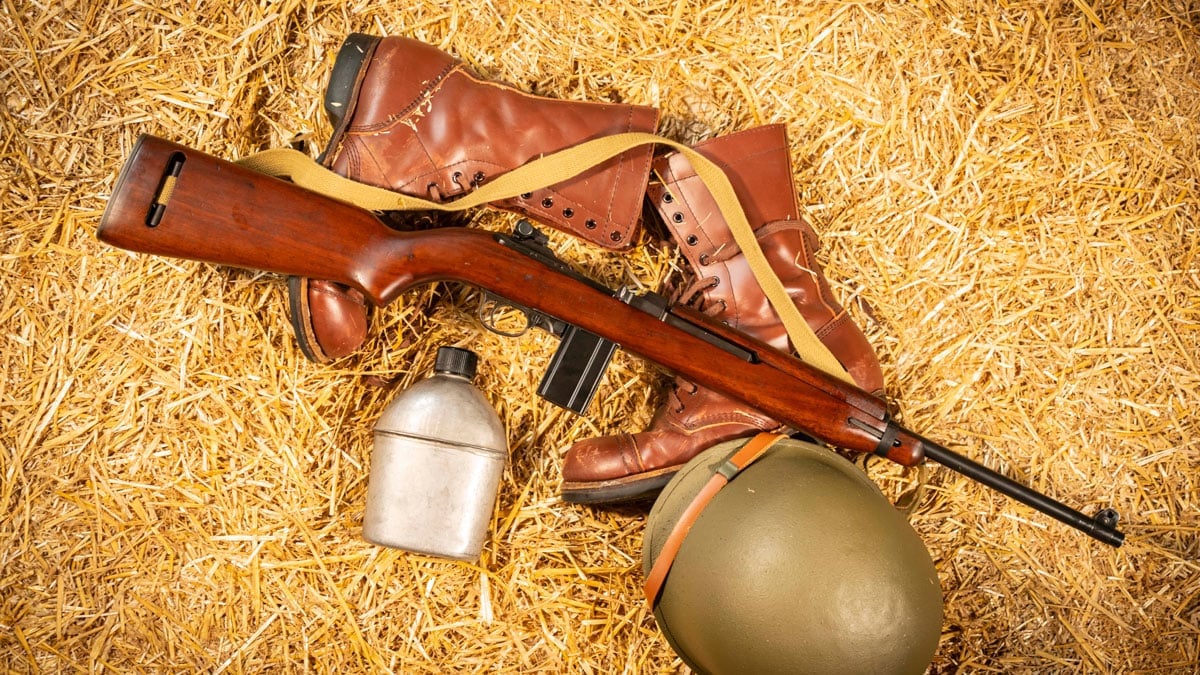
M1 Carbine

The German military’s Bewegungskrieg (mobile warfare) blurred the line between combat and non-combat troops, many of whom were generally lightly armed with handguns. The M1 Carbine debuted in 1942 as a personal defense weapon for troops whose main job precluded direct combat or who needed a lighter firearm than the heavy M1 Garand. 

This light semi-auto carbine weighs just 5 pounds and fires the intermediate .30 Carbine cartridge. The M1 Carbine was initially fielded with 15-round magazines, but 30-round magazines were available by 1945. 

At nearly half the weight of the M1 rifle, it was still more powerful and had a greater effective range than the M1911 service pistol. The carbine was intended for officers, radiomen, truck drivers, and the like. But the light and quick-shooting M1 Carbine found favor with paratroopers, such as those of the 82nd and 101st Airborne, who dropped behind the lines before the Normandy landings.

The M1 and M1A1 carbines were the most produced American firearms of the Second World War, with over 6 million made. The M1 Carbine’s success had crossover appeal for decades on the commercial market, well before the AR-15 became popular. You can shop the grades of original wartime carbines, post-war commercial copies, and even the finest new production models from makers like Auto-Ordnance, Inland Manufacturing, and Fulton Armory. 
 

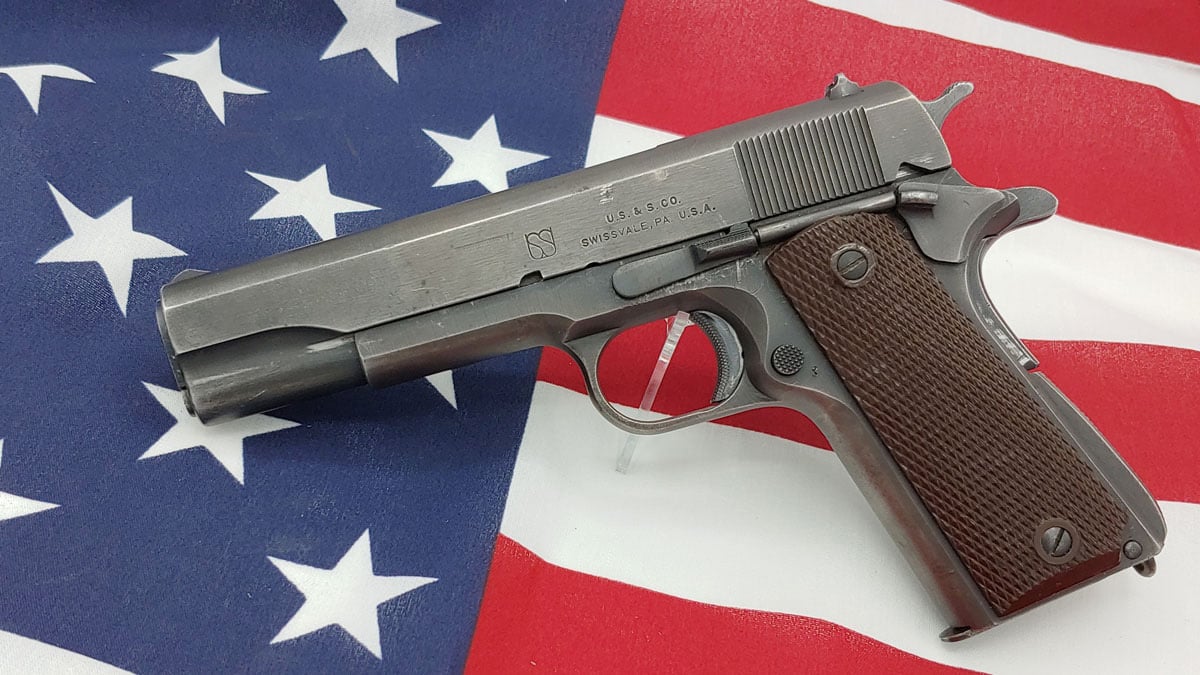
M1911 .45 Pistol

Famed for its close-range hitting power, the M1911 service pistol chambered for .45 ACP served the U.S. Armed Forces for 75 years. The M1911A1, along with the older Great War M1911, was the primary sidearm among officers, BAR men, tank crewmen, and anyone who could find one. 

Today, the 1911’s legacy looms large. The .45 ACP cartridge remains a popular choice, and the 1911 platform has evolved to fit any taste. However, the GI 1911 is still made by several manufacturers. You can shop for any number of pre-war 1911s or collect any of the wartime models from Colt, Remington Rand, Ithaca, Union Switch & Signal, or Singer. 

Some of the best representations made today come in the form of the Colt Government Model and the Springfield Mil-Spec.
 

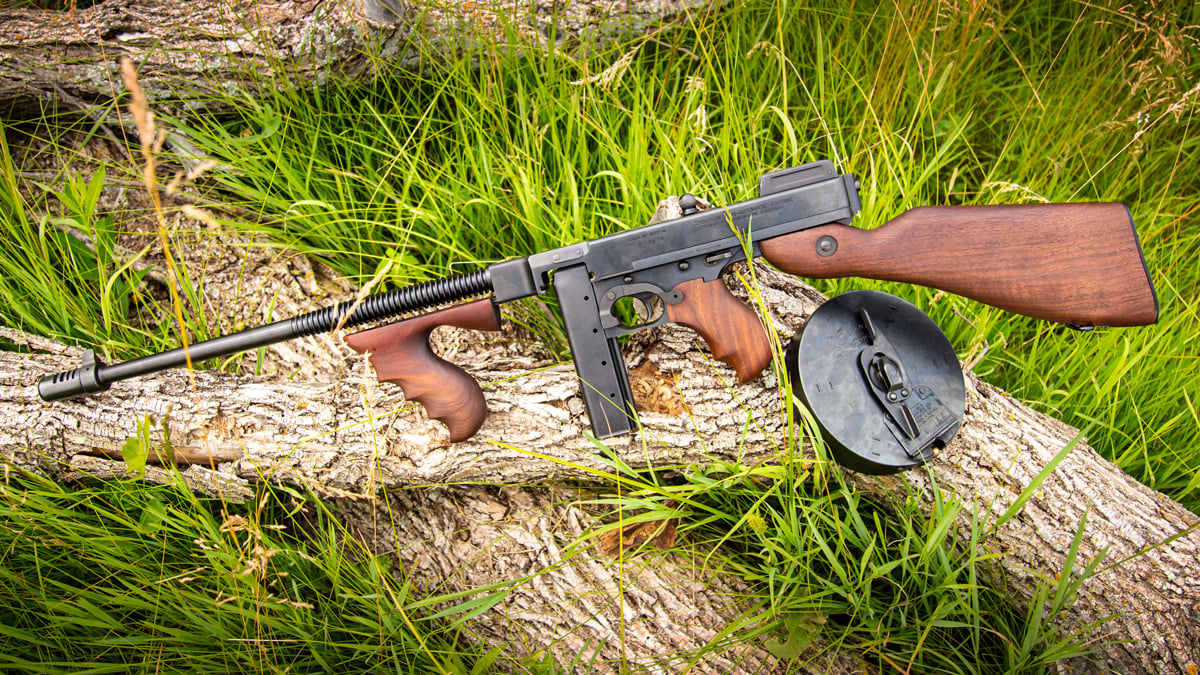
Thompson Submachine Gun

Gen. John Thompson developed the “Tommy Gun” in 1918 as an antidote to the trench warfare of World War I. The war’s sudden end forced Thompson to look to the civilian market and foreign sales for his open-bolt submachine gun chambered in .45 ACP. Belatedly, the U.S. Army adopted it in 1938. The simplified M1 and M1A1 models were standard equipment for NCOs and point men on patrol, but American paratroopers and Rangers favored them for their firepower. Although the Thompson was supplanted by the cheaper M3 Grease Gun, over 1.5 million were made for the war effort.

Original Thompsons, just like other fully automatic or select-fire long guns, such as the BAR and Sten, are regulated by the National Firearms Act. Limited supply and wartime provenance result in high prices at auction. Thankfully, Auto-Ordnance offers a semi-auto alternative that is more within reach and still scratches the itch for those interested in this classic.

While generations come and go, the evidence and legacy of World War II endure. Some of it is confined to the monotony of museums, but the guns of WWII are still very much alive and relevant to firearm collectors and shooting enthusiasts today. The Greatest Generation gave us a free world, and they gave us what they carried to make it free, too. 

Terril James Hebert - Guns.com Author

Terril James Hebert

Terril Hebert is the world's okayist historian and firearms journalist who occasionally moonlights as an NRA pistol instructor. In his spare time, he enjoys forensic accounting, waxing poetically about the efficiency of musket balls, and working on his latest fire-starting techniques.

View All Articles by Terril James Hebert

revolver barrel loading graphic

Loading