The Birth
News of the young round came in January 2023, shortly before the round’s official launch at the SHOT Show in Las Vegas, Nevada. The debut was shared concurrently by Remington Ammunition and Henry Repeating Arms, joining forces to create a straight-walled round built specifically for lever-driven rifles, the latter company’s forte. The round’s official name is indeed 360 Buckhammer, abbreviated 360 BHMR.
The Lever Gun Straight Wall
Coming on the heels of the already-surging 350 Legend straight-wall chambering from Winchester, the 360 rolled out of the gate facing an uphill battle. While the Legend recoils less and has already found a home on countless bolt actions and semi-automatic modern sporting rifles, the 360 clearly defines its market as the lever gun world.

Already in its first year, Henry Repeating Arms is chambering four of its centerfire rifles for the round: Steel Side Gate Lever Action, Lever Action X-Model, Brass Side Gate, and even the break-action Single Shot Steel.
The Metrics
The 360 BHMR is a rimmed, straight-wall case with a length of 1.80 inches. Its roots run deep, reaching back to the beloved .30-30 Winchester, which has essentially been blown out and necked up. According to SAAMI specs, overall length measures a minimum 2.35 and maximum 2.5 inches.
Though named the 360, the round’s projectile metric is actually .358 to .359 inches in diameter. The rounds were tested and optimized for 1:12 twist barrels. SAAMI lists a max pressure rating of 50,000 PSI.
Ammo Options

Naturally, Remington has been leading the charge on the factory ammunition front, with a pair of bread-and-butter Core-Lokt options. The first is a beasty 200-grain soft point, with the other a slightly lighter 180-grainer. However, Remington is not alone.
Partner company Federal Ammunition, another American powerhouse, has announced a 360 Buckhammer Power Shok offering, as well as a selection in the lever gun favorite Hammer Down family, though neither was yet available at the time of this writing.
Relation to Earlier Rounds

Parent company Remington advertises that the triumvirate of performance – energy, velocity, and ballistics – are similar to the lever gun deer hunter’s gold standard .30-30 Winchester. That said, fans of the old-school, brush-busting lever-driven .35 Remington will certainly recognize similarities to that now sadly fast-fading chambering. Shooters need only glance at projectile diameters and weights to find the connection with the big ol’ .35, itself a shorter-range yet hard-hitting deer and bear darling.
Effective Range
Per Remington website advertising, the round is “optimized for lever-action rifles and accurate at 200-plus yards.” That’s on par with the 350 Legend, which touts its effective range to 200 yards. The question lies in the inclusion of the plus sign.

According to comparable factory ammunition specs, the 360 BHMR drops less (-7.8 inches) at 200 yards and retains more energy (968 foot pounds) at 200 yards than the .30-30 (-8.4 inches /947 foot pounds), 350 Legend (-9.4 inches/924 foot pounds), and 450 Bushmaster (-12 inches /948 foot pounds). The Buckhammer’s muzzle velocity through a 20-inch SAAMI test barrel, listed at 2,399 feet per second, tops those three as well.
The 180-grainer offers the highest advertised muzzle velocity at 2,399, compared to 2,217 from the 200-grain. The 200-yard velocity, energy, and drop are also superior. Though we’ve felt more comfortable in our testing at, or inside, 200 yards, the decision of hunting beyond that range ultimately comes down to the hunter.
The Firearms
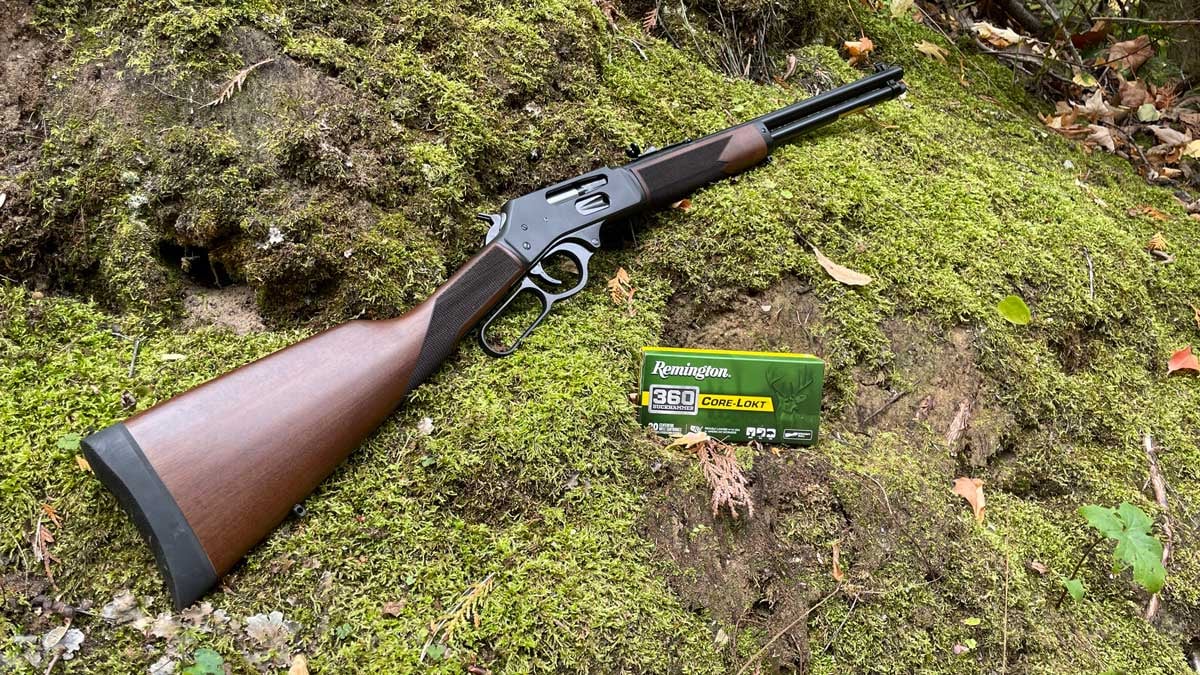
Four Henry firearms have been announced, but at the time of this writing, we haven’t seen them all shipping just yet. So far, we’ve handled two of Henry’s 360 Buckhammer firearms, both lever actions. The Steel Side Gate uses a hunter-friendly blued steel receiver mated to American walnut furniture. There’s a 20-inch barrel and traditional semi-buckhorn iron sights.
The X-Model, Henry’s line of blacked-out, tactical-minded levers, wears a 21.375-inch barrel that is threaded at 5/8x24, fitted with fiber-optic sights, and dressed in synthetic furniture. The break-action Single Shot hit shelves recently, and the Brass Side Gate with its high-polish receiver should be coming soon.
The Recoil Question
There’s no denying that the straight-wall 350 Legend’s selling point centers on its incredibly low recoil. How does the Buckhammer compare? Per Remington’s website, the “360 Buckhammer shoots like a light load shot from a .30-30 Winchester lever-action rifle.” Having fired both, we’d tend to agree with the 360 feeling quite comparable on the shoulder to the .30-30.

The Buckhammer recoils considerably more than the 350 Legend, but considerably less than the 450 Bushmaster, another straight-wall thumper. According to Remington ammunition recoil charts, both the 180- and 200-grain 360 Core-Lokt loads recoil at 14.1 foot pounds, while the.30-30 Winchester is listed at 16.3 foot pounds, which we’d argue is a bit higher than normally publicized.
Related: Low Recoil Ammo for Deer Hunting
The 450 Bushmaster, meanwhile, rests at the top of the chart, with a shoulder-hitting measurement of 22.2 foot pounds. To put things into perspective, our longtime favorite straight-wall .45-70 Government pounds out recoil measurements in the range of 25 to 35 foot pounds of recoil energy, dependent – like the others – on the weight of the gun, ammunition selection, and other variables.
Ideal Use?

The 360 Buckhammer has been purpose-built for lever-action rifles, targeting the deer hunting market. While those in states with straight-walled hunting restrictions are the prime buying group, lever gun hunters everywhere will give it a good look. Without doing true field testing on multiple types of game, we can still draw some conclusions with knowledge of the round, the projectile and ammunition types, and ballistics.
Related: 360 Buckhammer And The Straight Wall Hunting Craze
The current load range and velocities should prove practical on a wide range of medium-to-larger sized North American game at realistic ranges. We wouldn’t hesitate to take the Buckhammer out for whitetail deer, black bear, wild boars, and similarly sized exotics the world over.