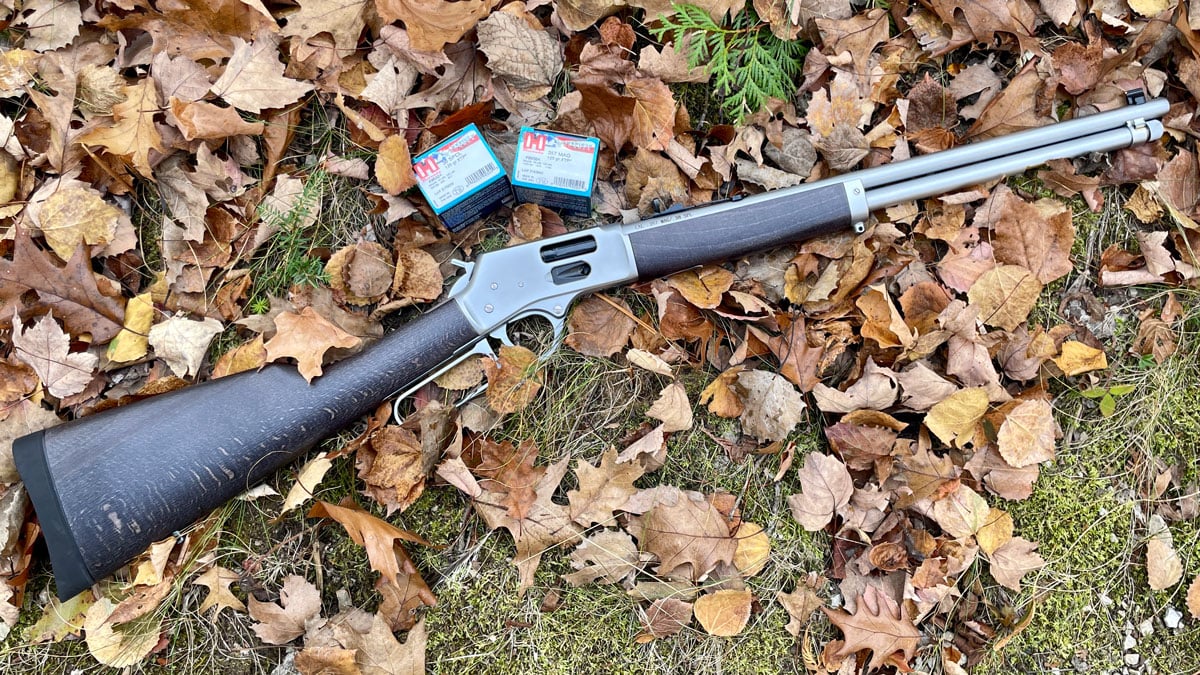
The Basics
The numbers on these two rifles are quite similar. Smith & Wesson’s standard 1854 uses a 19.25-inch round barrel that is threaded and with an included thread cover in place. Henry’s All Weather Big Boy, by contrast, uses a 20-incher and is only threaded on a few variants.
Related Review: Cool, Hard Chrome – Henry Big Boy All-Weather in .357 Mag
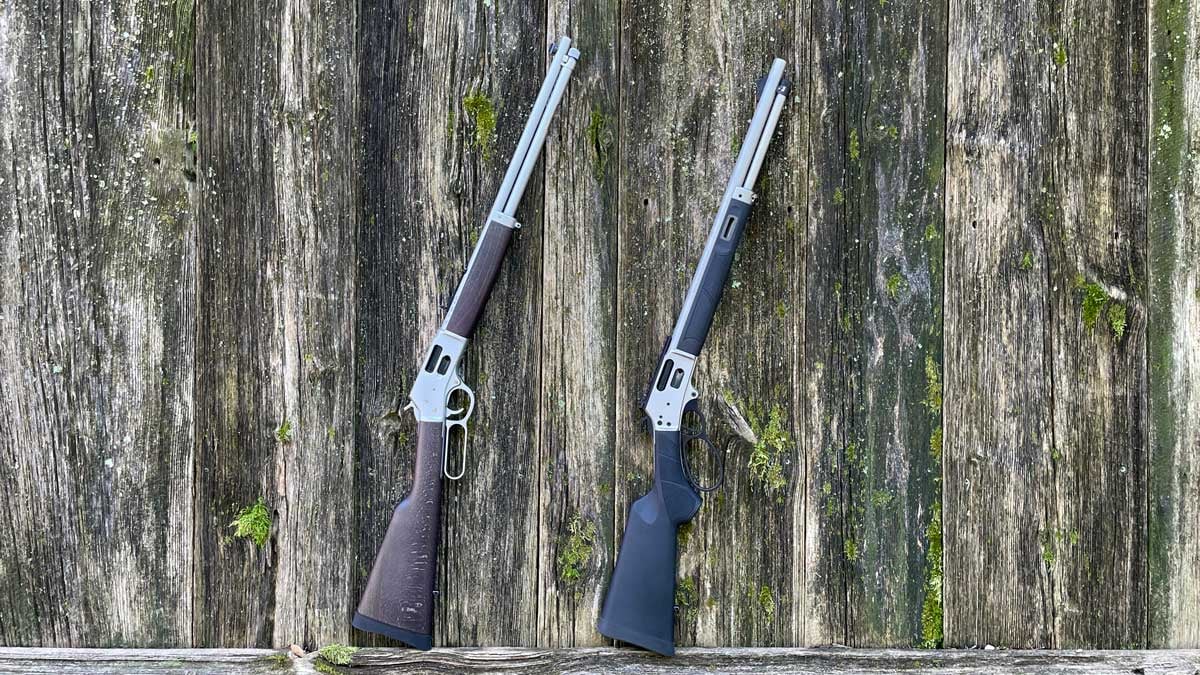
Where the S&W wears a large loop, Henry’s All Weather stays standard on the Big Boy lineup. Both ship in a branded cardboard box with little fanfare other than Henry’s slip-on receiver cover.
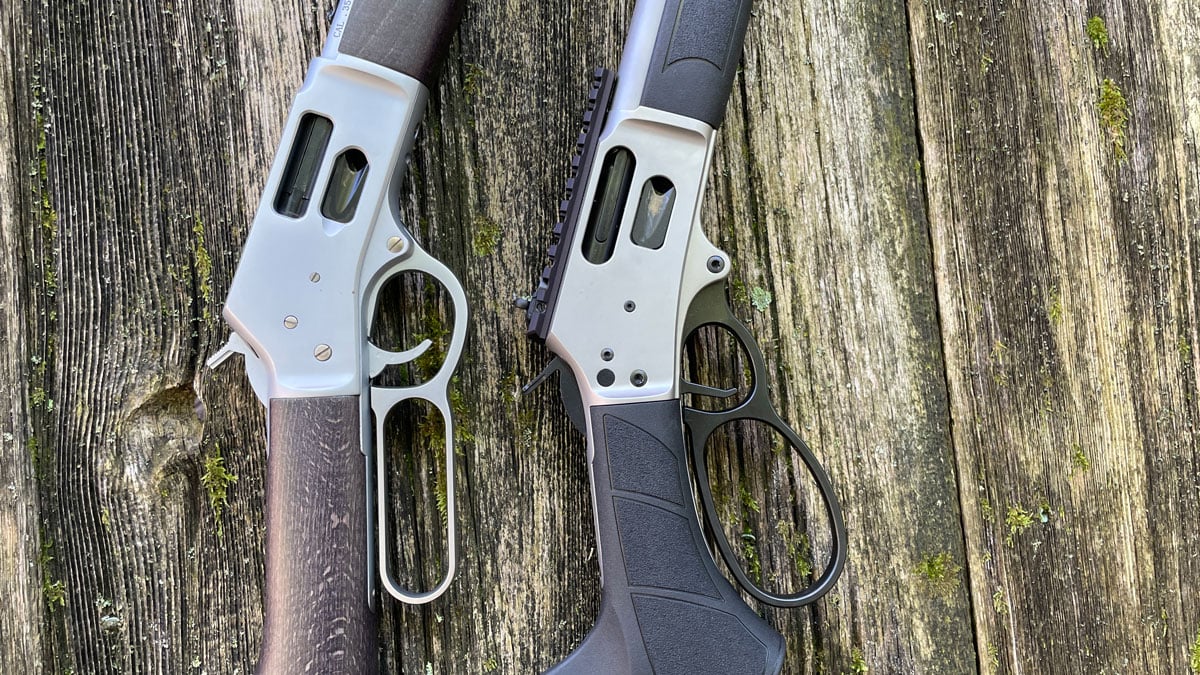
As Smith & Wesson’s lever is new to the market this year, it’s not quite fair to compare the list of model variants and chamberings with Henry’s extensive catalog. But things are progressing quickly at S&W, with first only .44 Magnum, then a .45 Colt addition.
Related Review: Smith & Wesson Model 1854 – Unexpected Tactical Cowboy
Specs
Furniture & Finish
For close comparison’s sake, we’re pitting Henry’s All-Weather Big Boy against S&W’s standard model 1854. This S&W comes dressed in black polymer stocks with textured grip panels. Three M-LOK slots at the forend allow shooters to mount accessories, while sling mounting points are found at the forend cap and buttstock. The stainless frame and barrel wear a matte silver finish. Ghost ring sights and a Picatinny rail add to the tactical appeal.
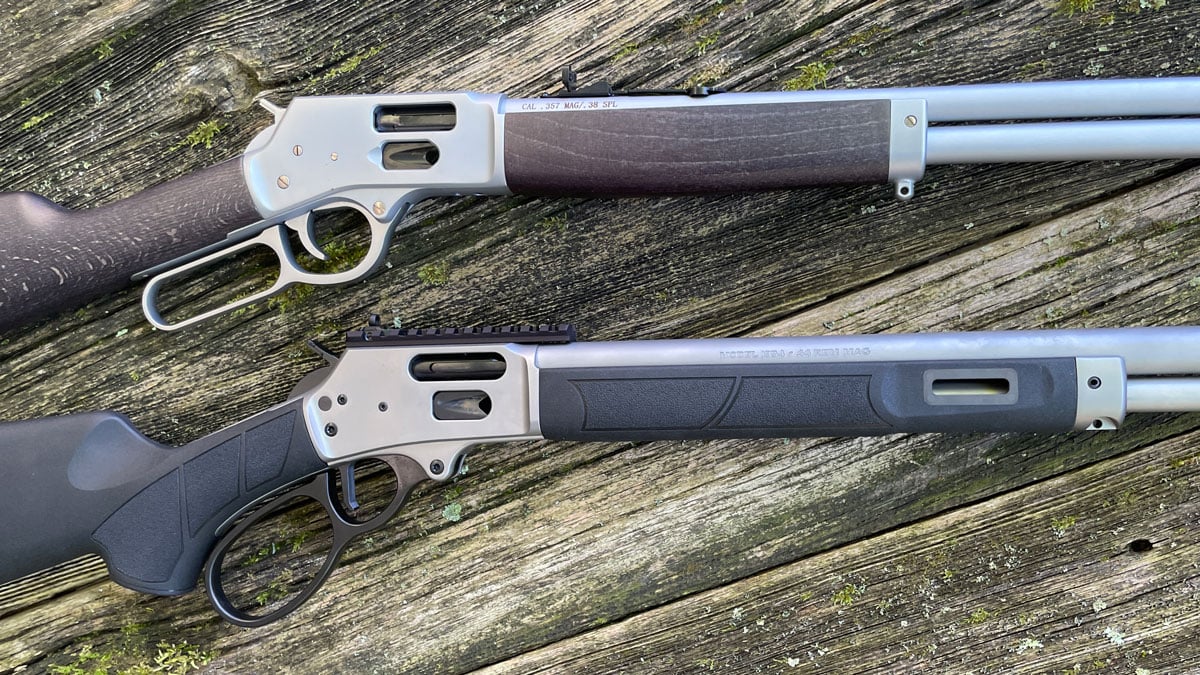
Henry’s All-Weather achieves the blacked-out furniture look with a dark-stained hardwood against what the company calls an “industrial hard chrome satin” finish on the receiver and hard chrome-plated steel barrel. Swivel studs come factory installed. Overall, the Henry presents a more traditional aesthetic.
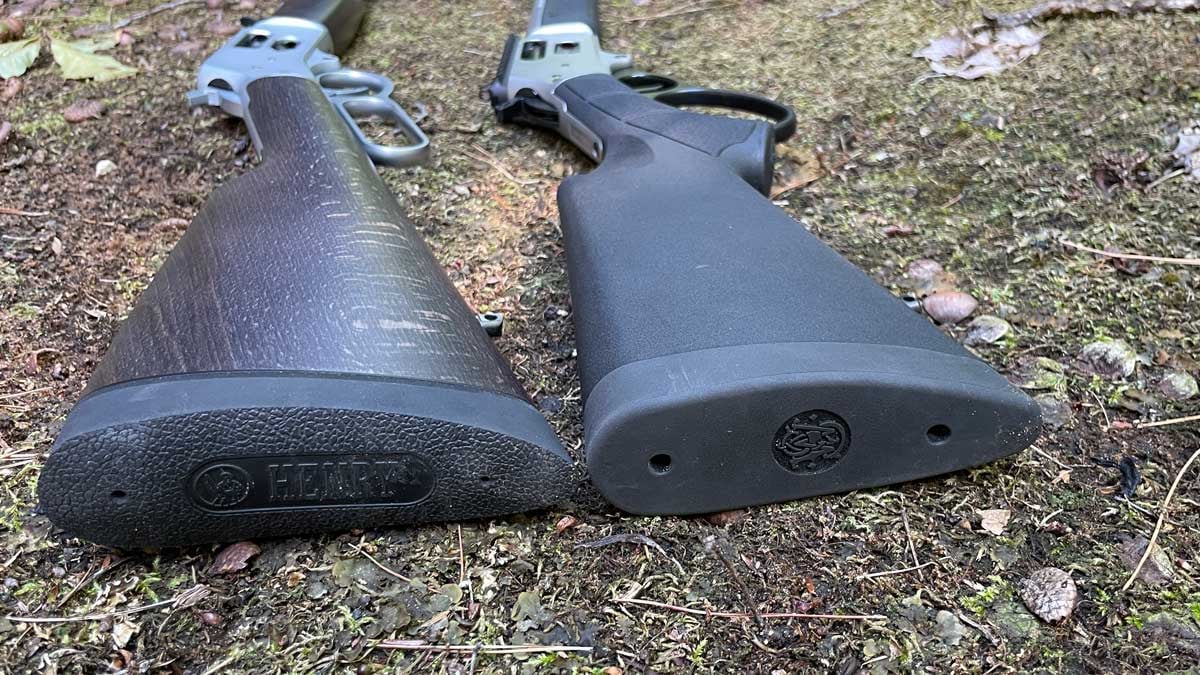
Both rifles are complete with a solid black rubber recoil pad, though neither has much recoil to negate. Hardwood feels more solid than synthetic to yours truly, but again, the choice defers to personal taste. S&W leans toward tactical appeal with the 1854, while the X-Models fill that niche for Henry.
Safety
The argument for and against a manual safety on lever actions rages on, and these two guns will satisfy both camps. Henry remains true to their more purist form, forgoing an unsightly push button for a transfer bar mechanism.

Not surprisingly, given the key locks on S&W’s wheel guns, the 1854 opts for a manual cross-bolt safety located at the rear of the receiver. This comes down to personal preference, but for those of us accustomed to classic levers without the cross-bolt, it takes some familiarizing.
Loading & Capacity
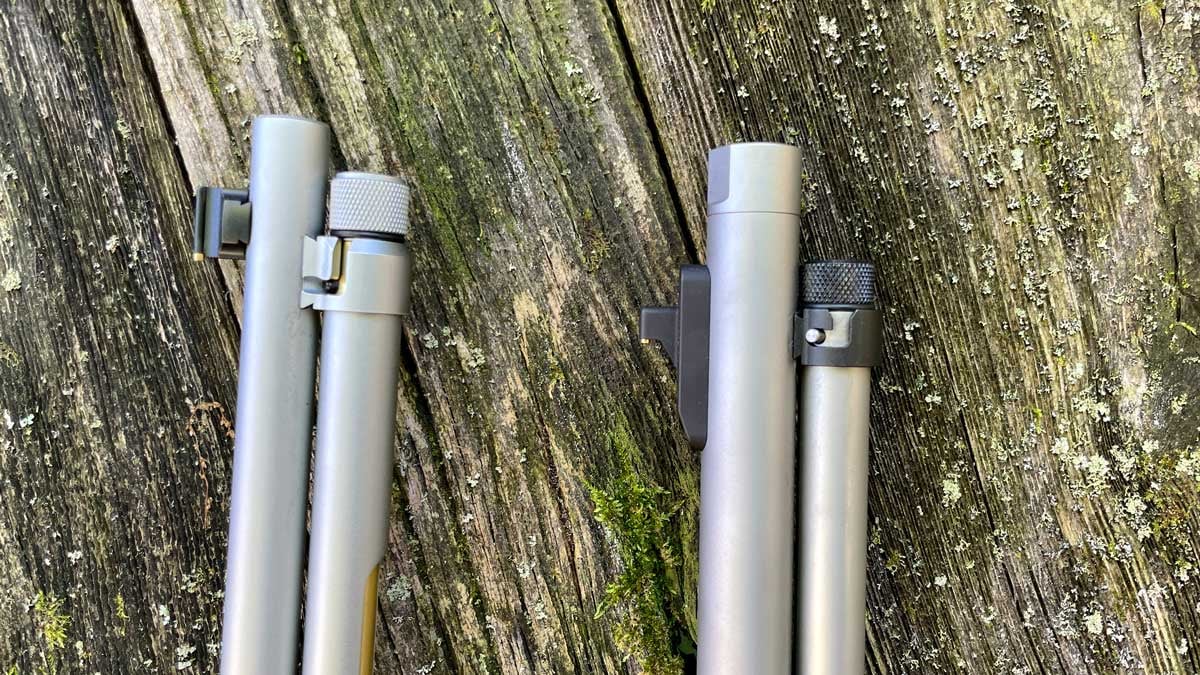
Both the S&W and Henry can be loaded via the receiver’s side gate, though the Henry can also be loaded via its expected tubular magazine port. S&W misses the boat here. While the 1854 does feature a removable mag tube, which is exceptionally handy for quick and safe unloading, their single piece tube does not allow for charging.
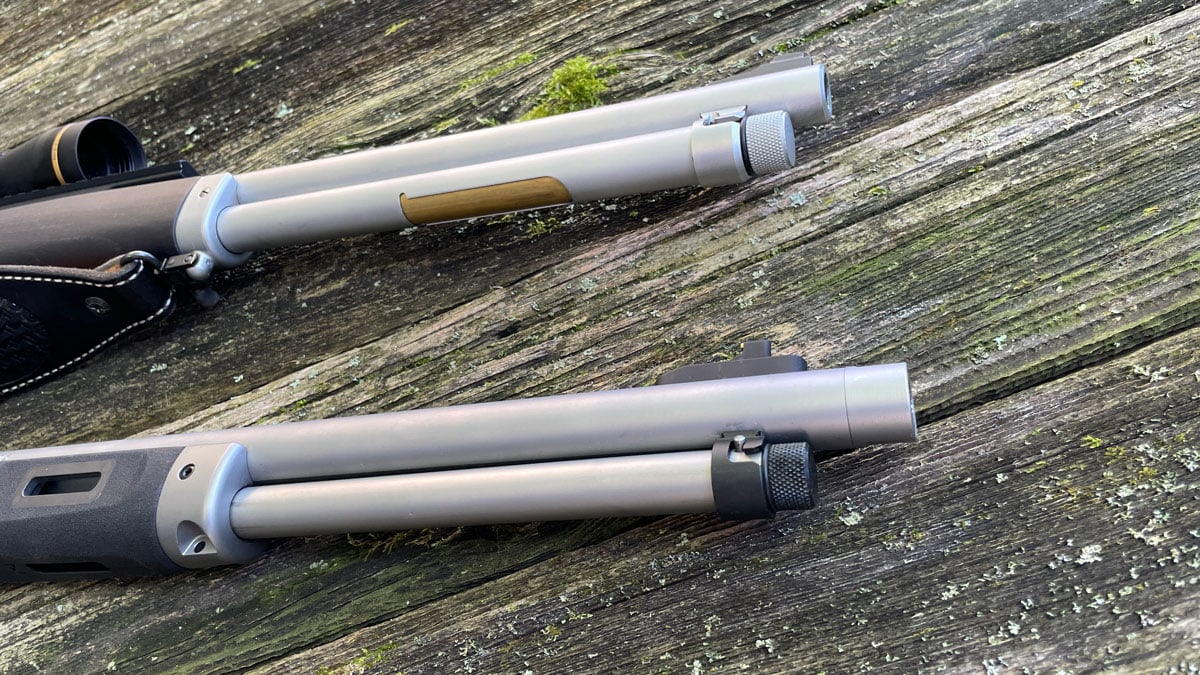
To be fair, Henry only recently added the side gate, so earlier models will not show that useful feature. Henry advertises 10 rounds for their .44 Magnum All-Weather, while S&W advertises nine, with a slightly shorter tube length.
Optical Setup
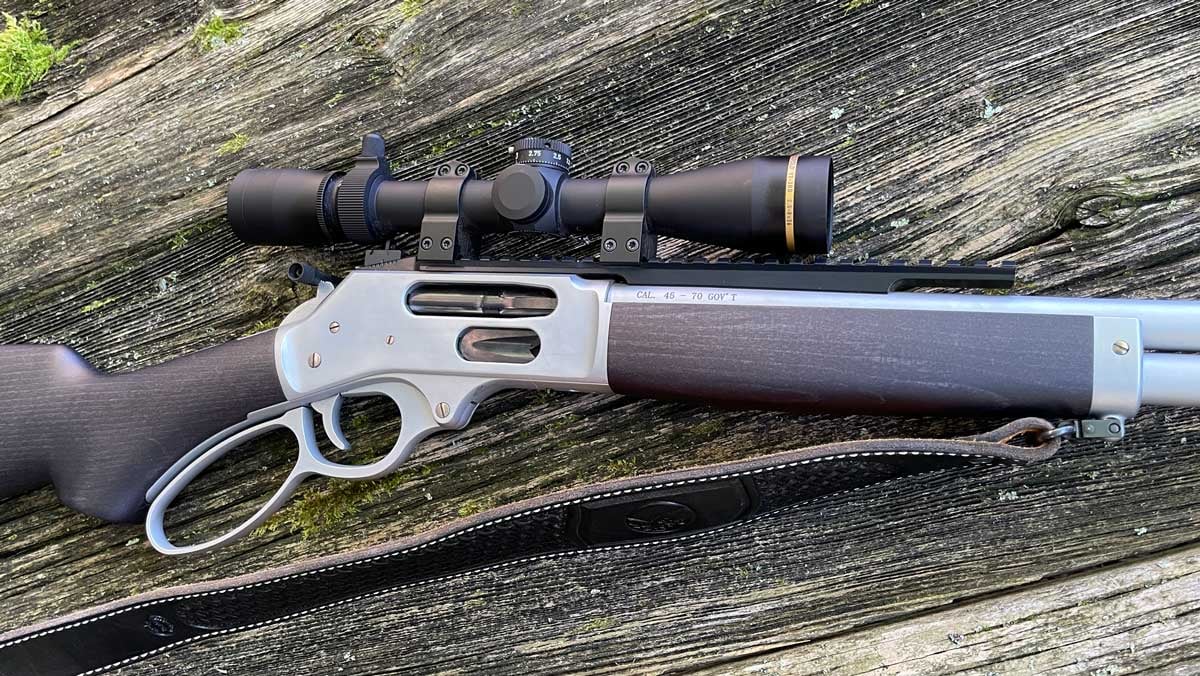
Whether you fall into the purist camp of iron sights alone or the “scope it” category, today’s lever guns do a quality job of covering both bases. Smith’s 1854 wears a gold beaded tall front sight with an XS ghost ring rear that is part of the included Picatinny rail. The receiver is drilled and tapped to be compatible with standard Marlin 1894 mounts, too. Well played, S&W.
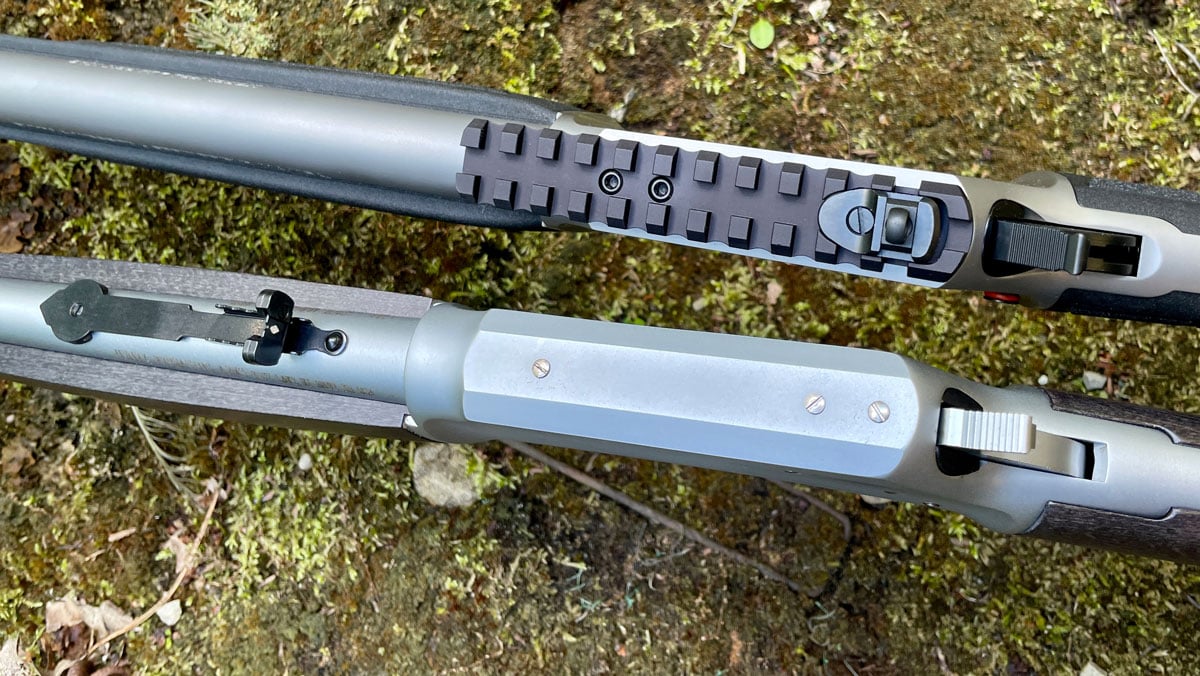
Henry uses its expected brass bead front paired with the fully adjustable semi-buckhorn and diamond insert rear. Except for the All-Weather Picatinny Rail Side Gate model with its named optics mount, the Big Boy All-Weather does not include a rail, but rather, is drilled and tapped.
Trigger
Two things are generally true here: a clean and crisp trigger pull aids in accuracy, and lever actions are not known for exceptional target triggers. Yet both manufacturers make moves in the right direction. Our test model Big Boy All-Weather breaks at a pleasant, crisp 4.5 pounds on a Lyman Digital Pull Gauge.
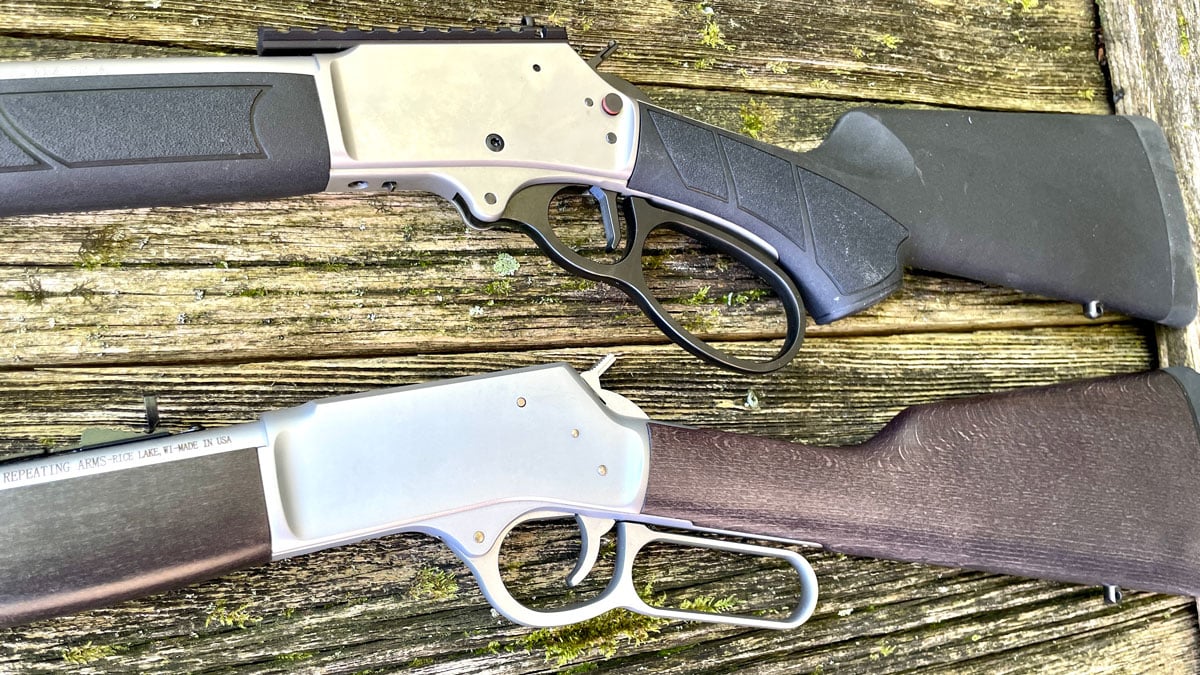
S&W takes an interesting approach to the 1854 trigger, using a flat blade more reminiscent of competition triggers, though they use a Marlin-related design that lets the trigger “flop” freely without spring tension. That aside, our 1854 test gun’s trigger pull was better than average, breaking repeatedly around the 5-pound mark with a little take-up and creep.
Both rifles are plenty accurate at the 50 and 100-yard ranges where one would reasonably hunt and shoot with the handgun chamberings. Not surprisingly, both makers’ levers ran with 100-percent reliability with every type of ammunition tested.
Price
As closely as we can compare apples to apples (the S&W 1854 Standard model against the handgun-chambered Henry Big Boy All-Weather), on-paper costs are eerily similar: $1,283 for the Henry and $1,279 for the S&W. Real-world prices vary widely (and are often less on Guns.com!), so take that into consideration. You’re certainly far more likely to find a used Henry given its longevity, with the new 1854s in shorter supply and higher demand.