S&W’s First Ever Lever?
We must mind our verbiage here, as the Model 1854 is not technically S&W’s first ever lever-driven action gun. Though not well known today, all the way back in 1854, partners Horace Smith & Daniel Wesson patented the Volcanic, a predecessor to modern levers displayed on both pocket pistols and full-length rifles.

Volcanic Repeating Arms was short-lived during Mr. Smith & Mr. Wesson’s tenure, though the story twisted and turned to involve such players as Oliver Winchester and Benjamin Tyler Henry, the birth of the original Henry rifle, and subsequent Winchester domination. That’s a tangled story for another day, but suffice it to say that the S&W names have been involved in the levered world, albeit some 170 years ago.

Regardless of how much time passed, it has become clear that the idea of rejoining the lever gun world never totally fell from the company’s consciousness. Given the continuing lever action boom, America’s fascination with Western cinema centered on shows like “Yellowstone,” and ongoing interest in both cowboy action shooting and tactical levers, the time was right. Whether we call S&W’s current Model 1854 the first production, modern – or certainly now the company’s most common – here is what we know about the young rifle.
Meet the Model 1854
The base Model 1854 is chambered solely in .44 Magnum at the time of launch and dressed in black synthetic stocks with textured grip panels. The receiver is forged of 416 stainless steel and fitted with a 19.25-inch round stainless barrel that’s threaded at 11/16-24 and comes with a thread protector.
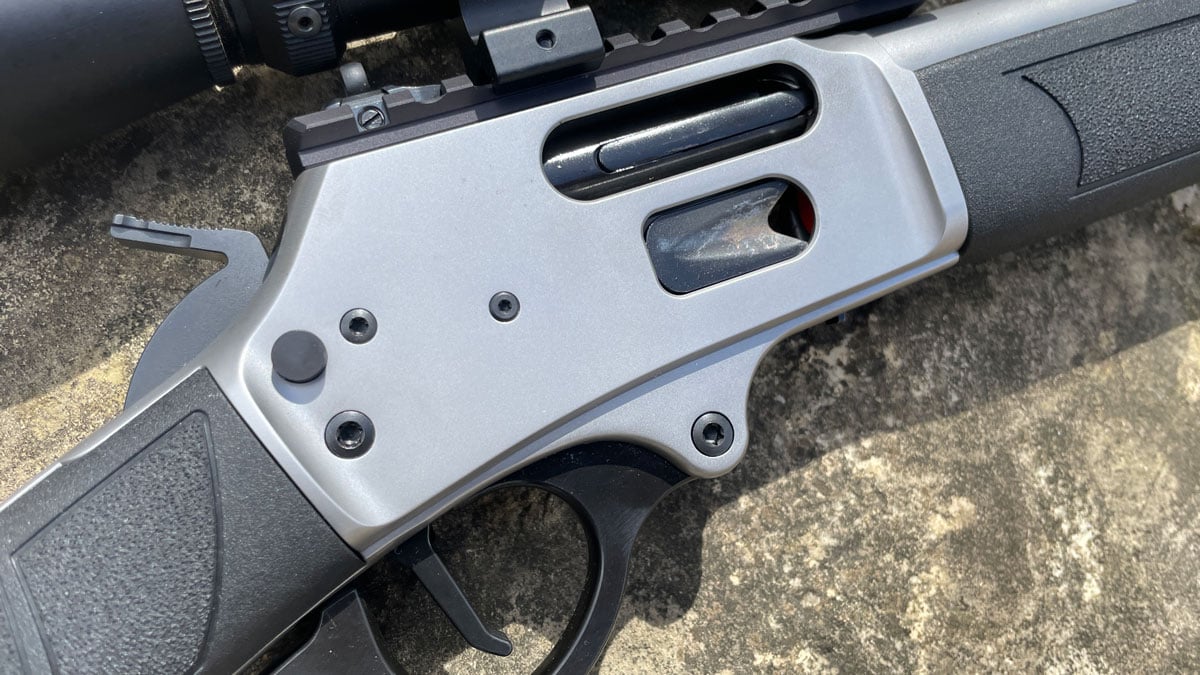

There’s a blued, oversized loop lever driving the action. Sights are comprised of an XS ghost ring rear that’s part of the factory-mounted Picatinny rail along with a tall brass bead front. If that’s not enough, the receiver is drilled and tapped to be compatible with standard Marlin 1894 mounts.


In a move more tactical than traditional, the noir polymer furniture sees the inclusion of three M-LOK slots at the sides and bottom of the forend, allowing shooters to mount accessories. The more common sling mounting points are found both as part of the forend cap and at the buttstock. The 1854 uses a manual crossbolt safety located at the rear of the receiver, not unlike Marlin’s design.


The rifle measures 36 inches overall, culminating with a solid black rubber recoil pad. The outfit weighs 6.8 pounds unloaded and un-scoped. There’s a side loading gate for charging the tubular magazine, which holds nine rounds of .44 Mag. Though there’s no cartridge-shaped port for loading the tube directly, the one-piece tube can be removed to quickly unload rounds. The flat-bladed trigger design, meanwhile, is reminiscent of target rifles.
Variants
Smith & Wesson is clear in its advertising that the 1854 draws from the company’s successful engineering in the handgun space to provide an action that is at once crisp and smooth, while also remaining strong enough for its centerfire chamberings and hearty field use.
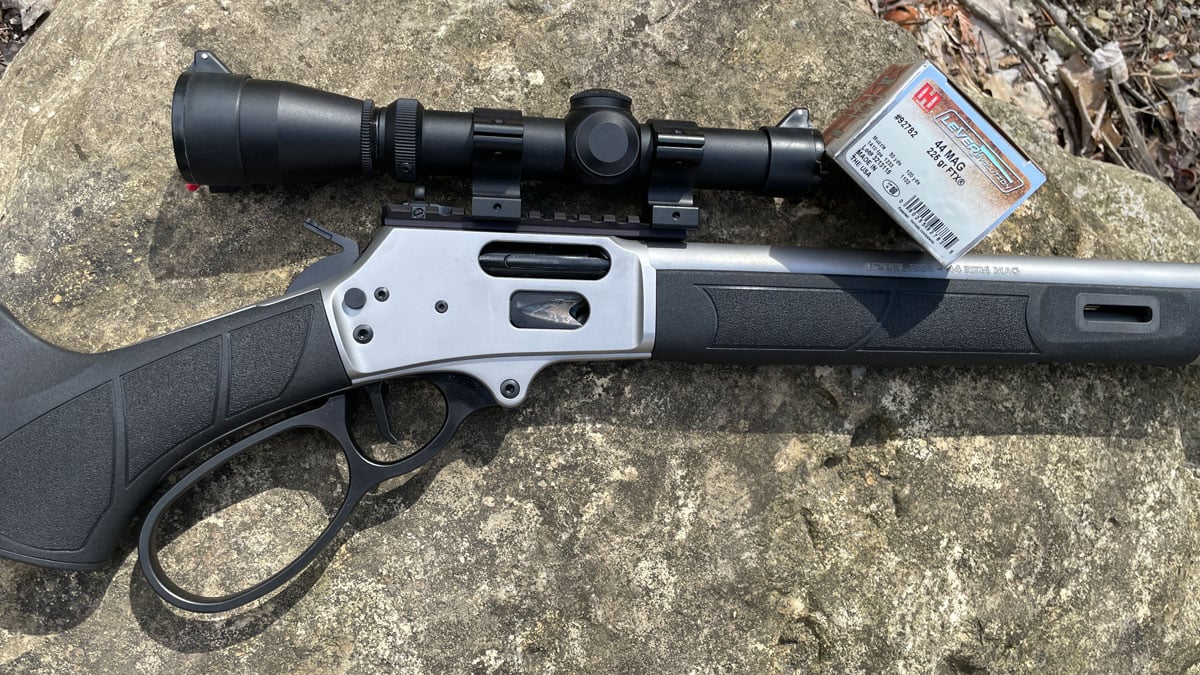
At the time of this writing, the model 1854 is available in two variants. The first is the most common, which we have been discussing, with an MSRP of $1,279. The second is the real looker, a limited edition of only 1,854 units, in the same chambering but with high-grade walnut furniture and black PVD finish, along with an increased retail cost of $3,849.
We hope to see a more standard production timber-stocked 1854 in the future. It’s not that we don’t love the current limited-edition run, but average purchasers will not be dropping four Gs on a gun they plan to use and not just stash in the safe.
Field Notes
We headed to the range with a mix of .44 Magnum ammunition from Federal, Hornady, Magtech, and HSM, which itself included a variety of bullet types and weights. Regardless of the selection, S&W’s Model 1854 cycled them all with ease, while also putting out impressive groupings on target.

While 50 yards is a more common testing distance for such a rifle in its traditional handgun chambering, we also moved back to 75 yards for a more official three-shot accuracy group.
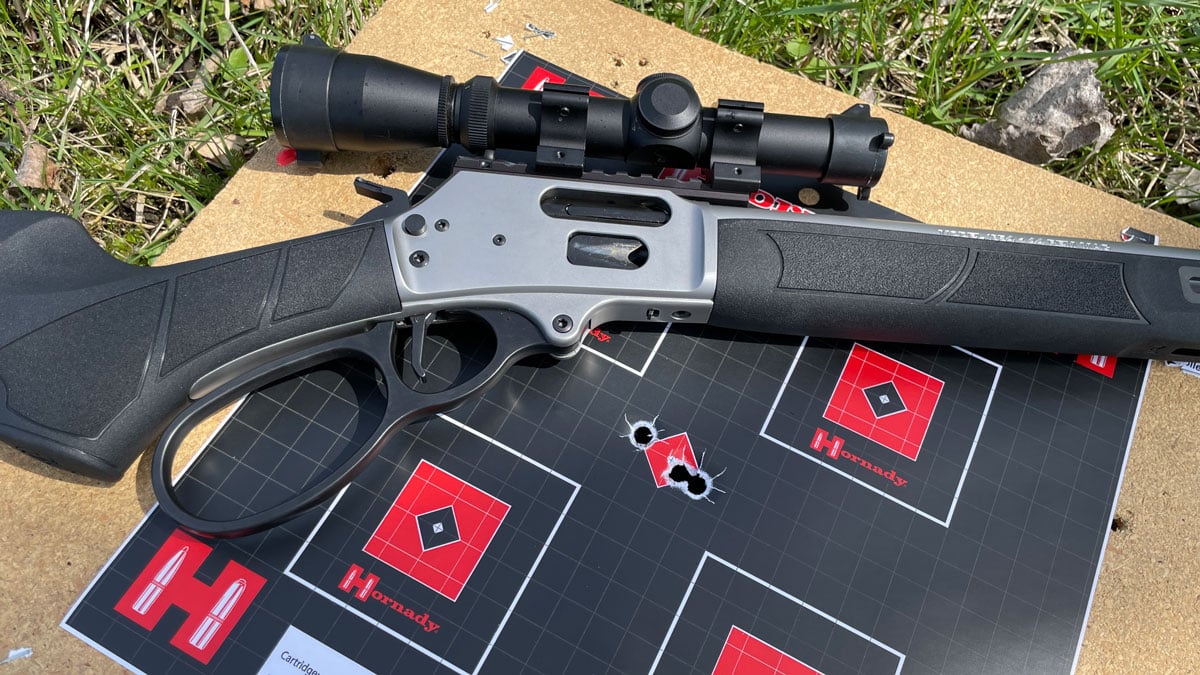
While the ghost ring sights are fine, we did mount a Leupold VX-1 1-4x20 optic, which is a simple task given the Pic rail. It’s worth noting that the rail extends slightly beyond the receiver, though not far enough to accommodate a Scout scope but plenty roomy for most scopes, red dots, and reflex sights.
Hits and Misses
The 1854’s action itself is smooth cycling, exhibiting clear attention to detail both internally and regarding fit and finish. The trigger is an interesting affair. Its flat blade seems to draw from competition rifles, though we discovered an unusual element. Even when the rifle is cocked, the trigger displays no forward spring tension, resulting in a floppy, jiggly quality. Though this in no way affected safe function or trigger pull, the jiggling of the trigger was immediately noticed by range bystanders in position to check out the newest lever gun.
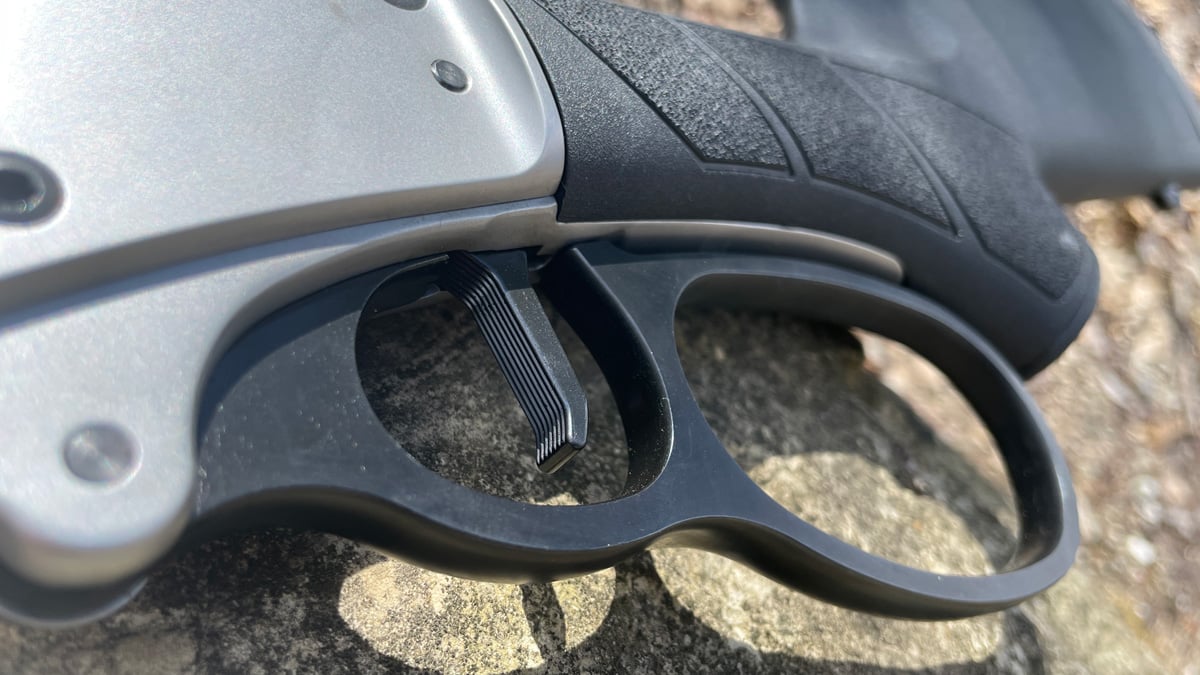
That oddity aside, the trigger pull was pretty decent, breaking right around the 5-pound mark with regularity, with a bit of take-up and hint of creep. That said, the pull remains on the better side for what lever gun shooters have come to expect, and we were quite pleased overall with the fit, function, and accuracy of the rifle.

The matte stainless metalwork paired with black synthetic is clearly reminiscent of Henry’s All Weather, making it a useful and more durable companion for field and hunting use, albeit with a penchant for the more tactically-minded buyers. The length of pull is a fairly standard 13.25 inches, though scoped shooters will note that like many other levers, the comb is too low for proper eye/optic alignment with anything other than ultra-low mounts, geared instead to the included iron sights.
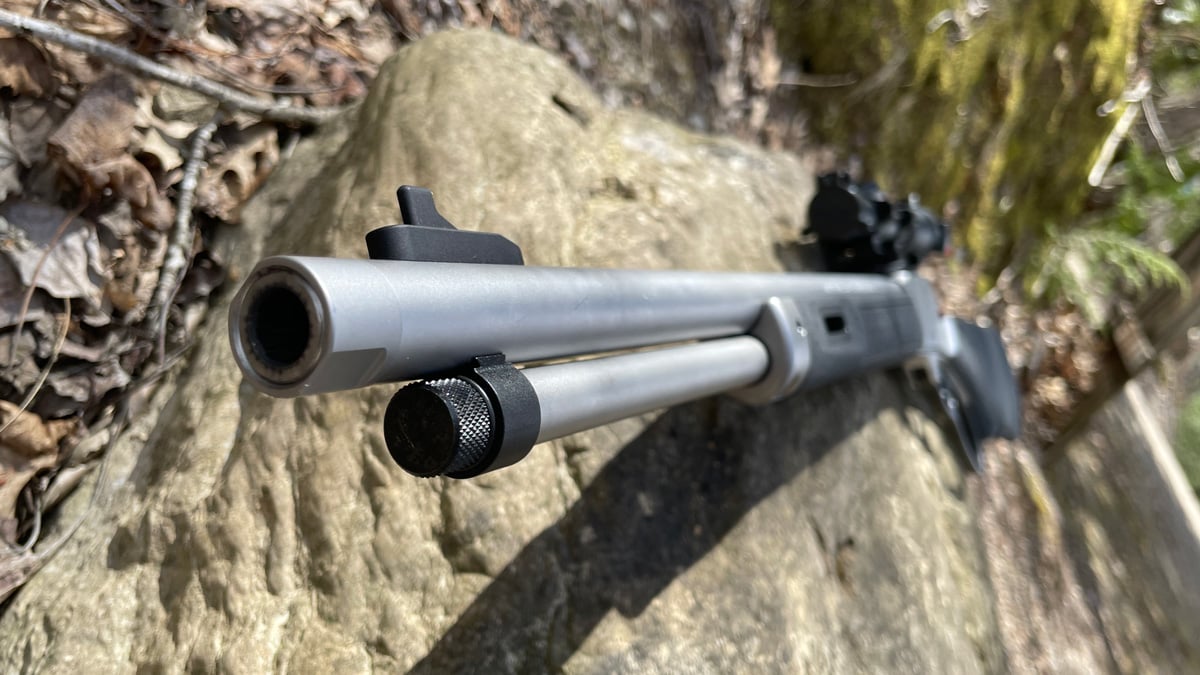
The final non-traditional feature – at least as far as those of us accustomed to Henry, Marlin, and Winchester will note – regards the magazine tube. Gone are the expected inner and outer tubes along with the tubular port. S&W has replaced that with a different design that pulls the entire tube free of the rifle, allowing cartridges to be quickly unloaded (if no suppressor is installed) but forgoing the ability to load via the tube.
Conclusion
The Model 1854 is an easy shooter, plain and simple. Its action is smooth and recoil light, which is not a surprise in a rifle that easily tops 7 pounds when loaded and scoped. With finish and dress geared toward durable use, there’s little doubt S&W’s first major production models in the series bridge the gap between closer range hunting and tactical appeal.
How they’ll hold up over time remains to be seen, but as far as our field testing, the rifle never missed a beat. What other chamberings, options, and finishes will join the series is another unanswered question, but we suspect the company has more in the works. All we know for certain is that more lever guns are always better than less, and we’re happy to see the S&W logo on a Western gun.