G3 History
First, let’s look at the history and development of the G3. While G3 is the German designation for the rifle design, Heckler & Koch did not get involved until the late 1950s. The original design was produced in Spain by the state-owned CETME factory and was first adopted as the Model 58 A.
After World War II, it was clear that the combat rifles of the future would be magazine-fed with a higher capacity and a lighter construction. This concept was realized late in the war, most significantly with the German StG-44.
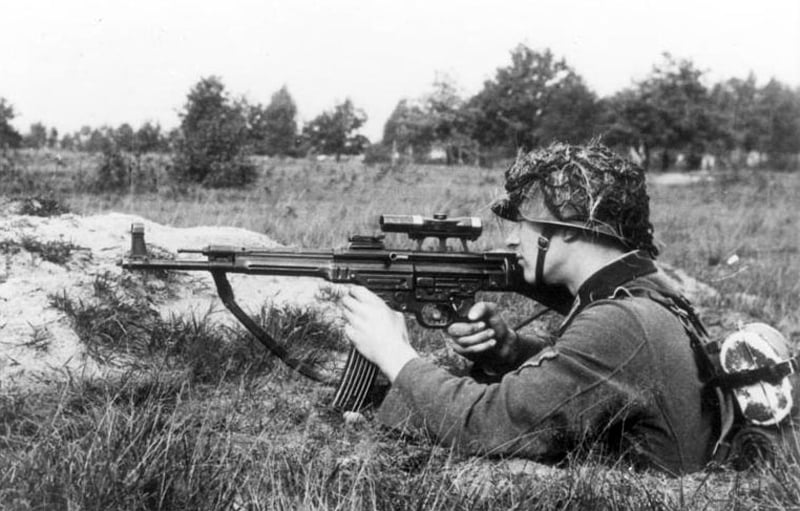
After the war, a German firearm inventor named Ludwig Vorgrimler made his way to Spain to build a new rifle. There he took the German design principles from the StG-45 (an experimental upgrade to the StG-44 that never saw production) to introduce a new, modern platform.
The rifle’s operation centered on a set of rollers that locked the bolt into place before being slowly overcome by the pressure of a fired cartridge, delaying the action from cycling long enough for the bullet to exit the barrel. This smooth roller-delayed action derived from the StG-45 would become the basis for many iconic designs still in production today.
Related: Two Guys One Gun Podcast, Episode 15 – Battle Rifles
Additionally, the new design incorporated a fluted chamber that created a layer of gas that floated the casings, aiding in extraction. The novel chamber concept was implemented to prevent failure-to-extract malfunctions caused by stuck casings, which were an issue in the StG series of rifles.
Finding the Right Cartridge
Vorgrimler started work on early experimental models, dabbling with different cartridges. The first prototypes were chambered in 7.92x33 Kurz, the same cartridge as the StG-44 and StG-45. At an early stage in the design process, experiments were made on a 7.92x41 cartridge, as a lighter version of the 8mm Mauser cartridge that was in vast surplus in Spain.

Eventually, the Spanish settled on the 7.62x51 CETME cartridge. It had the same dimensions as the NATO round, yet a lighter grain weight and powder charge to keep the recoil impulse light. This rifle design was adopted by the Spanish in 1957 under the designation CETME Model 58 Model A. Shortly after its Spanish adoption, the West German government became interested in the rifle, but with the country’s acceptance into NATO in 1955, West Germany demanded the rifle be chambered in 7.62x51 NATO.
That’s when Heckler & Koch got involved. HK created a 7.62 NATO version of the rifle that modified the action for firing both semi and full-auto from a closed bolt. The rifle design also fed from stamped, detachable 20-round box magazines.
Due to some politics, the German government eventually canceled the adoption of the CETME Model B in favor of the FAL. However, this was a minor setback, as Belgium-based FN, still holding a grudge over WWII, would not license production of the FAL to Germany. This led the Germans right back to the CETME design.

Eventually, the rifle was licensed and produced by Heckler & Koch with the new German designation: G3 rifle. The rifle became extremely popular and entered mass production, being exported to over 70 countries for service.
FN FAL History
Between articles and podcasts, I have discussed the history of the FN FAL fairly extensively, as it is one of my favorite battle rifle designs. The Guns.com warehouse has even had the pleasure of having several G-Series FALs cycle through our inventory.

In short synopsis, the FAL is a Belgian-designed battle rifle adopted in the early 1950s. The rifle is designed to operate from a closed bolt with select fire capabilities, and it feeds from a 20-round box magazine.

With a bit of cartridge drama of its own, the FAL was forced to abandon its lighter .280 British cartridge in favor of the newly adopted 7.62x51 NATO round as a stipulation of a false promise from the United States that the caliber change would lead to the adoption of the design. Despite the renege by the Americans, the rifle was extremely popular and was adopted by over 90 countries. It was found opposite the communist-made AK-47 in countless proxy wars, earning the affectionate nickname “Right Arm of the Free World.”


The FAL had very modern features for the time, including a bolt hold/release button, an adjustable gas system, and a non-reciprocating charging handle. The rifle has seen conflict at every corner of the globe, being adopted by nations like Israel, the United Kingdom, Rhodesia, Austria, and Canada. In fact, during the Falklands War, the rifle was used by both the British and Argentinian militaries, a rare occasion where the rifle was pitted against itself.
In Comparison
Both rifles entered service around the same time, both rifles are chambered for 7.62 NATO with a 20-round standard capacity, and both competed for a lot of the same markets. There is a deep rivalry between the designs, considering the FAL licensing being withheld led to the German pursuit of the G3.

I have a PTR-91 and a DSA Israeli FAL to compare. PTR is one of the leading manufacturers of H&K clone firearms, and DSA is probably the largest FAL manufacturer in the world. Now, it’s fair to say there is a a subjective nature to deciding which is best, so I’ll list my pros and cons of each design. Also, to state my bias, John Grüner and I often go back and forth on which design is better, and I have always been team FAL.


First, let’s settle on what is similar. On the range, both rifles are chambered in .308 and have pretty much the same recoil impulse. They are moderately easy to control, and you can make shots with acceptable levels of accuracy. The sights are different styles but extremely similar in the adjustments that they allow.

Shooting a simple Bill drill on the range, both rifles performed well. The FAL had an advantage of a few fractions of a second; however, I am sure if I shot the drill 10 times on each rifle, it would even out. In any case, the actual shooting of the rifles feels almost identical. Things only differ in the manual of arms.
FAL Pros & Cons
Now getting to the pros and cons, starting with the FAL. The biggest advantage the system has is its modern controls. The close placement of the non-reciprocating charging handle on the receiver and the bolt hold/release lever both make the manual of arms extremely easy to manipulate. Reloading the FAL is quick, and while I fumbled through a reload on my shot timer (see, training is important!), the easy tap of the bolt release after inserting a new magazine is a major advantage over the G3 design.

The first notable downside is the extreme canted angle of the pistol grip. It is uncomfortable, especially if you’re shooting for extended periods. I would even go as far as to argue that it makes the firearm harder to control, as it can be a struggle to hold a solid grip. A more vertical grip would be much appreciated and improve the shooting experience.

The second con might be surprising, but I would mark the adjustable gas system as a downside. In all fairness, it is one of the downfalls of the success of the rifle, as many soldiers were not properly trained on the system and altered settings, which led to a reputation of unreliability. In theory, it’s a great system because you can fine-tune the recoil impulse. In reality, if you mess with the setting without understanding the principles, the rifle will not cycle properly.

Along those same lines, if you are not using the same consistent ammo loads every time you shoot, the mismatched ammo brands most people use require fine-tuning every time you shoot something different. I opened the gas system all the way up to keep it running reliably regardless of ammo, but on extraction, I noticed some higher-performance ammo had separated at the rim, likely due to over-gassing.

Lastly, FALs can be a little pricey. The FAL is somewhat of a collectible and is not in circulation on the domestic market in the same numbers as the G3 and its variants. With companies like PTR still producing rifles, and countless old surplus CETMEs coming in at well under $1,000, the collectible price of an FAL puts it out of reach for some. Even with DSA making rifles in the U.S., FALs often fetch almost twice as much as their G3 format counterparts.
G3 Pros & Cons
One of the notable features of the G3, as I witnessed shooting the PTR, is that the system is extremely reliable. The fluted chamber makes for an easy and strong extraction as evidenced by flinging the brass into the next zip code. No worry of adjusting the gas system to fit the ammo – the rifle just runs.

Also, while the entire platform is often found for inexpensive prices on the surplus market, surplus magazines are dirt cheap. These stamped magazines are easily found for under $10, and unlike the metric vs inch pattern of the FAL, you don’t have to worry about figuring out different magazine fitments.


Admitting my bias, I’ll state that the main reason I am team FAL is due to the controls. The blaring con on the G3 is the charging handle and length of pull. The charging handle is spring-loaded and retained against the receiver. I hate the design concept of a spring-loaded charging handle because it is so easy to slip over when making a fast reload.


Additionally, the charging handle is placed far to the front of the receiver, making it a reach during a reload. As there is no bolt-hold/release control, you’re forced to reach forward, grab the charging handle without slipping over it, lock it to the rear, insert a new mag, and release the handle. It’s too many movements for a reload. On the shot timer, it felt like it took an eternity to reload this rifle.

The length of pull is another issue with the G3. I’ll admit that can be subjective, but considering how far forward the receiver sits, it does affect your grip placement. This is evident as the PTR has a shorter barrel yet is still about the same overall length of the FAL. Those extra inches are found in the length of pull.
Summary
Either way you lean, there is no denying the impact and incredible design history of both of these rifles. Each an excellent piece of firearm design history that continues to see success and use in several nations across the globe.

So, which is better? Ultimately, the best design is the one you train on. Shooting is a skill, and even if you favor one design over the other, you’ll be ineffective if you don’t train.
The great thing about living in the United States and having resources like the certified used inventory at Guns.com is that you don’t have to pick just one. Why not get both? But don’t just buy one to stick in the safe and pull out to show your friends. Grab some ammo, hit the range, and train. Who knows – maybe you’ll even surprise yourself with which rifle works best for you.